
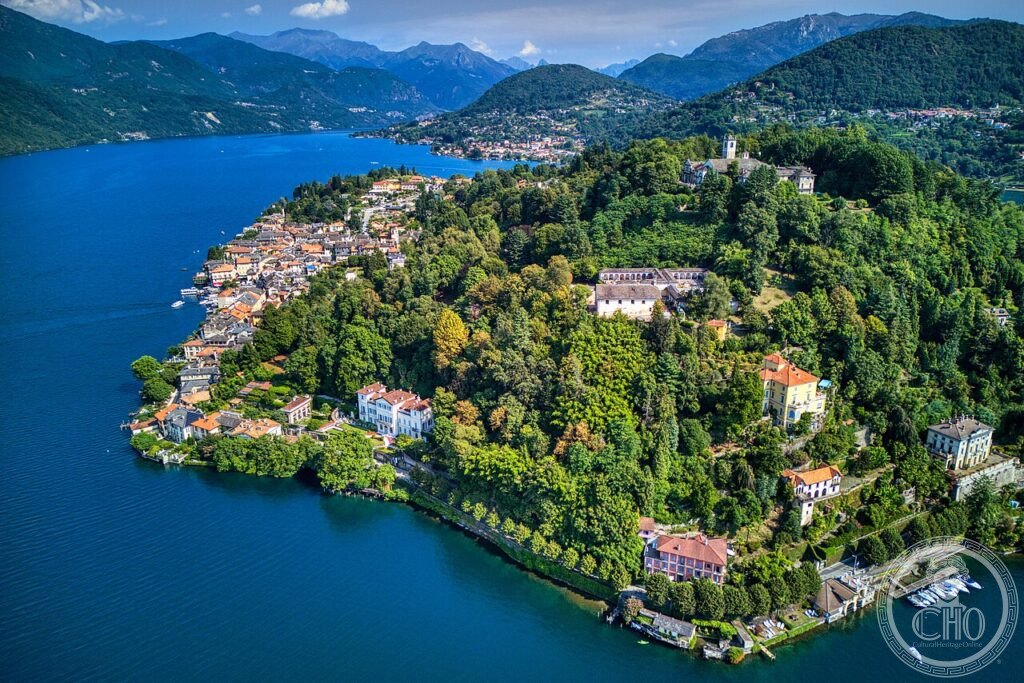
The Sacro Monte di Orta occupies a wooded promontory above the Lago d’Orta — Italy’s most romantic lake, according to romantic writers from Balzac to Nietzsche, who came here with Lou Andreas-Salomé in 1882 and fell in love with the combination of the lake and the medieval village below — and contains twenty chapels built between 1590 and 1788 to narrate the life of Saint Francis of Assisi, each a small theatre of coloured stucco figures in landscape paintings, arranged in the forest so that the visitor moves between enclosed spaces and open panoramic views of the lake and island of San Giulio, creating one of the most beautiful pilgrimage routes in the Alps.
At a glance
The Sacro Monte di Orta is a sacred mountain (sacro monte) on the promontory above Orta San Giulio on the Lago d’Orta (Cusio), in the province of Verbano-Cusio-Ossola (VCO), Piedmont. Founded in 1590 and completed (in its current extent of 20 chapels) in 1788, it is the second most visited of the nine Sacred Mountains of Piedmont and Lombardy inscribed on the UNESCO World Heritage List in 2003 (ref. 1052). The chapel programme — 20 chapels each representing a scene from the life of Saint Francis of Assisi — was designed and built over almost two centuries and contains approximately 376 life-size terracotta figures and approximately 900 m² of fresco painting.
Key facts
- Foundation: 1590 (Friar Cleto Bacari, Franciscan); the first chapel (Stigmata of Saint Francis) was built on the promontory above Orta in 1590; the complex was designed by the Franciscan friar Cleto in response to the enormous success of the nearby Sacro Monte di Varallo (founded 1491); the last chapel was completed in 1788
- Chapels: 20 chapels along a 1-km processional route; each chapel represents a scene from the life of Saint Francis (from the Conversion of 1202 to the Canonisation of 1228); the chapels are scattered through a woodland of chestnut, beech, and oak trees — the “bosco sacro” (sacred wood)
- Figures and frescoes: Approximately 376 life-size terracotta figures; principal sculptors: Cristoforo Prestinari (Milan, late 16th century), Giovanni d’Enrico (1580-1644; the same sculptor who worked at Varallo); principal painters: Melchiorre d’Enrico, Pier Francesco Mazzucchelli “il Morazzone”
- Lago d’Orta: The smallest and most intact of the major Italian pre-Alpine lakes (18 km long, 2.5 km wide); the lake drains south (exceptional among north Italian lakes, which drain east to the Po); the Isola di San Giulio (the island in the lake) is historically one of the oldest Christian communities in northern Italy (San Giulio evangelised the island in 390 CE)
- UNESCO: 2003, ref. 1052 — “Sacri Monti of Piedmont and Lombardy” (same inscription as Varallo)
- GPS: 45.7997, 8.4197 — Google Maps
History
The foundation of the Sacro Monte di Orta in 1590 was directly inspired by the success of the Sacro Monte di Varallo (founded 1491), which by the late 16th century had become the major pilgrimage site of the Piedmontese Alps and was receiving hundreds of thousands of pilgrims annually. The Franciscan order, which had administered the Varallo site through its Observant branch, saw the opportunity to create a new sacred mountain specifically dedicated to Saint Francis of Assisi (their founder) — a narrative sequence that would both compete with the Varallo programme (dedicated to the life of Christ) and provide a distinctively Franciscan devotional experience.
The choice of the Orta promontory was motivated by the existing tradition of the site: the chapel of the Madonna dell’Assunta on the promontory (which still stands at the highest point of the Sacro Monte complex) was already a place of Marian devotion, and the combination of the lake view, the woodland, and the existing cult made it an ideal setting for a new sacred space. The slow pace of construction — 20 chapels over 198 years (1590-1788) — reflects both the scale of the project and the long-term institutional commitment of the Franciscan community of Orta and their lay benefactors.
What you see
The Sacro Monte di Orta is entered from the piazzale at the foot of the promontory in Orta San Giulio (a 5-minute walk from the main piazza of the village) via a shaded path through the woodland. The 20 chapels are distributed along the path at intervals of 50-150 m; each chapel is a small stone room with a window or iron grille through which the visitor looks at the scene inside. The chapels vary in scale from intimate (the Conversion, chapel 1 — a small room with 3 figures) to monumental (the Canonisation, chapel 20 — a large hall with dozens of figures in a crowd scene).
The forest setting is the defining quality of the Orta experience — unlike Varallo, where the chapels are built on a bare rocky hillside and the architecture is prominent, at Orta the chapels are embedded in a mature woodland and the visitor’s experience alternates between the enclosed, shaded chapel interiors and sudden views through the trees over the lake and the island of San Giulio. The island view (most clearly seen from chapels 14-17, at the highest point of the processional route) is one of the most celebrated lake panoramas in northern Italy.
Gallery
Practical information
- Opening: The Sacro Monte path and the chapel exteriors are always accessible. Chapel interiors are open daily (April-October) 9:30-12:30 and 14:30-17:30; reduced hours in winter. Free admission.
- Boat to Isola di San Giulio: From the embarcadero in Orta village; runs year-round; approximately €4 return; crossing time 4 minutes. The island is dominated by the Benedictine abbey (founded 7th century CE; the current Romanesque basilica is 11th century CE); the single cobbled path around the island perimeter (the “Via del Silenzio e della Meditazione”) takes 15 minutes; access to the abbey interior is by appointment.
- Duration: 1.5-2 hours for the Sacro Monte; 30 minutes for the island. Allow a half-day combining both.
Getting there
Via Sacro Monte, Orta San Giulio (VCO), Piemonte. By train: from Milan Centrale, train to Novara (40 min) then Novara-Domodossola regional service to Orta-Miasino station (50 min); total approximately 1h50. By car: from Milan, A26 north to Arona exit then SS32 north to Borgomanero, then east on SS229 to Orta (80 km, 1h10). From Turin, A4 east to Settimo Torinese then SS26 north to Gattinara, then east to Borgomanero and SS229 (120 km, 1h40). Car parking in Orta San Giulio is very limited; the road into the village is closed to private vehicles on weekend mornings in summer; use the parking area at the foot of the hill and take the local shuttle or walk (10 min).
Nearby
- Stresa e le Isole Borromee — 20 km east on Lago Maggiore; the three Borromean Islands (Isola Bella: the Borromeo family palace and terraced garden, 1630-1670; Isola dei Pescatori: the authentic lakeside fishing village; Isola Madre: subtropical botanical garden); the most visited lake site in northern Italy
- Sacro Monte di Varallo — 40 km north; UNESCO 2003 (same inscription); the first and most artistically complex of the nine Sacred Mountains; 44 chapels, 800 life-size figures, major works by Gaudenzio Ferrari (see separate CHO card)
- Lago Maggiore e Verbania — 20 km east; the Villa Taranto botanical garden (Lake Maggiore, Verbania; 16 hectares, 20,000 plant species, one of the finest botanical gardens in Europe; open April-November)
Sources
- UNESCO: whc.unesco.org/en/list/1052
- Wikipedia EN: Sacro Monte di Orta
- Turner, Jane (ed.): Grove Dictionary of Art, s.v. “Sacri Monti,” Oxford, 1996
- Comune di Orta San Giulio: comune.ortasangiulio.no.it
Find it on the map
See this place and what’s around it →📷 Become a Cultural Heritage Online photographer
Share your photos of places: they stay published under your name as the author. The more they're seen, the more you get noticed — and soon a contest will reward the most appreciated photos.
Log in or sign up free to add a photo