
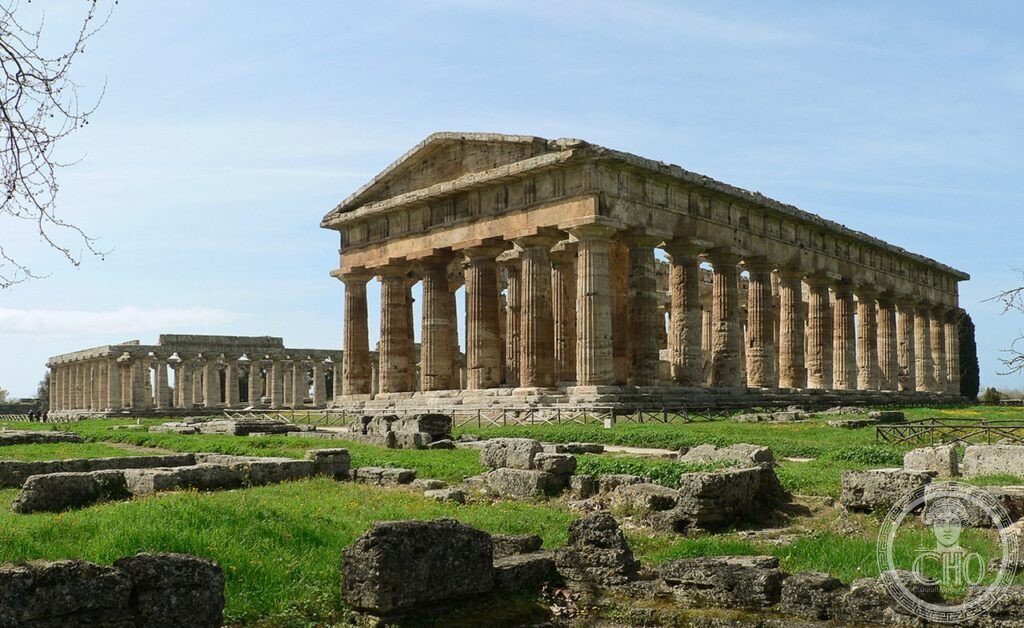
Paestum — i Tre Templi Dorici (VI-V sec. a.C.): il Più Completo Complesso di Templi Greci Fuori dalla Grecia (UNESCO 1998)
Three Greek Doric temples stand on the coastal plain 100 km south of Naples in a state of preservation that has no equivalent anywhere outside Greece — their columns still erect, their entablatures largely complete, their stone still carrying the warm honey-gold colour of Italian travertine that distinguishes them at once from the white marble of Athens — and the oldest of them, the “Basilica” (now known as the Hera I temple, 550 BCE), is the oldest surviving Doric temple on the mainland of the ancient Greek world, predating the Parthenon by a century.
At a glance
Paestum (ancient Poseidonia) is an ancient Greek and Roman city on the Tyrrhenian coast of Campania, approximately 85 km south of Naples, in the municipality of Capaccio Paestum (Salerno). Founded by Greek colonists from Sybaris (on the Ionian coast of Calabria) around 600 BCE as Poseidonia (city of Poseidon), it was conquered by the Lucanians (a local Italic people) in 400-390 BCE, renamed Paistom, and became a Roman colony in 273 BCE. It was gradually abandoned during the early medieval period due to malaria and coastal flooding. The three Doric temples (Hera I “the Basilica,” ca. 550 BCE; “Neptune”/Hera II, ca. 450 BCE; Athena/Ceres, ca. 500 BCE) are the most complete surviving Greek temple complexes outside Greece, inscribed on the UNESCO World Heritage List in 1998 (ref. 842) as part of the “Cilento and Vallo di Diano National Park with the Archeological Sites of Paestum and Velia, and the Certosa di Padula.”
Key facts
- Hera I (“Basilica”), ca. 550 BCE: The oldest surviving Doric temple on the western Greek mainland; 50 × 24 m; 9 × 18 columns; the unusual number of front columns (9, an odd number) distinguishes it from canonical Doric temples; the columns have a strong entasis (outward curve) characteristic of the archaic period
- “Nettuno”/Hera II, ca. 450 BCE: The best-preserved Doric temple in the world outside Greece; 60 × 25 m; 6 × 14 columns; the columns (height 8.88 m) and entablature are almost completely intact; misnamed “Temple of Neptune” since the Renaissance (modern scholarship attributes it to Hera II or to Zeus, but “Neptune” remains in common use)
- Athena/Ceres, ca. 500 BCE: 33 × 14.5 m; 6 × 13 columns; a transitional Doric-Ionic temple; used as a Christian church in the early medieval period (traces of Christian altars visible inside)
- City walls: The Greek and Roman city walls (approximately 5 km perimeter, 4th century BCE) survive to a height of up to 4 m in sections; the city plan (agora, forum, forum temples) is partially excavated and visible
- Museo Nazionale di Paestum: Houses the Tomb of the Diver (Tomba del Tuffatore, 480 BCE) — the most important Greek fresco surviving on a portable support: a symposium scene and a diving figure on the five slabs of the grave; the only example of Greek figured fresco on a portable surface surviving from the ancient world
- UNESCO: 1998, ref. 842 — “Cilento and Vallo di Diano National Park”
- GPS: 40.4218, 15.0050 — Google Maps
History
Poseidonia was founded around 600 BCE by colonists from Sybaris, one of the wealthiest Greek cities in Italy (Sybaris was on the Ionian coast of Calabria, and its colonists established Poseidonia as a port and agricultural base on the Tyrrhenian side of the Italian peninsula). The site was chosen for its position on the coastal plain of the Sele river, well-watered and fertile, near the mouth of the Sele where a sanctuary of Hera (the Heraion of Foce del Sele, 7 km north) had already been established. The construction of the three major temples — an extraordinary investment for a colonial city of perhaps 5,000-10,000 inhabitants — over a period of 100 years (550-450 BCE) reflects the prosperity of the early city and its competitive desire to demonstrate its cultural status as a Greek polis.
The Lucanian conquest (400-390 BCE) transformed the city but did not destroy it; the Lucanians maintained the Greek temples and continued the Greek religious practices while adding their own distinctive painted tomb tradition (the Lucanian painted tombs of the IV-III century BCE, now in the museum, are major works of ancient Italian art). The Roman colony of 273 BCE added a forum (partly excavated), Roman temples, and a macellum (market building) to the existing Greek city; the amphitheatre (mid-1st century BCE) bisects the forum.
What you see
The visit to Paestum is essentially a walk through a large open archaeological park (entrance from Via Magna Grecia, the main road through the site) from south (the Hera I / Basilica) to north (the Athena / Ceres temple) and back via the Roman forum. The three temples are arranged on a north-south axis approximately 400 m apart, with the Roman forum and city buildings between them and the Greek agora to the east of the forum.
The most powerful experience in the site is standing between the Hera I “Basilica” (south) and the “Nettuno” temple (the closer, taller, more perfectly preserved one just 100 m north) and looking at both simultaneously: the Hera I (older, with wider columns, stronger entasis, and fewer columns preserved in the peristyle) and the “Nettuno” (younger, with a more restrained Doric profile, near-complete entablature, and the warm afternoon light turning its travertine columns orange at 17:00). No photograph prepares a visitor for the physical scale — the “Nettuno” temple is approximately 18 m tall to the apex of the pediment; in the flat coastal plain with no other large buildings nearby, it appears even larger.
Gallery
Practical information
- Archaeological park: Open daily 9:00 to 1 hour before sunset (approximately 17:30 in winter, 20:00 in summer). Last entry 30 min before closing. Admission ~€8 (includes museum). Free for under 18 and first Sunday of the month.
- Season: September-November and March-May are best (pleasant temperatures; the light in October-November is exceptional). July-August is very hot (30-35°C in the park; no shade except under the temple porticoes) and extremely crowded.
- Museum: Included in the park ticket; the Tomb of the Diver (480 BCE) and the Lucanian painted tombs are the primary attractions; the museum is air-conditioned (essential in summer). Open same hours as the park.
- Duration: 2-2.5 hours for park + museum combined. The 5 km of city walls can be walked on a separate visit (no ticket required outside the park).
Getting there
Via Magna Grecia 919, Capaccio Paestum (SA), Campania. By train: Trenitalia regional service from Salerno (35 km north; 40 min by train) or Napoli Centrale (95 km north; 1h15 direct or 1h45 via Salerno) to Paestum station (on the Paestum platform); the station is 400 m from the park entrance. By car: from Salerno, A3 south to Battipaglia exit then SS18 south (20 km); from Naples, A3 south to Battipaglia; from Reggio Calabria, A3 north to Buccino exit then SP19 west. The site has a large car park (free).
Nearby
- Museo Nazionale di Paestum — inside the site walls (the ticket to the park includes the museum); the Tomba del Tuffatore (480 BCE), the only surviving Greek figured fresco on portable support from the ancient world; Lucanian painted tombs (IV-III c. BCE); Bronze Age finds from the surrounding plain
- Heraion di Foce del Sele — 7 km north; the Sanctuary of Hera at the mouth of the Sele river; founded by the same Sybarite colonists as Poseidonia; the metope sculptures from the early sanctuary (VI century BCE) are in the Museo di Paestum; the site has a small outdoor exhibition
- Certosa di San Lorenzo, Padula — 50 km east via Salerno; one of the largest Baroque monasteries in Europe (1300-1880; UNESCO 1998 as part of the same inscription as Paestum); the main cloister (102 × 152 m) is the largest monastic cloister in Italy
Sources
- UNESCO: whc.unesco.org/en/list/842
- Wikipedia EN: Paestum
- Cifarelli, Miriam (ed.): Ancient Greece at the Getty, J. Paul Getty Museum, 1994
- Ministero della Cultura — Paestum: museopaestum.beniculturali.it
Find it on the map
See this place and what’s around it →📷 Diventa un fotografo di Cultural Heritage Online
Condividi le tue foto dei luoghi: restano pubblicate con la tua firma come autore. Più vengono viste, più ti fai conoscere — e presto un concorso premierà le foto più apprezzate.
Accedi o registrati gratis per aggiungere una foto