
Castel del Monte — il Castello Ottagonale di Federico II (1240-1250): Geometria, Astronomia e il Mistero della Funzione
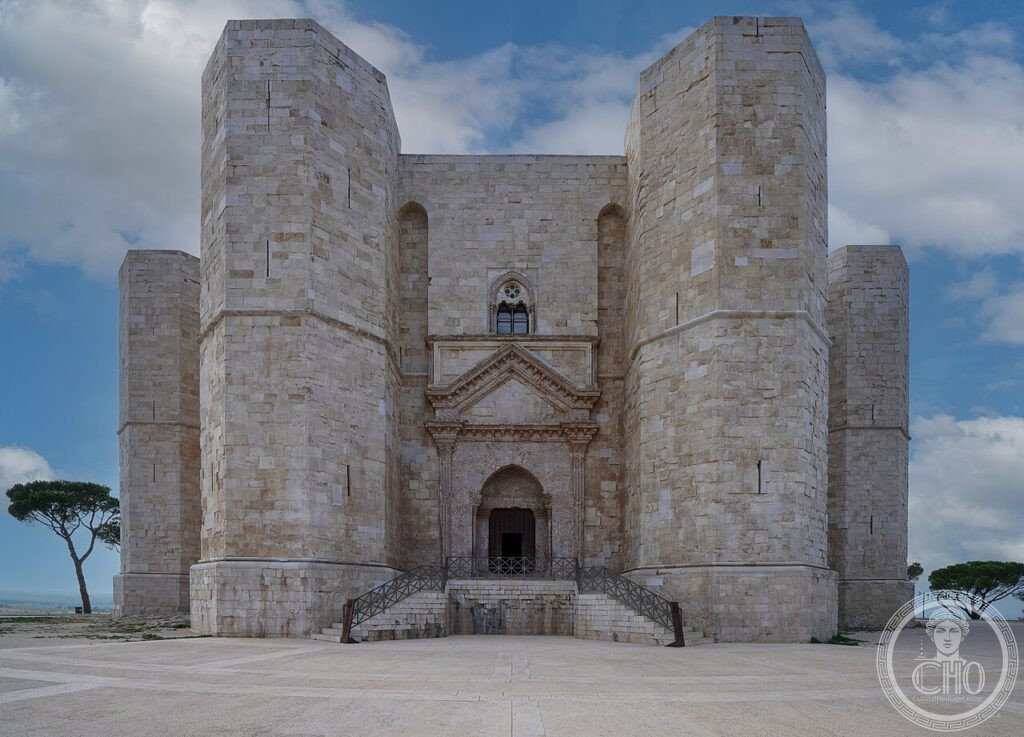
A perfect octagon set on a hill in the Apulian plateau with eight octagonal towers at its eight corners and eight trapezoidal rooms on each of its two floors — and no moat, no keep, no permanent garrison, no evidence of sustained habitation: Castel del Monte (1240-1250) is the most geometrically precise and architecturally enigmatic building constructed by the Holy Roman Emperor Frederick II, the scholar-emperor whose court in Palermo was simultaneously the centre of Arabic science, Greek philosophy, Sicilian poetry, and German chivalric culture, and who built this castle for a purpose that historians have argued about for 750 years without reaching agreement.
At a glance
Castel del Monte is an octagonal castle built by the Holy Roman Emperor Frederick II of Hohenstaufen (King of Sicily, Germany, and Jerusalem; 1194-1250) on a 540-metre hill in the Murge plateau of Puglia, approximately 16 km from Andria, between 1240 and 1250. Inscribed on the UNESCO World Heritage List in 1996 (ref. 398), the castle is widely regarded as the most important example of medieval secular architecture in southern Italy and as one of the most geometrically complex and architecturally unique buildings of the medieval period anywhere in Europe. The castle’s plan — a perfect octagon with eight octagonal corner towers, each enclosing eight trapezoidal rooms on each of two floors — is a unique geometric formulation in medieval European architecture.
Key facts
- Geometry: A perfectly regular octagon in plan; eight octagonal corner towers at the angles; each tower contains two rooms (one per floor) in a roughly trapezoidal plan. The plan has been analysed as reflecting: the octagonal plan of the Church of the Holy Sepulchre (octagonal baptistery added by Crusader builders); Islamic astronomical instruments (astrolabes have octagonal frames); the number eight as a symbol of the cosmic union of heaven (circle) and earth (square); the octagonal dome of Charlemagne’s palatine chapel at Aachen (which Frederick II explicitly used as a model for his imperial authority)
- Astronomical alignment: The castle is oriented so that at the spring and autumn equinoxes, the shadow cast by the northeast tower falls precisely into the entrance portal — a solar calendar function embedded in the architecture. The corner towers also create shadow-play effects at solstices that appear to have been intentional.
- Materials: The main walls are in local white limestone (pietra di Trani); the decorative elements (portals, window frames, column capitals) are in Breccia corallina marble and in Breccia rossa from the Proconnesus quarries; the intarsia floors (now mostly lost) were in coloured marbles. The decorative quality of the surviving marble column capitals (fluted columns, composite Corinthian capitals with acanthus leaves) is equal to the finest contemporary work in Sicily and Campania.
- Function debate: The castle has no cistern for water storage, no kitchen, no stable, no evidence of sustained habitation. Proposed functions include: hunting lodge (Frederick II was an avid falconer, and the castle is in the Apulian plateau, a prime hunting territory); palace of justice (the octagonal form as a symbol of cosmic justice); prison (later use; Manfredi of Hauteville imprisoned relatives here); astronomical observatory; symbolic monument with no practical function.
- UNESCO: 1996, ref. 398 — “Castel del Monte”
- GPS: 41.0843, 16.2700 — Google Maps
History
Frederick II (1194-1250) was born in Jesi (near Ancona) to the Emperor Henry VI and Constance of Hauteville (daughter of Roger II of Sicily). He became King of Sicily at the age of four (1198), Holy Roman Emperor in 1220, and King of Jerusalem (by marriage and negotiation, without military conquest, in the Sixth Crusade, 1228-1229) — a combination of titles that made him the most powerful single ruler in thirteenth-century Europe. His court at Palermo was the most cosmopolitan intellectual environment in the medieval West: he corresponded with Arab mathematicians and philosophers, maintained Muslim soldiers in his army and Muslim scholars at his court, wrote the most important medieval treatise on falconry (De arte venandi cum avibus, “On the Art of Hunting with Birds,” in Latin), founded the University of Naples (1224), and spoke Arabic, Latin, Italian, French, and German.
The construction of Castel del Monte is not precisely documented; the most specific document is a 1240 letter from Frederick II ordering the Justiciary of the Terra Bari to purchase lime for the construction of “the castle we wish to be built at Monte Sancti Angeli de Sterpeto” — a toponym that corresponds to the hill of Castel del Monte. The construction was effectively complete by Frederick’s death in 1250; the castle was never used by his successors as a residence and was already being used as a prison for Hohenstaufen relatives by the Angevin period (after 1268).
What you see
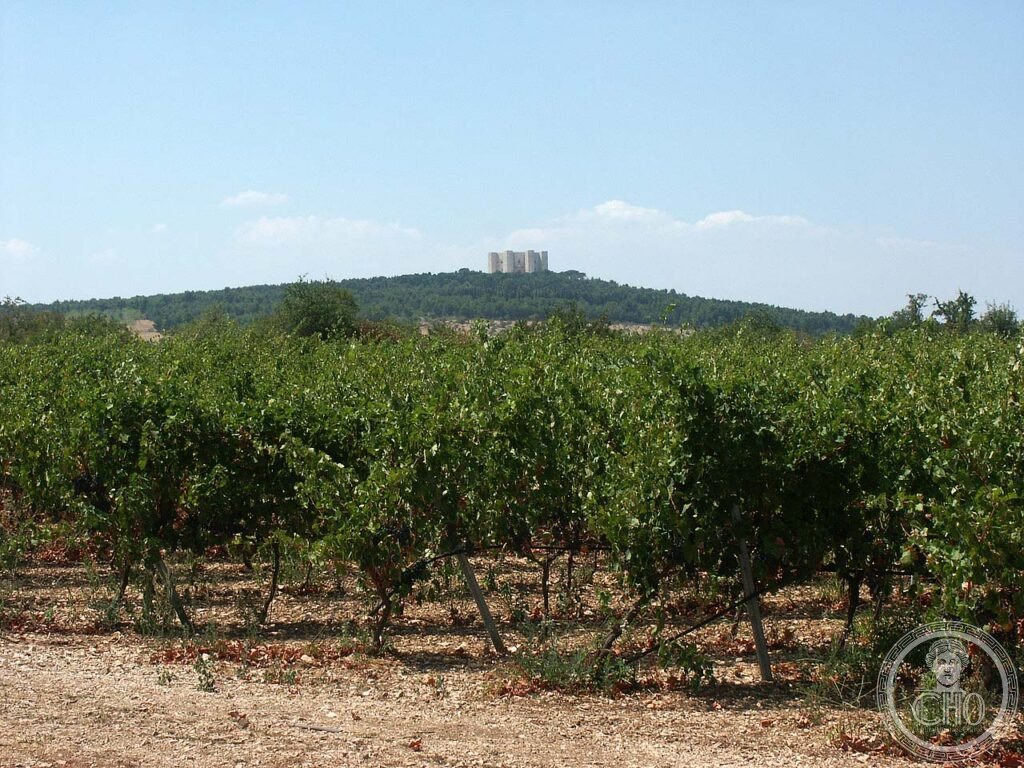
Castel del Monte stands alone on its hill, visible from many kilometres away across the flat Apulian plateau. The approach by the access road reveals the octagonal geometry progressively: from a distance the castle appears as a regular polygon on the hilltop; closer, the eight corner towers become visible as projecting volumes; at the entrance (the north-east portal, the only original entrance), the carved marble portal (a round arch supported by two columns of Breccia corallina, with carved capitals) is the finest surviving decorative element of the original construction.
Inside, the plan is immediately clear: a large octagonal courtyard (in the centre), surrounded by eight trapezoidal rooms on the ground floor (four with pointed vaulting in a French Gothic style, four with simpler barrel vaulting), connected by a staircase in one of the corner towers to eight similar rooms on the upper floor. The marble column capitals in the courtyard (originally, before the post-medieval looting removed most of the decorative elements) and the surviving fragments of intarsia marble floor demonstrate the quality of the original decorative programme. Most of the marble and the stucco decoration has been removed since the fourteenth century; what survives is the architectural shell and the quality of the construction itself.
Gallery
Practical information
- Opening: Daily 9:00-19:30 (April-September) / 9:00-18:30 (October-March); closed 25 December and 1 January. Admission ~€7 (MIC); free for under 18 and first Sunday of the month.
- Access note: The final stretch of road to the castle is restricted to authorised vehicles in high season (July-August weekends); a shuttle bus runs from the parking area at Castel del Monte village (3 km). Signposted from the SS170 (Andria-Canosa road).
- Duration: 1-1.5 hours for the castle interior and the exterior walk around the perimeter.
- Context: The Castello Svevo di Bari (15 km north) and the Castel del Monte together constitute the two most important surviving Hohenstaufen castles in Puglia; the Castello di Bari (also Frederick II, 1233-1240) has a more conventional rectangular plan and is open to the public.
Getting there
Strada Statale 170, Andria (BAT), Puglia. By car: from Bari, 65 km west via SS98 to Andria then SS170 south to the castle (signposted from Andria); 1 hour. From Matera, 80 km east. No direct public transport from Bari; STP Bari runs a bus from Andria to Castel del Monte village (from which the shuttle operates in summer). Organised tours from Bari and Matera available. By train: from Bari to Andria (Trenitalia, 45 min), then taxi or local bus to Castel del Monte (~25 min).
Nearby
- Andria — 16 km north-east; the city where Frederick II was born and where his third wife, Yolanda of Jerusalem, is buried; the underground city (the Ipogeo) and the Basilica di Sant’Agostino; the Palazzo del Monte (XIII century)
- Trani e il Castello e il Duomo — 30 km north-east; the Romanesque cathedral on the harbour (one of the finest coastal Romanesque churches in Italy; XII-XIII century) and the Castello Svevo di Trani (1233, Frederick II); both are on the Adriatic seafront
- Matera — 75 km south-east; UNESCO (1993, ref.670); the two ravines (gravine) with the Sassi cave-dwellings (inhabited from Neolithic to 1952); the rupestrian churches with Byzantine frescoes; the most archaeologically complex city in southern Italy
Sources
- UNESCO: whc.unesco.org/en/list/398
- Wikipedia EN: Castel del Monte, Apulia
- Götze, Heinz: Castel del Monte, Gestalt und Symbol der Architektur Friedrichs II, Prestel, 1984
- Ministero della Cultura: casteldelmonte.beniculturali.it
Find it on the map
See this place and what’s around it →📷 Diventa un fotografo di Cultural Heritage Online
Condividi le tue foto dei luoghi: restano pubblicate con la tua firma come autore. Più vengono viste, più ti fai conoscere — e presto un concorso premierà le foto più apprezzate.
Accedi o registrati gratis per aggiungere una foto