
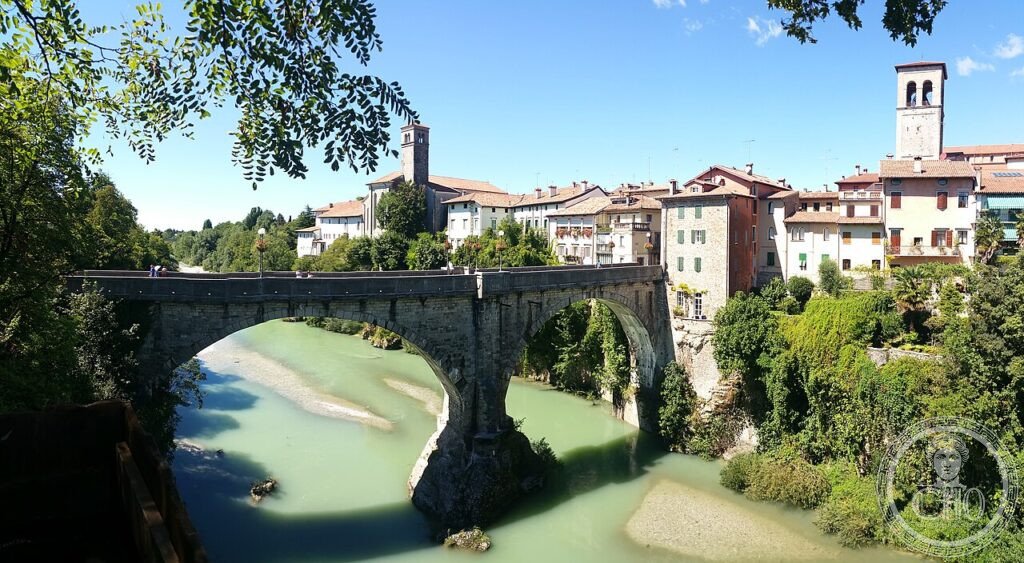
Cividale del Friuli e il Tempietto Longobardo — la Capitale del Primo Ducato Longobardo (568-776) e i Rilievi in Stucco dell’VIII Secolo
Julius Caesar founded Forum Iulii as a military base in 56 BCE; six centuries later, the first Lombard duke to cross the Alps made it the capital of the first Lombard duchy in Italy; and two centuries after that, an unknown Lombard architect or sculptor created in a small oratory of the Benedictine monastery of Santa Maria in Valle the most complete surviving example of Lombard decorative art — eight female figures in white stucco (the largest and finest stucco sculpture programme to survive from anywhere in the early medieval West) arranged under a triumphal arch in a building that combines the Roman constructive tradition, the Byzantine figurative tradition, and the new Lombard artistic tradition in a synthesis that has no parallel in any other single early medieval room in Europe.
At a glance
Cividale del Friuli is a town of approximately 11,000 inhabitants in the province of Udine, in Friuli-Venezia Giulia, inscribed on the UNESCO World Heritage List in 2011 (ref. 1318) as part of the “Longobardi in Italia: i Luoghi del Potere” (Lombards in Italy: Places of Power) serial inscription, which covers seven Lombard-period sites in Italy. Cividale is inscribed as the site of Forum Iulii (the Roman city of Julius Caesar), the capital of the first Lombard duchy in Italy (from 568 CE), and the location of the Tempietto Longobardo (the Lombard Oratory of Santa Maria in Valle), the most complete surviving example of early medieval decorative art in the western world.
Key facts
- Roman origins: Forum Iulii founded by Julius Caesar in 56 BCE as a military base during the Gallic Wars; the name gave the region its name: Friuli (from Forum Iulii)
- Lombard capital: First Lombard duke of Friuli: Gisulf I, installed by the Lombard king Alboin in 568-569 CE immediately after the Lombard invasion of Italy; Cividale remained the capital of the Duchy of Friuli until the Frankish conquest in 776 CE
- Tempietto Longobardo: Part of the Benedictine monastery of Santa Maria in Valle; the main chamber (approximately 6.5 × 11.5 m) is dated to the VIII century (the most common attribution is to the Lombard period, 720-760 CE, though some scholars date it to the Carolingian period after 776 CE); the stucco decoration (eight female figures under a triumphal arch on the west wall, plus four figure reliefs and a rich decorative frieze) is the finest surviving example of early medieval Western stucco sculpture
- Museo Archeologico Nazionale: Lombard gold and silver finds (7th-8th century CE); the Tesoro delle Longobarde (treasure of the Lombard ladies: 7th century CE female burial with gold fibulae, cross pendants, and jewellery from Pannonia); the Altar of Ratchis (carved marble altar, 740 CE, with the most important Lombard relief sculpture in existence)
- UNESCO: 2011, ref. 1318 — “Longobardi in Italia: i Luoghi del Potere”; 7 sites: Cividale del Friuli, San Salvatore-Santa Giulia Brescia, Castelseprio-Torba, Tempietto del Clitunno, Santa Sofia Benevento, Monte Sant’Angelo, Spoleto
- GPS: 46.0939, 13.4340 — Google Maps
History
The Lombards (Langobardi in Latin) were a Germanic people who crossed the Alps from Pannonia (modern Hungary and Austria) into Italy in 568 CE under their king Alboin, at the invitation — according to the Lombard historian Paul the Deacon (Paulus Diaconus, 720-799 CE, himself a native of Cividale) — of the Byzantine general Narses, who had just defeated the Ostrogoths and wished to destabilise the Byzantine position in Italy. Alboin captured Forum Iulii immediately and installed his nephew Gisulf I as the first Duke of Friuli; within three years the Lombards controlled most of northern and central Italy (Brescia, Milan, Pavia, Spoleto, Benevento), though the Byzantines retained Venice, Ravenna, Rome, and Calabria.
The Duchy of Friuli, with its capital at Forum Iulii (now renamed Cividale), was the principal military bulwark of the Lombard kingdom against attacks from the Avars and Slavs from the east; it was repeatedly the site of major battles and was sacked at least three times. Despite this, the duchy accumulated substantial wealth from trade on the Via Iulia Augusta (the Roman road from Aquileia to the north) and from the control of the Alpine passes; the evidence for this wealth is the extraordinary quality of the Lombard goldsmithing and carved marble work that survives in the Museo Archeologico.
What you see
The Tempietto Longobardo (Oratorio di Santa Maria in Valle, Piazzetta San Biagio 6) is the essential single space of the visit: a small room approximately 11.5 m long and 6.5 m wide with a richly decorated west wall. The wall is divided into three sections by a triumphal arch; the upper section above the arch is decorated with a row of eight female figures in white stucco, each approximately 60-70 cm tall, arranged under a row of arched frames separated by twisted columns. The figures are in Byzantine court dress (long gowns, pallium) with elaborate hairstyles and frontal pose; the quality of the modelling — the differentiation of textile folds, the treatment of the faces, the jewellery — is dramatically different from anything else surviving from the seventh and eighth centuries in Italy. The lower section of the west wall has four large relief figures in stucco (approximately 90 cm tall); the arch itself is decorated with a continuous vine scroll in stucco relief.
The Museo Cristiano e Tesoro del Duomo (adjacent to the cathedral on Piazza Duomo) houses the Altar of Ratchis: a marble altar from approximately 740 CE with relief carvings on three faces (the Majestas Domini — Christ enthroned surrounded by seraphim — on the front; the Adoration of the Magi and the Visitation on the sides). The quality of the carving — particularly the expressiveness of the faces of the Magi and the angels — is the finest surviving Lombard marble work.
Gallery
Practical information
- Tempietto Longobardo: Via Monastero Maggiore / Piazzetta San Biagio; open Tuesday-Sunday 10:00-13:00 and 15:00-18:00 (winter) / 10:00-13:00 and 15:00-19:00 (summer). Admission ~€4. Combined ticket with Museo Cristiano e Tesoro del Duomo (~€6) recommended.
- Museo Archeologico Nazionale: Piazza del Duomo 13; open Tuesday-Sunday 8:30-19:30; admission ~€6 (or combined with Tempietto ~€9). The Lombard treasure (Tesoro delle Longobarde) and the Ratchis Altar are the principal exhibits.
- Duration: 3 hours for a complete visit to Tempietto + Museo Cristiano + Museo Archeologico + the historic centre; allow a half-day.
Getting there
Cividale del Friuli (UD), Friuli-Venezia Giulia. By train: from Udine, 10 km east; 15 min by regional train (Trenitalia FVG); 2-3 departures/hour. From Trieste, 45 min to Udine then change. From Venice, 1h45 to Udine. By car: from Udine, A23 (exit Udine Sud) then SS56 east (20 min); ample parking outside the medieval walls. From Trieste, 45 km west via A4 then A23.
Nearby
- Udine e il Tiepolo — 10 km west; the historic capital of Friuli; the Palazzo Arcivescovile (Archiepiscopal Palace) has a cycle of frescoes by Giambattista Tiepolo (1726, the largest Tiepolo fresco cycle in Friuli); the Piazza della Libertà is one of the most beautiful small squares in north-eastern Italy
- Aquileia — 45 km south; Roman capital of northeastern Italy; UNESCO World Heritage (1998, ref.875); the largest Roman basilica mosaic floor in the western world (354 CE, 760 m², under the Basilica di Santa Maria Assunta)
- Trieste e il Carso — 55 km south-east; the Habsburg port city; the karst plateau above the city (the Carso, with its sinkholes, caves, and dry valleys) is the defining landscape of northeastern Italy
Sources
- UNESCO: whc.unesco.org/en/list/1318
- Wikipedia EN: Cividale del Friuli
- Paulus Diaconus: Historia Langobardorum (VIII sec.); ed. moderna: MGH SS rer. Lang. et Ital., Hannover, 1878
- Comune di Cividale / Museo Archeologico: museoarcheologicocivdale.beniculturali.it
Find it on the map
See this place and what’s around it →📷 Diventa un fotografo di Cultural Heritage Online
Condividi le tue foto dei luoghi: restano pubblicate con la tua firma come autore. Più vengono viste, più ti fai conoscere — e presto un concorso premierà le foto più apprezzate.
Accedi o registrati gratis per aggiungere una foto