

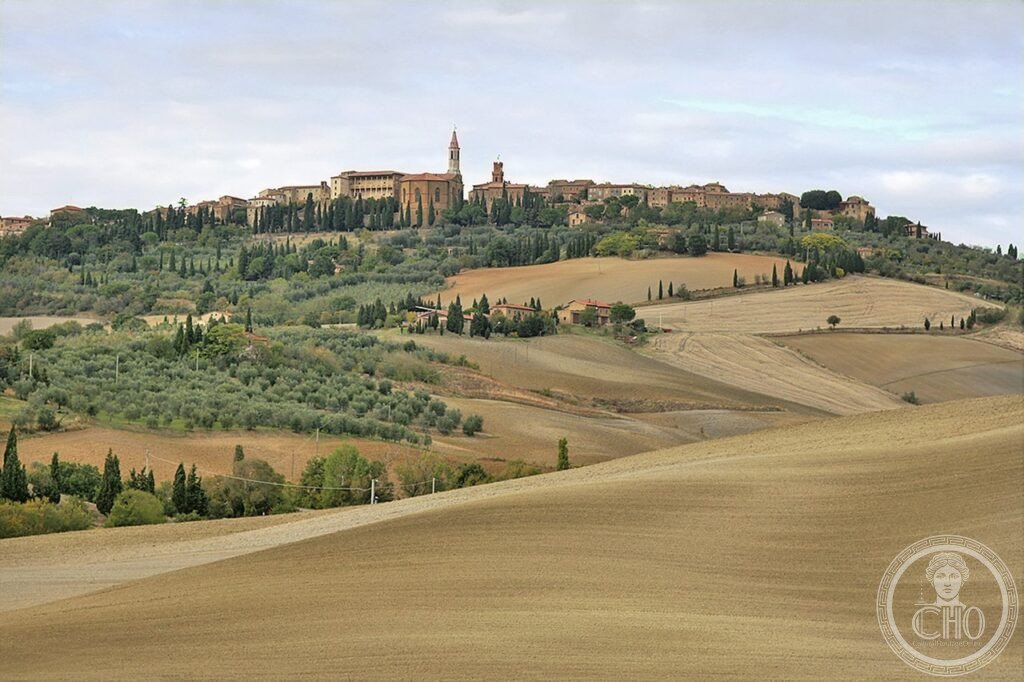
A pope redesigned a village — the hamlet of Corsignano, his birthplace — into a model Renaissance city in three years (1459-1462), and the resulting town plan (a cathedral, a bishop’s palace, a town hall, and a private palace, all arranged around a single trapezoidal piazza by the architect Bernardo Rossellino following the principles of the Florentine humanist Leon Battista Alberti) is the first realised example of a planned Renaissance urban ensemble in Italy; the valley surrounding it, the Val d’Orcia, is managed as a UNESCO cultural landscape for its agricultural terraces, cypress allées, and medieval villages that together create the visual archetype of Tuscan landscape painting from Simone Martini to Ambrogio Lorenzetti.
At a glance
Pienza is a small town (3,500 inhabitants) in the province of Siena in the Val d’Orcia, inscribed on the UNESCO World Heritage List in 2004 (ref. 1026) as the core component of the “Val d’Orcia” cultural landscape. The UNESCO inscription covers both the town of Pienza (for its planned Renaissance urban core, built 1459-1462 by Enea Silvio Piccolomini, later Pope Pius II) and the surrounding agricultural landscape of the Val d’Orcia (the valley of the Orcia river between Siena and Monte Amiata), selected for the quality and coherence of its agricultural landscape as a managed cultural environment that has been maintained essentially unchanged since the fifteenth century.
Key facts
- Pienza — urban plan: 1459-1462; architect Bernardo Rossellino (Florence, 1409-1464); patron Pope Pius II (Enea Silvio Piccolomini, 1405-1464, born in Corsignano/Pienza); the project transformed the medieval village of Corsignano into the “ideal city” of Pienza in approximately 3 years (the shortest planning and construction period for any major Renaissance urban project)
- Piazza Pio II: The central trapezoidal piazza is flanked by four buildings: the Cattedrale dell’Assunta (Duomo, 1459-1462; the most complete surviving example of a Florentine Renaissance church built outside Florence), Palazzo Piccolomini (1459-1462; the private residence of Pius II; the hanging garden on the south façade with the view of the Val d’Orcia is the earliest documented Italian Renaissance garden), Palazzo Vescovile (the bishop’s palace, adapted from an existing building), and Palazzo Comunale (the town hall)
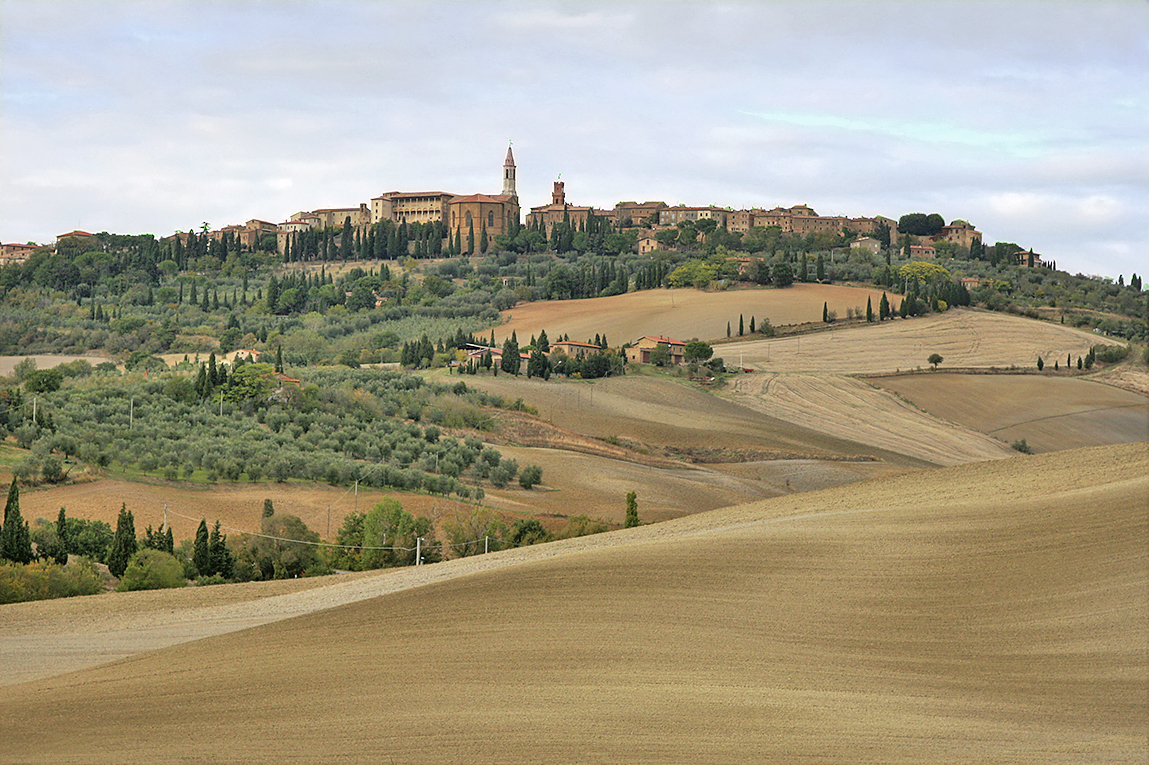
- Val d’Orcia landscape: The UNESCO inscription covers 61,194 hectares of the Orcia valley; the landscape is characterised by: clay hills (crete senesi) with a distinctive grey-green colour when bare; wheat fields; vineyard terraces; cypress allées marking farmsteads and chapel paths; medieval hilltop villages (San Quirico d’Orcia, Montalcino, Castiglione d’Orcia, Radicofani)
- Pecorino di Pienza: The Val d’Orcia is the production area for Pecorino di Pienza, an aged sheep’s milk cheese (matured in 10-80 days for fresh/aged variants); the local pecorino is matured in ash, in clay pots, or rubbed with black truffle oil
- UNESCO: 2004, ref. 1026 — “Val d’Orcia”
- GPS: 43.0786, 11.6788 — Google Maps
History
Enea Silvio Piccolomini was born in 1405 in Corsignano, a small village on the crest of the hills above the Val d’Orcia. He became one of the great humanist scholars of the fifteenth century (his Historia rerum ubique gestarum, 1461, was the most important geographical text of the age; he corresponded with Lorenzo Valla and Guarino Veronese; he wrote poetry and a novel in Latin), served as secretary to the Council of Basel, was elected bishop and then cardinal, and in 1458 was elected Pope Pius II. Within months of his election he began planning the transformation of Corsignano into a model city.
The project had two motivations: personal (the transformation of his birthplace into a monument to his family and his papacy) and ideological (the demonstration that the principles of Albertian humanist urbanism — rational planning, classical proportion, the relationship between city and landscape — could be realised in practice, not merely theorised). The architect Rossellino had worked with Alberti on the completion of San Miniato and on other Florentine commissions; Pius chose him for this project specifically because of his connection to Alberti’s ideas.
What you see
The historic centre of Pienza is compact — the planned Renaissance core occupies approximately one hectare — and can be walked in 30 minutes. The experience begins in Piazza Pio II, which is entered from Via del Casello (the main approach from the east): the trapezoidal plan of the piazza is immediately apparent from the convergence of the flanking buildings toward the Duomo’s façade, which creates a perspectival illusion of greater depth. The Duomo interior (luminous, with three equal naves lit by large windows in the German Gothic style — Pius had been bishop of Siena and Trieste and had seen the great Gothic cathedrals of Germany) has five important altarpieces by the Sienese painters Matteo di Giovanni, Vecchietta, Giovanni di Paolo, Sano di Pietro, and Lorenzo di Pietro (Vecchietta).
Palazzo Piccolomini (currently partially open; the courtyard and the loggia are visible) has a courtyard of three superimposed loggias (ground floor, piano nobile, attic) in the proportions established by Brunelleschi’s Ospedale degli Innocenti — the model for Italian Renaissance courtyard design — and a hanging garden (now replanted) on the south side, from which the view over the Val d’Orcia stretches 20-30 km to Monte Amiata (1738 m) on the horizon.
Gallery
Practical information
- Duomo: Daily 10:30–19:00 (summer) / 10:30–17:00 (winter). Free admission. The crypt (with original Romanesque capitals) is accessible only on guided tours.
- Palazzo Piccolomini: Tuesday–Sunday 10:00–18:00. Admission ~€7 (audioguide included). The papal apartments (piano nobile) are the primary attraction; the loggia with garden and valley view is the highlight.
- Pecorino tasting: The main street (Corso il Rossellino) has several cheese shops offering tastings of fresh, semi-aged, and aged Pecorino di Pienza; the aged variety matured in walnut leaves or truffle is the most characteristic.
- Val d’Orcia landscape drive: The SP146 from San Quirico d’Orcia south through Pienza to Chianciano Terme passes the most iconic sections of the landscape; early morning in spring (March-May) when the wheat is green and the light is low is the best time for photography.
Getting there
Pienza (Siena), Toscana. By car: from Siena, 52 km south via SR2 (Via Cassia) and SP146; from Rome, 170 km north via A1 (exit Chiusi-Chianciano Terme) then SP146 west; from Florence, 140 km south via A1 (exit Valdichiana) then SP327 west to Montepulciano, then SP146 west. No direct rail connection; the nearest station is Chiusi-Chianciano Terme (25 km east, on the Florence-Rome main line); infrequent buses to Pienza. A car is effectively required for visiting the Val d’Orcia landscape beyond the town centre.
Nearby
- Montalcino — 22 km west; the fortified hill town is the production centre for Brunello di Montalcino DOCG (the most expensive Italian red wine); the Fortezza (1361) at the top of the town offers a panoramic view of the Val d’Orcia; the Abbazia di Sant’Antimo (IX-XII century, Romanesque, south of Montalcino) is one of the finest Romanesque abbeys in Tuscany
- San Quirico d’Orcia — 10 km north-west; the Horti Leonini (1580, formal Renaissance garden with topiary holm oaks) are free and open daily; the Collegiata (XII century) has a Romanesque portal by Giovanni Pisano
- Bagno Vignoni — 10 km north; a Renaissance thermal pool (Vasca delle Terme, 1490) in the centre of the village — the thermal water (47°C) fills a large stone basin surrounded by colonnaded loggias; the bathing pool no longer allows swimming (the thermal spring now serves a hotel), but the visual effect is unique
Sources
- UNESCO: whc.unesco.org/en/list/1026
- Wikipedia EN: Pienza
- Frommel, Christoph Luitpold: “Pienza. Städtebau als Aufgabe,” in: Pienza: Städtebau und Humanismus, Hirmer, 1997
- Comune di Pienza / Parco Artistico Naturale e Culturale della Val d’Orcia: comune.pienza.si.it
Find it on the map
See this place and what’s around it →📷 Become a Cultural Heritage Online photographer
Share your photos of places: they stay published under your name as the author. The more they're seen, the more you get noticed — and soon a contest will reward the most appreciated photos.
Log in or sign up free to add a photo