
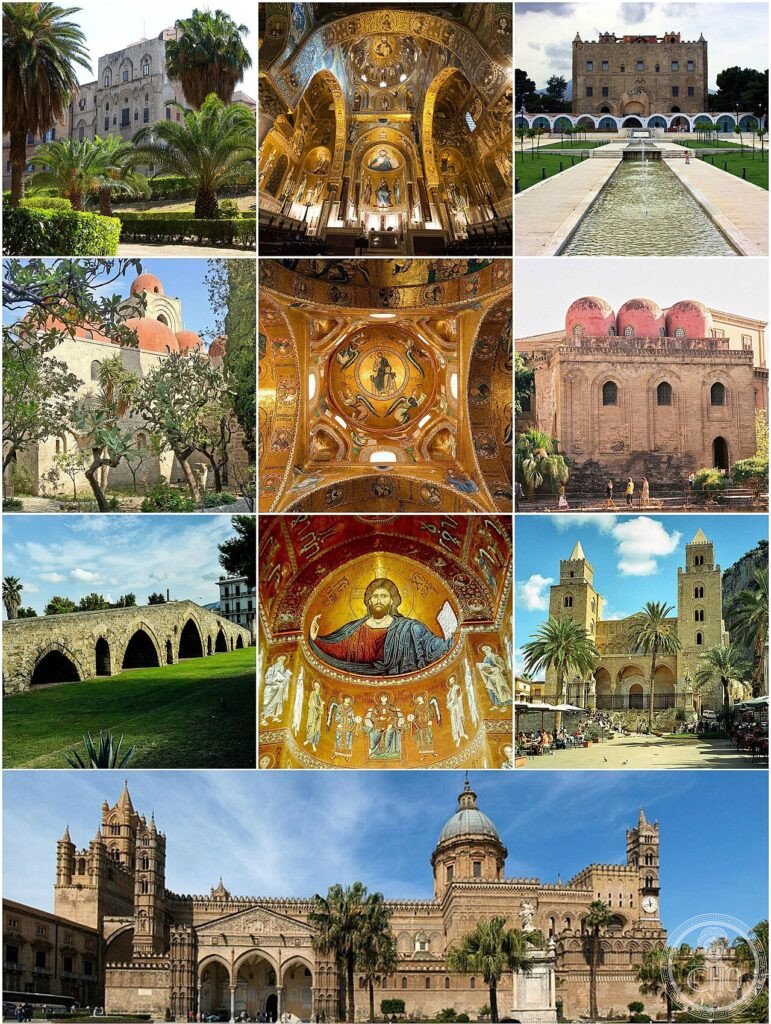
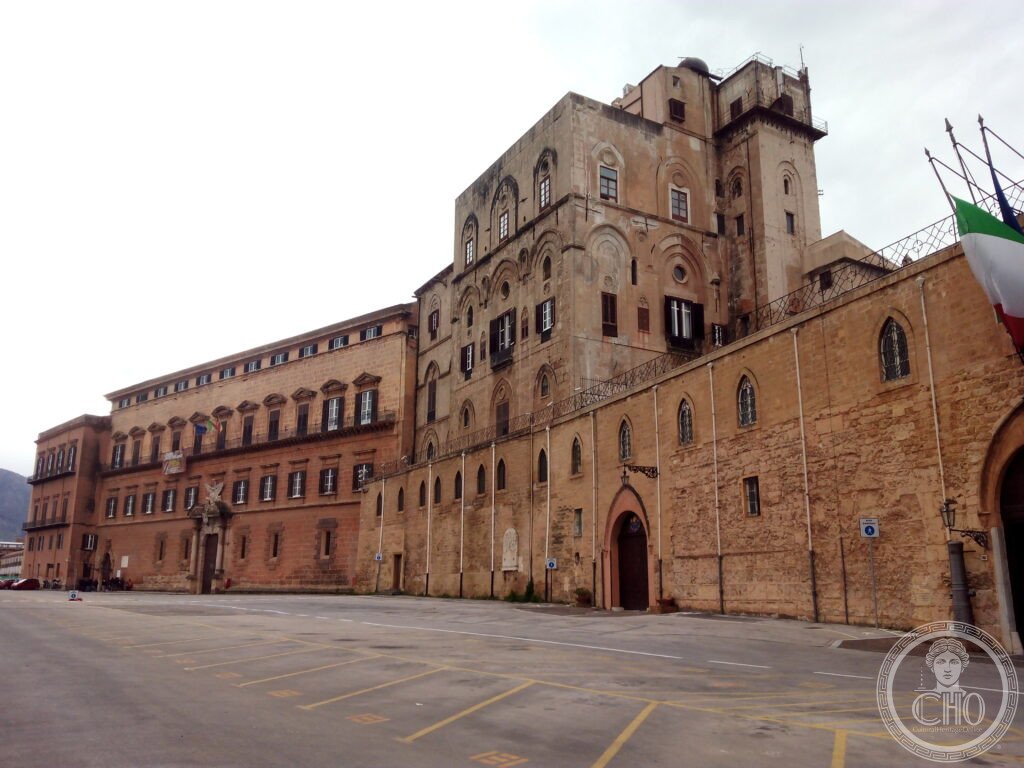
The Cappella Palatina is a room twelve metres wide and thirty-three metres long in the Palazzo dei Normanni in Palermo where, for the first time in the history of Western art, Byzantine mosaic workers, Arab craftsmen, and Norman builders worked simultaneously in a single space to serve a single king — Roger II (1130–1154), the Norman king of Sicily who spoke Arabic, used Arab administrators, maintained a harem, patronised Arab geographers, commissioned a Byzantine mosaic programme, and built a Latin church — and whose kingdom was, for its fifty years of existence, the most culturally cosmopolitan state in medieval Europe.
At a glance
The Arab-Norman monuments of Palermo are a group of nine buildings in Palermo, plus the cathedrals of Cefalù (80 km east) and Monreale (8 km south-west), inscribed on the UNESCO World Heritage List in 2015 (ref. 1487) as “Palermo Arab-Norman and the Cathedral Churches of Cefalù and Monreale.” The inscription recognises these buildings as the outstanding expression of the Norman Kingdom of Sicily (1130–1194), a political entity that achieved an extraordinary synthesis of Latin-Christian, Byzantine-Greek, and Arab-Islamic cultural traditions in architecture, art, administration, and law — a synthesis without parallel in medieval Europe.
The nine Palermo monuments included in the UNESCO inscription are: the Palazzo dei Normanni (with the Cappella Palatina), the Cattedrale di Palermo, the chiesa di San Giovanni degli Eremiti, the chiesa di Santa Maria dell’Ammiraglio (La Martorana), the chiesa di San Cataldo, Palazzo della Zisa, Villa Maredolce (Castello della Favara), the Ponte dell’Ammiraglio, and the church of San Spirito.
Key facts
- Cappella Palatina: 1130–1143; commissioned by Roger II; mosaic programme in Byzantine style (possibly Greek or Byzantine craftsmen from Constantinople); Arab stalactite ceiling (muqarnas) in carved painted wood — the finest example of Islamic ceiling decoration outside the Arab world; Norman nave (Latin basilica plan with marble columns)
- Roger II (1095–1154): First king of Sicily (1130); his court in Palermo maintained parallel Greek, Arabic, and Latin chancelleries; employed Arab geographers (al-Idrisi wrote the Tabula Rogeriana, the most accurate map of the known world to 1154); Arabic was used in official documents alongside Latin and Greek
- La Martorana (1143): Church of Santa Maria dell’Ammiraglio; the mosaic of Roger II being crowned by Christ (one of the earliest surviving royal portraits in mosaic) is the most important single image in the Palermo UNESCO inscription
- Palazzo della Zisa (1165–1167): Arabic “pleasure palace” (zisa = arabic “splendid”); cube-shaped building with muqarnas interior and a cooling system based on water channels running through the walls
- UNESCO: 2015, ref. 1487 — “Palermo Arab-Norman and the Cathedral Churches of Cefalù and Monreale”
- GPS: 38.1114, 13.3581 — Google Maps (Cappella Palatina)
History
Sicily was conquered by the Arab emirate of Aghlabid Tunisia between 827 and 902 CE; for almost two centuries (902–1072) it was an Arab emirate, with Palermo (Bal’harm) as its capital — the most advanced city in Europe at the time, with street lighting, running water, and markets with tropical goods from across the Arab world. The Norman conquest (1061–1072, led by Robert Guiscard and his brother Roger I) brought the island under Norman control, but the Arab population was not expelled — it was incorporated. The Norman kings, pragmatic administrators who had learned from their Byzantine and Arab predecessors, maintained the Arabic-speaking bureaucracy, the Arabic agricultural system, and the Arab court culture, adding a Latin ecclesiastical hierarchy and a Byzantine artistic programme that produced the unique hybrid architecture of the Cappella Palatina and La Martorana.
Roger II (king 1130–1154) was the cultural apex of this synthesis: born in Sicily, fluent in Arabic (reportedly), educated by both Greek and Arab scholars, he was simultaneously a Norman knight, a Byzantine emperor in aesthetic preference, and a patron of Arab science. His commission of the geographer Muhammad al-Idrisi to produce a comprehensive world map (the Tabula Rogeriana, 1154) resulted in the most accurate geographical description of the known world to that date — covering Eurasia, North Africa, and the Far East, drawn on a silver disk approximately 2 metres in diameter.
What you see
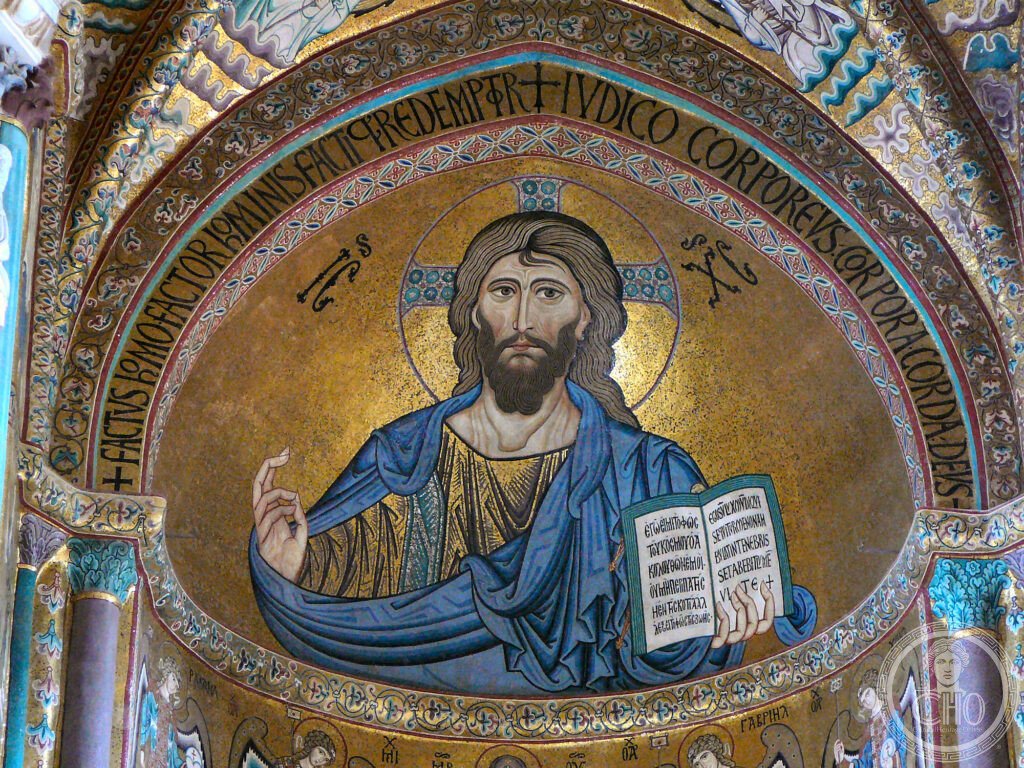
The Cappella Palatina (in the Palazzo dei Normanni, now the Sicilian Regional Assembly): a three-nave basilica with a Byzantine mosaic programme covering all surfaces of the walls and vault (Christ Pantocrator in the apse, Annunciation on the triumphal arch, cycle of the Life of Christ in the nave, cycle of Saints Peter and Paul in the lateral apses) and an Arab muqarnas ceiling in the nave (wooden stalactite honeycomb painted with figurative scenes in the Arab court style — hunting, musicians, polo players, birds). The combination of Byzantine mosaic (hieratic, two-dimensional, in gold background) with Arab painted wood (narrative, colourful, secular) is the defining feature of the Norman synthesis and is unlike anything else surviving in Europe.
La Martorana (Piazza Bellini): the mosaic of Roger II (north apse, 1143) shows the king in Byzantine imperial dress (loros, stemma) being crowned by Christ, with a Greek inscription identifying him as “Roger, King of Sicily.” The image is explicitly modelled on Byzantine imperial coronation iconography, appropriated for a Norman king in the westernmost outpost of Byzantine artistic influence.
Gallery
Practical information
- Cappella Palatina: Palazzo dei Normanni, Piazza del Parlamento; open Monday–Saturday 8:15–17:40 (last entry 17:00); Sunday 8:15–13:00 (last entry 12:45). Admission ~€15 (includes Cappella Palatina + Sala di Ruggero). Book online (federicosecondo.eu) to avoid queues, which can be very long in summer.
- La Martorana: Piazza Bellini; open Monday–Saturday 9:30–13:00 and 15:30–17:30; Sunday 9:00–10:30. Admission ~€2.
- Palazzo della Zisa: Piazza Zisa; open Tuesday–Sunday 9:00–18:30. Admission ~€6 (includes Cappella Palatina if combined ticket). The muqarnas interior on the ground floor is one of the most extraordinary interior spaces in Sicily.
- UNESCO Passport: A combined ticket covering all 9 Palermo monuments is available at ~€20; valid for 3 days. Highly recommended for a full visit.
Getting there
Palermo, Sicilia. By plane: Palermo Falcone-Borsellino airport (PMO), 30 km west; Prestia e Comandè shuttle bus (every 30 min) to the city centre (~1h); taxi ~€45. By train: Palermo Centrale FS; direct from Rome via ferry (10h+) or by train+ferry from Naples; faster by Freccia to Naples then ferry overnight. By ship: Grandi Navi Veloci (Genova–Palermo, 20h; very comfortable; excellent value in a cabin). The Cappella Palatina is 20 minutes on foot from Palermo Centrale, or 5 minutes by bus (line 101, 102 to “Piazza del Parlamento”).
Nearby
- Cattedrale di Palermo — 300 m west; UNESCO 2015 (same inscription); the exterior collects Norman, Gothic, Baroque, and Neoclassical additions across eight centuries (1185–1801); the royal tombs (Roger II, Frederick II, Henry VI, Constance of Hauteville) are in the southern transept; the treasury has the Imperial Crown of Constance (1194)
- Monreale e il Duomo — 8 km south-west; UNESCO 2015 (same inscription); the cathedral of Monreale (1172–1189, William II) has the largest continuous Byzantine mosaic programme in the world outside Constantinople (approximately 6,340 m² of gold mosaic); the Benedictine cloister (1172) has 228 twin columns, each with unique carved capitals
- Cefalù e il Duomo — 80 km east; UNESCO 2015 (same inscription); the Norman cathedral (1131, Roger II) has the earliest surviving mosaic of Christ Pantocrator in the apse of a Western church (1148); the beach below the town is among the finest in Sicily
Sources
- UNESCO: whc.unesco.org/en/list/1487
- Wikipedia EN: Arab-Norman Palermo
- Tronzo, William: The Cultures of His Kingdom: Roger II and the Cappella Palatina in Palermo, Princeton University Press, 1997
- Fondazione Federico II: federicosecondo.eu
Find it on the map
See this place and what’s around it →📷 Become a Cultural Heritage Online photographer
Share your photos of places: they stay published under your name as the author. The more they're seen, the more you get noticed — and soon a contest will reward the most appreciated photos.
Log in or sign up free to add a photo