
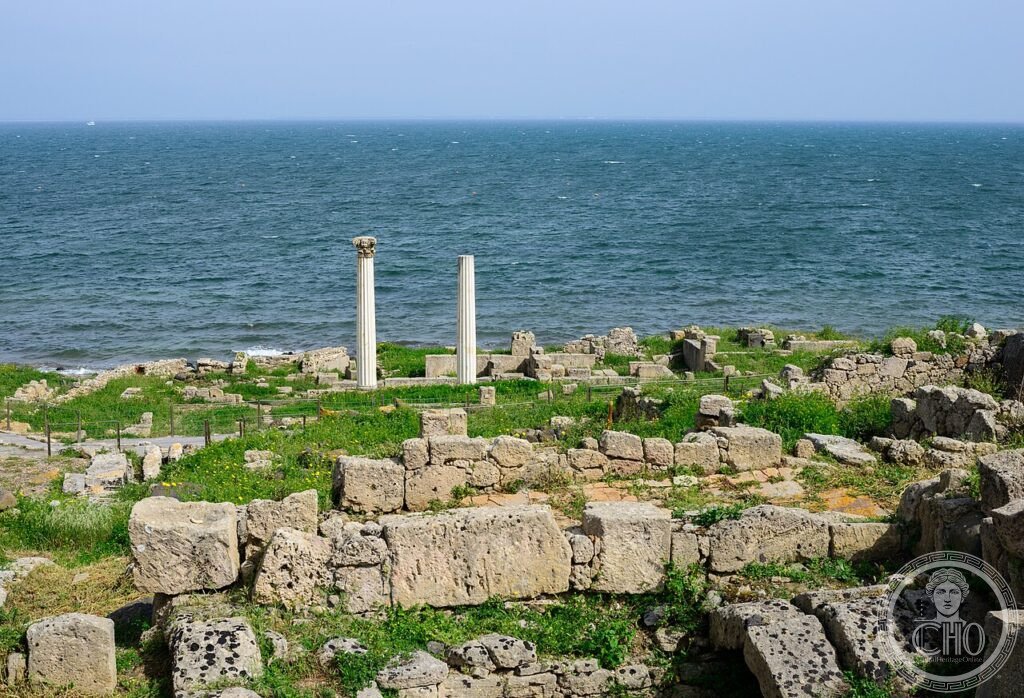
Three thousand years on a peninsula pointing south-west into the Golfo di Oristano: Tharros was Phoenician first (eighth century BCE), then Punic, then Roman (taking the name Tharros officially in the early Empire), then Byzantine, and finally abandoned in 1070 CE when its last inhabitants moved 10 kilometres north to found Oristano. The two columns still standing on the headland above the sea — the only visible above-ground fragments of the Roman city — are the skyline of what was for twelve centuries one of the most important port cities in Sardinia.
At a glance
Tharros is an archaeological site on the southern tip of the Sinis Peninsula, a sandy low headland projecting south-west from the Oristano plain into the Gulf of Oristano (Golfo di Oristano) on the west coast of Sardinia. The site was occupied continuously from approximately the eighth century BCE (Phoenician foundation) to 1070 CE (abandonment in favour of Oristano) — almost 1,800 years of continuous occupation — making it one of the most long-lived urban sites in Sardinia. The name “Tharros” is probably pre-Phoenician (of Nuragic or earlier origin), inherited by the Phoenician colony when it was founded.
The site is managed by the Soprintendenza dei Beni Archeologici di Cagliari and Oristano; the most important finds (jewellery, figurines, tomb goods, Bronze Age artefacts) are displayed in the Museo Civico di Cabras and the Museo Nazionale di Cagliari.
Key facts
- Foundation: VIII century BCE (Phoenician colony, probably from Tyre); the site was chosen for its defensibility (peninsula, water on three sides) and its proximity to the Stagno di Cabras (a large lagoon with abundant fish resources)
- Punic period: VI–III century BCE; Tharros became one of the most important Punic cities in Sardinia; the tophet (sacred enclosure with child urns) has been excavated; the Punic necropolis (Via dei Sepolcri) extends north of the urban area
- Roman period: from 238 BCE (Roman conquest of Sardinia); Tharros becomes a Roman municipium; the two surviving columns (I century CE) are from a Roman temple; the city had a theatre, baths, a forum, and a street grid
- Abandonment: 1070 CE; the population relocated to Oristano (10 km north) — reasons uncertain but likely a combination of Saracen raids and the decline of the port
- Nuraghe San Giovanni: A Bronze Age nuraghe (1700–1000 BCE) survives on the headland, pre-dating the Phoenician foundation and attesting to earlier Nuragic occupation of the peninsula
- GPS: 39.8863, 8.4375 — Google Maps
History
Sardinia was colonised by the Phoenicians in the ninth–eighth centuries BCE as a staging post on the trade routes from the Levant to the Iberian Peninsula and the Atlantic tin trade. Tharros was one of a group of Phoenician colonies on the west coast of Sardinia (others include Sulci, modern Sant’Antioco; and Nora, near Pula), all of them chosen for their accessibility from the sea and their ability to trade with the Nuragic population of the interior.
The Punic period (from approximately the sixth century BCE, when Carthage replaced Tyre as the dominant power in the western Phoenician world) brought Tharros to its greatest extent: the city had a planned street grid, a sacred enclosure (tophet) for the deposits of cremated remains of infants associated with Punic religious practice, an extensive necropolis, and a sophisticated production of gold jewellery (the gold from Tharros, in various European museum collections, is considered among the finest surviving examples of Phoenician-Punic goldsmithing). After the Roman conquest of Sardinia in 238 BCE, Tharros became a Roman municipium and acquired the physical infrastructure of a Roman town: a forum, a theatre, public baths (thermae), and the two columns that are its most recognisable monument today.
What you see
The visit to Tharros is essentially an outdoor archaeological walk on the headland in the sun — there are no roofed structures and minimal shade, so morning or late afternoon visits are strongly recommended in summer. The most visible elements are: the two standing Roman columns (approximately 6 m high, from a porticoed building of the I century CE, on the highest point of the headland); the cardo maximus (the main north-south Roman street, paved in basalt, still visible for approximately 150 m); the insulae on either side of the cardo (foundations of Roman houses and shops); and the Punic necropolis on the north slope (individual chamber tombs cut in the rock, accessible by iron ladders).
The view from the headland is one of the most beautiful in Sardinia: south to the open sea, west to the San Giovanni di Sinis beach (one of the finest white-sand beaches in Italy, 5 minutes’ drive away), and north across the Stagno di Cabras (lagoon). The Nuraghe San Giovanni, visible on the headland, is one of the few Nuragic towers in Sardinia with an associated Phoenician-Punic city — the stratigraphic relationship between the two cultures is visible in the excavations on the west slope of the headland.
Gallery
Practical information
- Archaeological area: Open daily 9:00–20:00 (summer) / 9:00–17:00 (winter). Admission ~€5 (includes the Tharros site). Combined ticket with Museo Civico di Cabras ~€8.
- Museo Civico di Cabras: The most important finds from Tharros are here (gold jewellery, ceramics, funerary steles, Bronze Age materials); open daily; admission ~€4. The museum also houses the “Giganti di Mont’e Prama” — approximately 30 fragments of limestone warrior statues (IX–VII century BCE), the earliest large-scale figurative sculptures found in the western Mediterranean, discovered in 1974 in a nuragic necropolis 6 km north of Tharros.
- Season: Best visited April–June and September–October; July–August is very hot (little shade on the headland) and the road to the site can be congested with beach traffic.
Getting there
Tharros, Penisola del Sinis, Cabras (OR), Sardegna. By car from Oristano: 15 km (20 min) via SP6 to Cabras then SP2 to San Giovanni di Sinis; follow signs for “Area Archeologica di Tharros.” No public transport to the site (the Sinis Peninsula is accessible only by car or bicycle). By bus: ARST buses from Oristano to Cabras (town, not the headland); from Cabras, taxi or bicycle. From Cagliari: 100 km, 1h15 by car (SS131 to Oristano then SP6). From Alghero airport: 100 km, 1h20 by car (SS292 to Oristano then SP6). Parking at the site: free, limited; arrive early in July–August.
Nearby
- Giganti di Mont’e Prama (Museo Civico di Cabras) — 6 km north; 30 limestone warrior statues (IX–VII century BCE), the oldest large figurative sculptures in the Mediterranean west of Greece; rediscovered 1974 in a nuragic necropolis north of the road to Cabras
- Su Nuraxi di Barumini — 50 km south-east; UNESCO 1997 (ref. 833); the best preserved nuraghe in Sardinia; the central tower (XVIII century BCE) reaches 14 m; surrounded by a village of approximately 200 nuragic huts (XI–X century BCE)
- Stagno di Cabras — surrounding the Sinis Peninsula; one of the most productive coastal lagoons in the Mediterranean (mullet, eel, bass, sea bream); the source of the Bottarga di Muggine (dried grey mullet roe) that is the most prized food product of western Sardinia
Sources
- Wikipedia EN: Tharros
- Bartoloni, Piero: Tharros: la necropoli punica, CUEC, 2000
- Museo Civico di Cabras: museocivicogallinas.it
- Soprintendenza BAP Cagliari e Oristano: Tharros excavation reports 1970–2010
Find it on the map
See this place and what’s around it →📷 Become a Cultural Heritage Online photographer
Share your photos of places: they stay published under your name as the author. The more they're seen, the more you get noticed — and soon a contest will reward the most appreciated photos.
Log in or sign up free to add a photo