
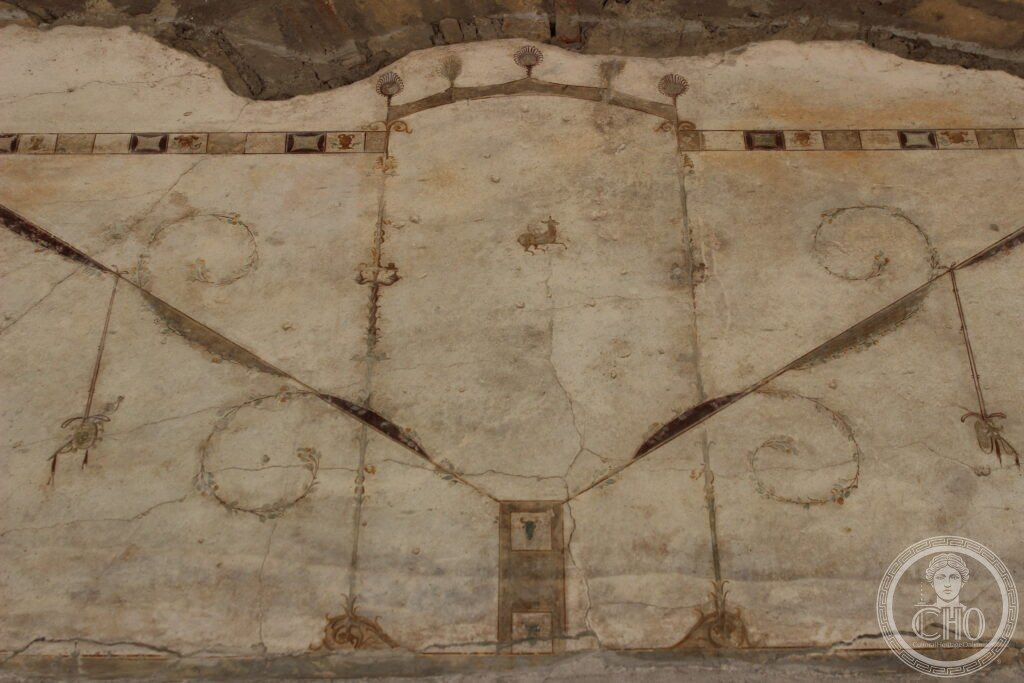
The largest Roman suburban villa ever excavated — 11,000 square metres of rooms, colonnades, and gardens packed around a swimming pool sixty-one metres long — buried under four metres of pumice by the eruption of Vesuvius in 79 CE and preserved so completely that its wall paintings (the finest surviving examples of the Second Pompeian Style) still retain colours that would have been lost to light within a generation if the house had stayed in use.
At a glance
Oplontis (the ancient Roman town of Oplontis, modern Torre Annunziata) is a coastal site 4 kilometres south-west of Pompeii, between Herculaneum and Stabiae on the Bay of Naples. The site contains two separate Roman villas, conventionally called Villa A (the “Villa of Poppaea”) and Villa B (a storage villa); only Villa A is routinely open to visitors. Villa A is the most completely preserved large Roman villa of the Republican and early Imperial period, covering approximately 11,000 square metres in its fully excavated extent.
Oplontis is part of the UNESCO World Heritage Site “Archaeological Areas of Pompei, Herculaneum and Torre Annunziata” (1997, ref. 829), which covers the most extensively excavated Roman urban and suburban sites in the world.
Key facts
- Villa A dimensions: ~11,000 m² excavated extent (probably larger; western sections not yet excavated); approximately 100 rooms; atrium, tablinum, triclinium, multiple oeci, bath complex, service area, two large swimming pools
- Swimming pool (natatio): 17 m × 61 m; the largest known private swimming pool of the Roman world; surrounded by a garden planted with plane trees (root cavities preserved)
- Wall paintings: Second Pompeian Style (c. 50–10 BCE); the most extensive surviving assemblage of this style anywhere; the rooms off the tablinum contain paintings of architectural fantasies (colonnades, tholos temples, stage facades) at life scale, some with theatrical masks, some with garden views through painted windows
- Poppaea Sabina: tradition (attested in an ancient source) associates the villa with Poppaea Sabina (30–65 CE), the second wife of Nero; the connection is not proven archaeologically but is consistent with the villa’s size and its wax tablet records (found in Villa B) naming members of Poppaea’s family
- Eruption: 24 August 79 CE; approximately 4 m of pumice and 2 m of ash covered Oplontis; skeletons of 53 people were found in a room of Villa B (a storage room), where they had sheltered; 1,100 coins and 2.5 kg of gold jewellery found with them (now in Naples museum)
- UNESCO: 1997, ref. 829
- GPS: 40.7539, 14.4337 — Google Maps
History
The site of the villa was first discovered in the sixteenth century during construction work near Torre Annunziata; occasional finds were made in the seventeenth century. Systematic excavation began only in 1964, when a deep trench for the Naples–Pompeii motorway cut through the southern section of the villa and revealed the large swimming pool. Excavation continued intermittently from 1964 to 1984, when the visible extent of Villa A was fully uncovered; further excavations since then have found additional rooms to the east.
The villa was built in the first century BCE (the earliest identifiable structural phases date to approximately 60–40 BCE) on a terraced site above the Sarno plain, facing the Bay of Naples. It was extensively renovated in the first half of the first century CE — the period of the most elaborate wall paintings now visible — and was apparently still undergoing renovation at the time of the eruption in 79 CE (ceramic storage vessels and decorating materials were found stacked in rooms, suggesting ongoing work). The association with Poppaea Sabina, the second wife of Nero (murdered on his orders in 65 CE, two years after which Nero deified her), comes from the Tabula Pompeiana — wax tablets recording a loan transaction by a “Lucius Crassius Tertius” who is described as the vilicus (estate manager) of the estate of “Poppaea Sabina August[a]” — found not in Villa A but in the storage Villa B, which was apparently a separate agricultural estate.
What you see
The visit enters through the service wing (the eastern side) and proceeds through the rooms of the south and central wings before reaching the main rooms (the tablinum and the large oeci off it) and the garden. The tablinum and adjacent rooms contain the most spectacular surviving examples of the Second Pompeian Style wall painting: architectural fantasies at full scale (pilasters, colonnades, receding porticos painted as if they were real architecture, garden scenes visible through painted doorways), in which the artist has created the illusion of looking through the walls of the room into other spaces. The colours — ochre, Pompeian red, Egyptian blue, and a distinctive green-grey — are remarkably well preserved because the eruption buried the site before sunlight could fade them.
The large swimming pool (natatio) is the most impressive single element of the visit: 61 metres long, lined in white plaster, surrounded on two sides by a colonnade (some columns still standing), with marble statues placed at intervals along the edge (some now in Naples, others still in situ as casts). On the east side of the pool, the upper storey of the east wing is visible — a series of cubicles (bedrooms) with windows overlooking the pool.
Gallery
Practical information
- Opening: Varies by season; generally April–October 9:00–19:30, November–March 9:00–17:00. Check current hours at pompeiisites.org (Oplontis is managed by the same organisation as Pompeii).
- Admission: ~€6 (standalone); combined tickets with Pompeii, Herculaneum, Boscoreale, and Stabiae available (~€22 for all 5 sites, valid 3 days). Oplontis is rarely crowded — a significant advantage over Pompeii.
- Photography: Permitted; no flash.
- Duration: 1.5–2 hours for a thorough visit to Villa A. Villa B (the storage villa, not always open) can be visited by request.
- Combination: Best visited in conjunction with Pompeii (4 km south-east, same Circumvesuviana train line); see Oplontis in the morning before the crowds at Pompeii in the afternoon.
Getting there
Via dei Sepolcri, Torre Annunziata (Napoli), Campania. By train: Circumvesuviana (Naples–Sorrento line); stop “Torre Annunziata Oplonti” (30 minutes from Naples Centrale; 15 minutes from Pompeii); the site is 200 m from the station exit. By car: A3 (Naples–Salerno) exit “Torre Annunziata Nord”; follow signs for “Oplontis Villa di Poppea.” From Naples: 25 km, 30 min by Circumvesuviana or 30–45 min by car. From Pompeii: 4 km; 15 min by Circumvesuviana.
Nearby
- Pompei (Scavi) — 4 km south-east; the largest excavated Roman city in the world; 66 hectares, 3,600 rooms open to visitors; UNESCO 1997 (same inscription); allow a full day
- Ercolano (Herculaneum) — 6 km north-west; UNESCO 1997 (same inscription); smaller than Pompeii but much better preserved (buried under 20m of volcanic material, not 4m of pumice); the wooden furniture, food, and fabrics survive at Herculaneum; do not skip if visiting Pompeii
- Vesuvio (Parco Nazionale) — visible from the site; the summit (1,281 m) is accessible by bus from Ercolano; the crater rim is a 30-minute walk from the car park; the view from the rim into the crater and over the Bay of Naples is exceptional
Sources
- UNESCO: whc.unesco.org/en/list/829
- Wikipedia EN: Oplontis
- Clarke, John R.: The Houses of Roman Italy, 100 B.C. – A.D. 250, University of California Press, 1991 (Oplontis pp. 84–96)
- Pompeii Sites: pompeiisites.org
Find it on the map
See this place and what’s around it →📷 Become a Cultural Heritage Online photographer
Share your photos of places: they stay published under your name as the author. The more they're seen, the more you get noticed — and soon a contest will reward the most appreciated photos.
Log in or sign up free to add a photo