
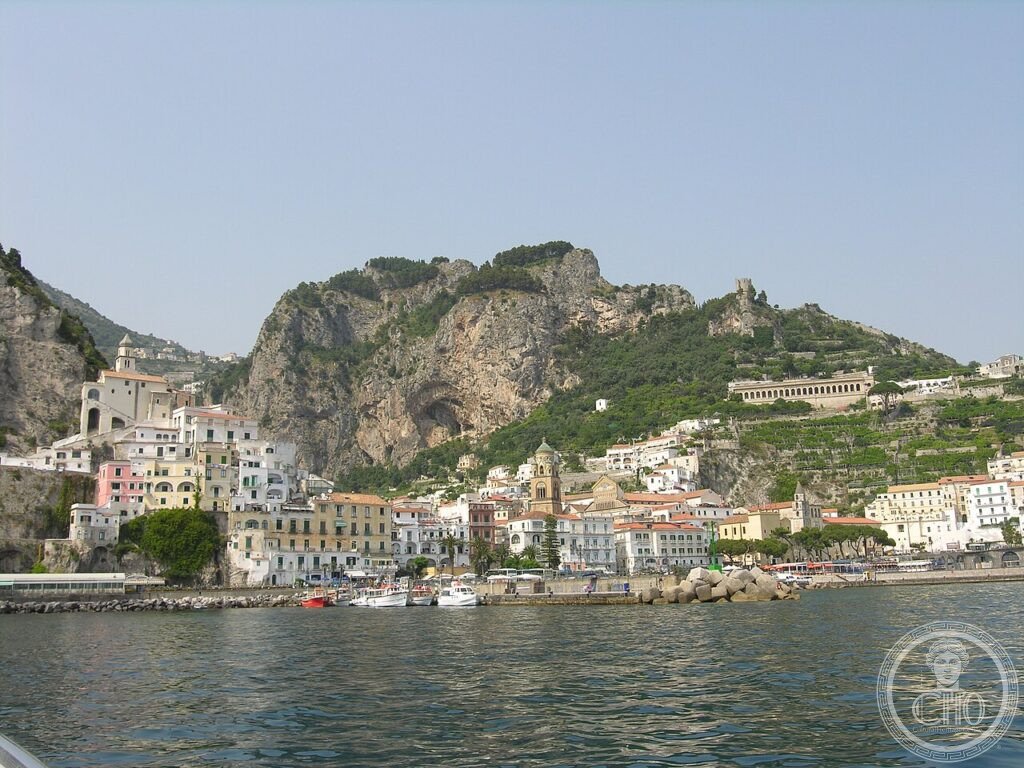
Once the most important port in the Mediterranean — with a fleet of 1,000 ships, consulates in Alexandria, Antioch, Constantinople, and Palermo, and a legal code (the Tabula de Amalpha, 1060) that governed maritime trade from Pisa to Tripoli — Amalfi was reduced to a small coastal town by a combination of Norman conquest (1073), Pisan sack (1135, 1137), and a catastrophic landslide (1343). What remains is a ravine city packed vertically between the sea and a limestone cliff, with a Duomo that collects Arab, Norman, Baroque, and Byzantine elements the way the port once collected cargo from three continents.
At a glance
Amalfi is a small town (population approximately 5,000) on the south side of the Sorrentine Peninsula in Campania, in the province of Salerno. It lies in a narrow ravine where the Valle dei Mulini meets the Tyrrhenian Sea, facing south at the narrowest point of the Amalfi Coast — a 50-kilometre stretch of limestone cliffs, terraced lemon groves, and small coastal towns that is one of the most photographed landscapes in Italy. The UNESCO inscription “Amalfi Coast” (1997, ref. 836) covers the entire coastal landscape from Vietri sul Mare to Positano, a cultural landscape formed by 2,000 years of human occupation, terrace agriculture, and seafaring.
In the ninth to eleventh centuries, Amalfi was one of the four Italian maritime republics (with Venice, Genoa, and Pisa), with a population estimated at approximately 70,000 — comparable to Constantinople — and a commercial empire that reached from Britain to India via the overland spice routes through Egypt and the Arab world.
Key facts
- Amalfi Maritime Republic: independent duchy from 839; controlled trade routes in the Mediterranean from IX to XI century; the Tabula de Amalpha (c. 1060) was the first Italian maritime law code, used as far as Tripoli and Acre until 1570
- Fleet: approximately 1,000 ships at the republic’s peak (c. 1000 CE); consulates in Alexandria, Antioch, Constantinople, Acre
- Conquest: by the Norman Roger II of Sicily in 1073; sacked by Pisa in 1135 and 1137; catastrophic landslide of 1343 destroyed the city centre and buried the lower town under the sea
- Duomo di Sant’Andrea: built from the IX century; the current facade (1891) is a 19th-century reconstruction of the Arab-Norman original; the Chiostro del Paradiso (1266) is a genuinely medieval Moorish-influenced cloister
- Tabula de Amalpha: the oldest surviving Italian maritime code (c. 1060 CE; original in the Museo della Carta); used for maritime commerce in the Eastern Mediterranean until c. 1570
- Carta bambagina (rag paper): Amalfi introduced paper-making to Europe in the XI century, from Arab technique; the Valle dei Mulini (paper mills valley) still has working historical paper mills
- GPS: 40.6341, 14.6027 — Google Maps
History
Amalfi’s rise to maritime power was rapid and unlikely: a small Byzantine duchy on a difficult coast, it developed a commercial fleet in the ninth century that exploited the gap between Byzantine Christian markets in the East and Muslim Arab markets in North Africa and the Levant. The Amalfitan merchants were uniquely positioned to trade between the two: as Byzantine subjects, they were tolerated in Constantinople; as the westernmost Byzantines, they had access to western European goods (wool, timber, iron) that the East lacked. By the year 1000, Amalfitan merchants had founded permanent colonies in Antioch, Alexandria, Cairo, and Jerusalem; the Amalfitan hospice in Jerusalem (founded c. 1048) would later become the Hospital of Saint John and eventually the Knights Hospitaller.
The republic fell in 1073, when the Norman Roger II conquered southern Italy and absorbed Amalfi into the Kingdom of Sicily. The city was sacked by Pisa in 1135 and 1137 (destroying the fleet and the archives); the catastrophic landslide and sea-storm of 1343 (which also destroyed much of Naples harbour) buried the medieval lower town. What survived was a fraction of the republic’s original extent; the population fell from an estimated 70,000 to approximately 5,000 by the sixteenth century, where it has remained.
What you see
Amalfi’s historic centre occupies a strip of land 400 metres deep and 300 metres wide between the sea and the foot of the limestone cliffs. The main piazza (Piazza del Duomo) faces the cathedral staircase (60 steps, visible from the harbour and from approaching boats as the dominant vertical element of the town). The Duomo of Sant’Andrea was built in the ninth century, extended and rebuilt in the eleventh and twelfth centuries (the bronze doors, cast in Constantinople in 1066), and the current facade is a neo-Arabic reconstruction of 1891, built to replace the original which had collapsed in 1861. The interior is an unexpected mix of Baroque (added in the seventeenth century), Gothic, and early Christian elements.
Behind and above the Duomo is the Chiostro del Paradiso (1266) — a genuinely thirteenth-century cloister in the Moorish-Norman style, with interlocking pointed arches in white limestone, fragments of ancient Roman sarcophagi used as garden markers, and a cypress tree at the centre. It is one of the most evocative medieval spaces in southern Italy, particularly at the end of the afternoon when the light comes horizontally through the arches from the west.
Gallery
Practical information
- Duomo di Sant’Andrea: Open daily 9:00–19:00 (summer) / 10:00–17:00 (winter). Admission ~€3 (includes Chiostro del Paradiso and the crypt with the relics of Sant’Andrea). Free for first hour on Sunday morning (mass).
- Museo della Carta (Valle dei Mulini): Historical paper mill, 500 m up the valley from Piazza del Duomo; open April–October 10:00–18:30; November–March Tuesday–Sunday 10:00–15:30. Admission ~€4. Demonstrates historical rag-paper production techniques.
- Limoncello and Sfusato Amalfitano: The Sfusato Amalfitano lemon (IGP protected origin) is longer and less bitter than Sorrento lemons; the local limoncello made from this variety is available in every shop. Delizia al limone (lemon cream pastry) is the local pastry.
- Crowds: Amalfi is overwhelmed by visitors in July–August (cruise ship passengers + day-trippers from Naples + car traffic). Best visited in April–May, September–October, or off-season.
Getting there
Amalfi, Salerno, Campania. By ferry: ALICOST / Travelmar ferries from Naples Molo Beverello (1h45), Salerno (35 minutes), Positano (30 minutes), Capri (55 minutes). By SITA bus: from Sorrento (1h30, SS163 coastal road, very scenic but slow); from Salerno (1h10, bus 5140/5100, frequent). By car: highly discouraged in summer; parking is extremely limited; access restricted to residents; park at Sorrento or Salerno and take ferry or bus. From Naples: 65 km, 1h30 by car (SS163 coastal road) or 1h45 by ferry from Molo Beverello.
Nearby
- Ravello — 6 km uphill; a clifftop village (365m altitude) with Villa Cimbrone (terraced garden with the “Terrace of Infinity”, view over the Gulf of Salerno) and Villa Rufolo (IX century; the wisteria terrace that inspired Wagner’s Parsifal garden; annual Ravello Festival of classical music June–September)
- Positano — 15 km west; the most photographed town on the coast; vertical lanes falling to the sea; the church of Santa Maria Assunta with the Byzantine “Black Madonna” (XIII century); expensive boutiques and hotels
- Paestum — 55 km south-east; three Doric temples (c. 550–450 BCE) standing in an archaeological park north of Agropoli; UNESCO 1998 (ref. 842); the Temple of Hera II is the best-preserved Doric temple in the world outside Greece; the Museo Nazionale with the Tomba del Tuffatore (Tomb of the Diver, 480 BCE, unique Greek fresco outside mainland Greece)
Sources
- UNESCO: whc.unesco.org/en/list/836
- Wikipedia EN: Amalfi
- Kreutz, Barbara: Before the Normans: Southern Italy in the Ninth and Tenth Centuries, University of Pennsylvania Press, 1991
- Comune di Amalfi: amalfi.it
Find it on the map
See this place and what’s around it →📷 Become a Cultural Heritage Online photographer
Share your photos of places: they stay published under your name as the author. The more they're seen, the more you get noticed — and soon a contest will reward the most appreciated photos.
Log in or sign up free to add a photo