
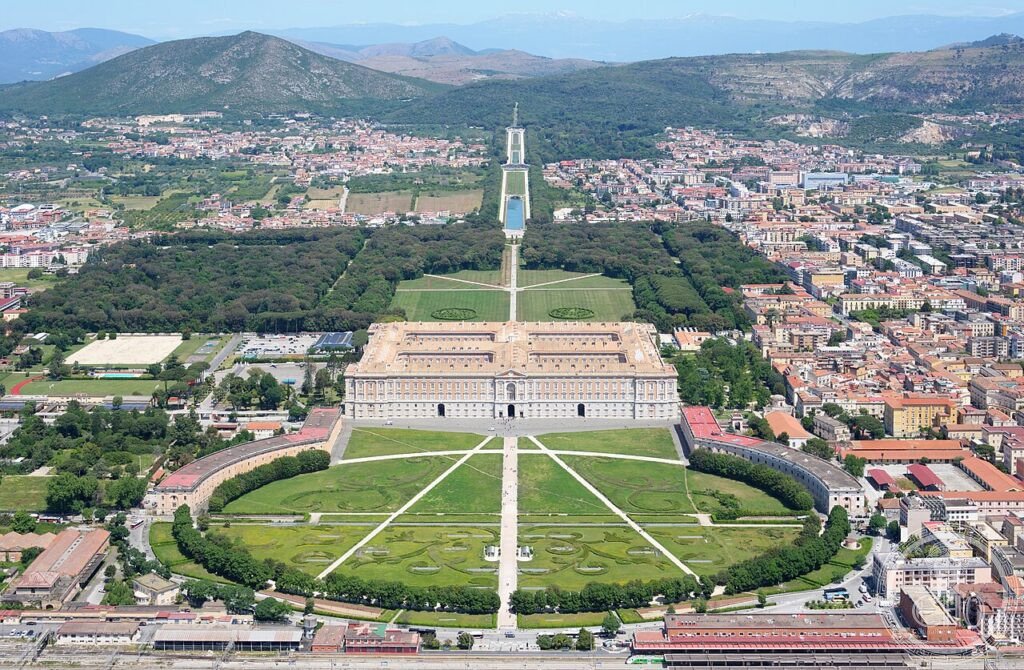
Reggia di Caserta — Il Versailles Italiano: Vanvitelli, i Giardini (3 km) e il Parco Borbonico
The largest palace in the world by volume — 235,000 square metres, 1,200 rooms, 34 staircases, 1,742 windows — built by the Bourbon kings of Naples as their answer to Versailles, and supplemented by a 3-kilometre garden axis that climbs from a formal parterre at the palace to a 78-metre waterfall cascading down a wooded hillside: a piece of artificial geography that makes Versailles look like a garden and Versailles look small.
At a glance
The Royal Palace of Caserta (Reggia di Caserta) is a Bourbon royal residence 35 kilometres north of Naples, in the provincial capital of Caserta in Campania. It was built for Charles VII of Naples (later Charles III of Spain) by the architect Luigi Vanvitelli (1700–1773), beginning in 1752, as the new capital of the Kingdom of Naples — a challenge to the dominance of Rome and Vienna in southern Italian politics, and a deliberate architectural response to the great royal palaces of contemporary Europe (Versailles, the Escorial, Schönbrunn). The palace was substantially completed by Vanvitelli’s son Carlo after Luigi’s death in 1773; the gardens reached their full extent between 1780 and 1845.
The UNESCO inscription (1997, ref. 549) covers the Palace, the Park, and the Aqueduct of Vanvitelli — the 38-kilometre Roman-engineered aqueduct (1753–1762) that supplies the water for the garden fountains and cascade.
Key facts
- Dimensions: 247 m × 190 m × 35 m high; ~235,000 m² floor area (largest in the world by volume among palaces); 1,200 rooms; 1,742 windows; 34 staircases; 5 floors; 4 internal courtyards
- Architect: Luigi Vanvitelli (1700–1773); son Carlo Vanvitelli completed the work after his death
- Garden axis: 3 km from the palace facade to the Grande Cascata; 18th-century hydraulic design using a 38-km aqueduct; seven fountain groups; English landscape garden (added by Carlo Vanvitelli and Queen Maria Carolina, 1780s); silk-producing mulberry plantations
- Grande Cascata: 78 m height; the water falls in two main leaps from a sculptural group of Diana and Actaeon at the top
- Apartments royaux: State apartments (visited); the throne room (Sala del Trono); the court theatre (Teatro di Corte, 1769, modelled on the San Carlo in Naples)
- UNESCO: 1997, ref. 549 — “18th-Century Royal Palace at Caserta with the Park, the Aqueduct of Vanvitelli, and the San Leucio Complex”
- GPS: 41.0736, 14.3260 — Google Maps
History
Charles VII of Naples (son of Philip V of Spain and Elisabeth Farnese; later King Charles III of Spain) came to the throne of Naples in 1734 at the age of eighteen and set about transforming his small, backward kingdom into a major European power. The decision to build a new royal residence outside Naples — on the model of Louis XIV’s Versailles but larger — was made in 1750, when Charles commissioned Luigi Vanvitelli to design the building. Vanvitelli, a Roman-trained architect of Dutch descent (his father Gaspar was a painter; the family name was originally van Wittel), produced a design that deliberately incorporated the lessons of the great European royal palaces: the scale of Versailles, the centralized planning of the Escorial, the Baroque drama of Bernini’s Roman work, and the hydraulic engineering of the great Italian Renaissance gardens.
The foundation stone was laid on 20 January 1752, Charles’s birthday. When Charles left for Spain in 1759 (to become Charles III of Spain), the palace was not complete; work continued under his son Ferdinand IV of Naples. The main building was complete by 1773 (the year Vanvitelli died); the gardens and the English landscape garden were added between 1780 and 1845 under the direction of Carlo Vanvitelli and, later, the English gardener John Andrew Graefer, commissioned by Queen Maria Carolina (daughter of Maria Theresa of Austria) to design the landscape garden in the English manner then fashionable across Europe.
What you see
The palace: the main approach is from the south (the entrance), where a vast rectangular forecourt leads to the eight-column portico. The interior visit covers the Royal Apartments (state rooms, throne room, bedroom suites), the Court Theatre, and the Great Staircase — one of the most theatrical pieces of architecture in eighteenth-century Italy, leading upward in two flights to a colonnaded landing and then to the central vestibule, all in white marble with coloured inlays. The staircase was designed to produce a specific sequence of visual effects as you climb: the columns of the landing first appear as a small, distant group, then expand to enclose you as you reach the top.
The garden: the best way to experience it is to take the shuttle bus (included in the ticket or separately available) to the top of the cascade and walk down the 3-kilometre axis to the palace, stopping at each of the seven fountain groups. This direction — downhill, looking south toward the palace — gives the correct compositional experience that Vanvitelli intended: the palace appears at the end of the axis, framed by jets of water in the foreground, getting larger as you descend. Walking up from the palace is harder and gives a less satisfying compositional experience.
Gallery
Practical information
- Opening: Wednesday–Monday 8:30–19:30 (April–October); shorter hours November–March. Closed Tuesdays. Admission: Palace + Park ~€22; Park only ~€12; combined tickets available. Shuttle bus in the park: ~€3 (recommended for the full garden visit).
- Book online: Booking the timed entry for the palace apartments is recommended in the high season (April–October, especially Saturdays and Sundays).
- Walking distance in the park: 3 km one way; comfortable footwear essential (no cobblestones in the park, but some uphill). The shuttle bus makes stops at each fountain group — validate your ticket before boarding.
- Photography: Permitted everywhere without flash; tripods require a permit.
- Duration: Minimum 3 hours (palace only); 4–5 hours (palace + full garden); allow a full day if visiting the English landscape garden and the San Leucio silk factory.
Getting there
Piazza Carlo III, Caserta. By train: direct from Naples Centrale (Intercity or Regionale; 35–45 minutes; very frequent); the palace is visible from the station exit (200 m). By car: A1/A30 exit Caserta Nord or Caserta Sud; the palace is in the centre of Caserta town. From Rome: 230 km, 2h by car, or 1h15 by Freccia from Roma Termini to Caserta. From Naples: 35 km, 35–40 min by car or direct train. The Reggia is directly opposite the Caserta FS station — the easiest access of any major Italian monument.
Nearby
- San Leucio — 3 km north; the Bourbon silk factory and royal village (bolgia reale), built by Ferdinand IV from 1773; a functioning silk weaving operation still producing fabric for Italian and European institutions; part of the UNESCO inscription
- Napoli Sotterranea + Spaccanapoli — 35 km south; the Greek-Roman underground tunnels (Neapolis, VI century BCE) below Naples; Spaccanapoli (the straight ancient decumanus); Santa Chiara, Gesù Nuovo, and the Duomo with the Cappella di San Gennaro
- Benevento — 45 km east; the Arco di Traiano (114 CE), considered the finest surviving Roman triumphal arch; the Rocca dei Rettori; the Egyptian obelisk of Domitian; the Roman amphitheatre; the Strega liqueur factory
Sources
- UNESCO: whc.unesco.org/en/list/549
- Wikipedia EN: Palace of Caserta
- Chierici, Gino: La Reggia di Caserta, Istituto Geografico De Agostini, 1937
- Reggia di Caserta: reggiadicaserta.beniculturali.it
Find it on the map
See this place and what’s around it →📷 Diventa un fotografo di Cultural Heritage Online
Condividi le tue foto dei luoghi: restano pubblicate con la tua firma come autore. Più vengono viste, più ti fai conoscere — e presto un concorso premierà le foto più apprezzate.
Accedi o registrati gratis per aggiungere una foto