

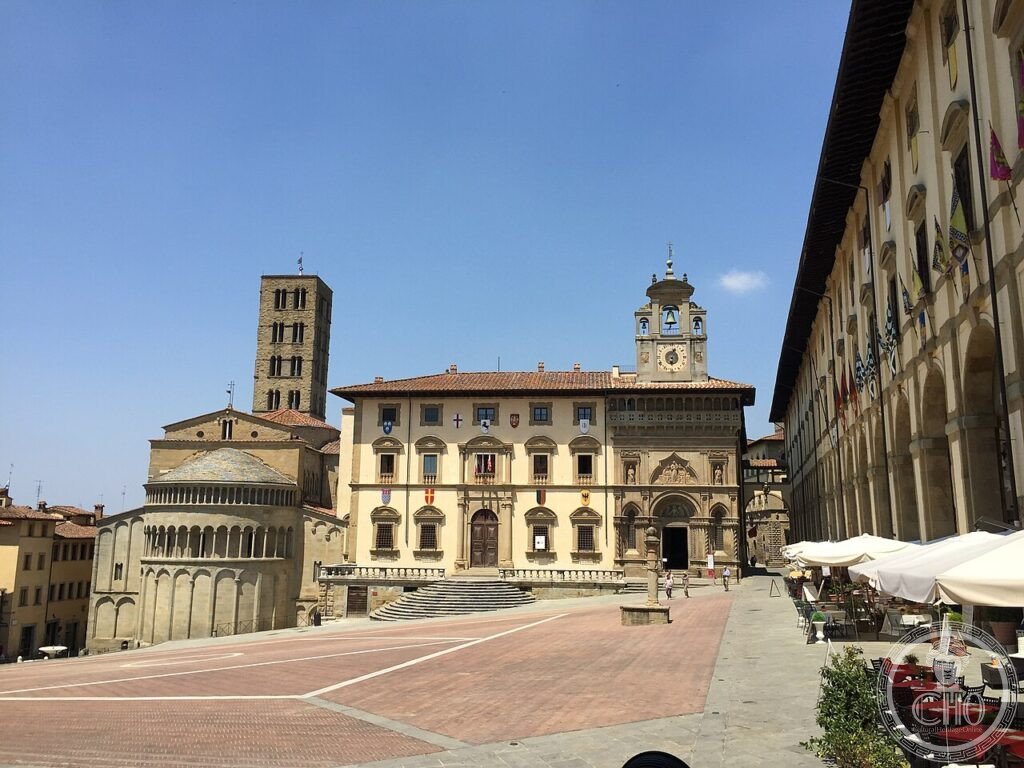
An Etruscan city on a hill above the Casentino and Val di Chiana, famous for three things that span 2,500 years: the Chimera di Arezzo (a bronze Etruscan monster, fifth–fourth century BCE, the archetypal work of Etruscan bronze casting), the Leggenda della Vera Croce (Piero della Francesca’s fresco cycle, 1452–1466, in the choir of San Francesco — one of the most mathematically rigorous and emotionally reserved works of the fifteenth century), and the Piazza Grande (a sloping medieval square with Giorgio Vasari’s loggia and the Antique Fair that has occupied it every first weekend of the month since 1968).
At a glance
Arezzo is a provincial capital in eastern Tuscany, on a hill (296 metres) at the confluence of the Arno valley, the Casentino, and the Val di Chiana. It was one of the most important cities of ancient Etruria (known for its bronze casting, ceramics, and wine); an important Roman municipium (Arretium, known for the red Arretine ware exported throughout the Empire); and a significant medieval commune that produced Guido d’Arezzo (inventor of the musical staff notation, c. 1025), Petrarch (born in Arezzo 1304), Boccaccio (briefly in Arezzo), and Giorgio Vasari (born in Arezzo 1511, author of “Lives of the Artists”).
The city’s two most famous monuments are the fresco cycle by Piero della Francesca in the Basilica di San Francesco (1452–1466) and the Piazza Grande, the sloping medieval square where Vasari’s loggia (1573) meets a variety of medieval and Renaissance buildings at different heights on the slope.
Key facts
- Leggenda della Vera Croce (Piero della Francesca): 1452–1466; choir of the Basilica di San Francesco; 12 fresco scenes illustrating the legend of the True Cross (from Adam to Solomon to Constantine to Heraclius); considered one of the greatest fresco cycles of the Italian Renaissance
- Chimera di Arezzo: V–IV century BCE; Etruscan bronze; lion with serpent tail and goat head on its back; found near Arezzo in 1553; now in the Museo Archeologico Nazionale, Florence; a cast is on display in the Museo Nazionale d’Arte Medievale e Moderna di Arezzo
- Piazza Grande: XII–XVI century; sloping irregular square; the Loggiato di Vasari (1573, Giorgio Vasari) on the north side; the Palazzo della Fraternita dei Laici (XIV–XVI century) to the east; the Palazzo Tribunali (XVI century) to the south
- Giostra del Saracino: medieval joust; held in Piazza Grande in June and September each year since at least the XIV century
- GPS: 43.4673, 11.8801 (Piazza Grande) — Google Maps
History
Arretium was one of the twelve cities of the Etruscan League — a confederation of the principal Etruscan cities that reached its peak of power in the seventh–fifth centuries BCE. The city was known particularly for its bronze casting; the Chimera (found near Arezzo in 1553) and the Minerva di Arezzo (also in the Florence archaeological museum) are the most important surviving examples of Etruscan bronze work. In the Roman period, Arretium was a prosperous municipium; the red Arretine ware (terra sigillata) — thin-walled red-glazed pottery with moulded decoration — was the standard tableware of the Roman Empire from the first century BCE to the second century CE and was exported from Arezzo to Britain, Germany, Egypt, and India.
The fresco cycle by Piero della Francesca was commissioned by the Bacci family (wealthy Aretine merchants) for the choir of the Franciscan church of San Francesco. Work began in 1452 (the commission had been initially given to Bicci di Lorenzo, who died in 1452 after completing only the preliminary decorations) and was completed around 1466. The iconographic programme follows the “Legend of the True Cross” — a popular medieval narrative tracing the history of the wood of Christ’s cross from the death of Adam to the seventh-century emperor Heraclius — in twelve scenes arranged over three registers on the east wall (altar wall) and the two side walls of the choir. Piero’s treatment is notable for its geometric clarity (the figures are monumental and simplified, placed in architectural compositions of great formal rigour), its use of light (the soft even light of a cloudy day, which Piero calculated geometrically), and its emotional detachment (the narrative scenes are presented with an objectivity more characteristic of the documentary than the devotional).
What you see
The Basilica di San Francesco: the fresco cycle occupies the choir (the east end of the church, behind a screen from the nave). Visit is timed and limited to 30 people per session; advance booking is strongly recommended. The main panel (the largest single element of the cycle) is the “Battle of Milvian Bridge” on the lower right of the east wall, where Constantine’s victory over Maxentius is represented as a flat heraldic confrontation of cavalry and standards against a pale blue sky — a deliberate visual contrast with the violence of actual battle that is characteristic of Piero’s approach throughout the cycle. Allow 30–45 minutes in the choir.
The Piazza Grande: the square slopes significantly (approximately 4 metres from north to south over 80 metres of length), which gives it an unusually dynamic sense of perspective: standing at the upper (north) end, the lower buildings appear to recede at an angle, while the Vasari loggia reads as a continuous horizontal element running against the slope. The Antique Fair (Fiera Antiquaria) is held on the first Sunday of every month, when the entire square and adjacent streets fill with antique dealers from all over Italy — one of the most important antique fairs in Europe.
Gallery
Practical information
- Basilica di San Francesco (Piero frescos): Open Monday–Friday 9:00–17:30; Saturday 9:00–17:30; Sunday 13:00–17:30 (winter reduced hours). Admission ~€8. Advance booking mandatory (cappellamaggiore.it or at the church). Maximum 30 people per session; sessions start every 30 minutes.
- Museo Nazionale d’Arte Medievale e Moderna: Open Tuesday–Sunday 8:30–19:30. Admission ~€4. Contains the cast of the Chimera and medieval/Renaissance painting including early works by Vasari.
- Giostra del Saracino: June (third Saturday) and September (first Saturday following 1 September); Piazza Grande; traditional costume; jousting on horseback; one of the most authentic medieval jousts in Tuscany.
- Antique Fair: First Sunday of the month (and preceding Saturday) in Piazza Grande and surrounding streets; free to visit; 400+ dealers; wide range from major pieces to bric-à-brac.
Getting there
Arezzo, Toscana. By train: direct from Florence (55 minutes; frequent; Arezzo is on the main Florence–Rome line); from Rome (2h30); direct or with change from Venice/Milan. The station is at the bottom of the hill, 15 minutes on foot from the Piazza Grande (uphill) or 20 minutes from San Francesco. By car: A1 exit Arezzo; follow signs to Centro Storico. Parking: Piazza Guido Monaco (large; free or paid), Piazza Risorgimento, or Via Guadagnoli. From Florence: 80 km, 55 min by train; 1h by car.
Nearby
- Monterchi (Madonna del Parto) — 25 km west; the only known representation by Piero della Francesca of a pregnant Virgin; detached fresco originally in a local chapel, now in its own dedicated museum in Monterchi; one of Piero’s most moving works
- Sansepolcro — 40 km north-east; Piero della Francesca’s birthplace (born c. 1415); the Museo Civico contains the “Resurrection” (1460s), which Aldous Huxley called “the greatest painting in the world”; also the “Madonna della Misericordia” polyptych (1445–1462)
- Cortona — 30 km south-east; an Etruscan-medieval hill town with one of the best views in Tuscany; the Museo dell’Accademia Etrusca has the Lampadario Etrusco (V-IV century BCE bronze chandelier) and Fra Angelico’s “Annunciation” (c. 1430)
Sources
- Wikipedia EN: Arezzo
- Wikipedia EN: Legend of the True Cross (Piero della Francesca)
- Lightbown, Ronald: Piero della Francesca, Abbeville Press, 1992
- Clark, Kenneth: Piero della Francesca, Phaidon, 1951
Find it on the map
See this place and what’s around it →📷 Become a Cultural Heritage Online photographer
Share your photos of places: they stay published under your name as the author. The more they're seen, the more you get noticed — and soon a contest will reward the most appreciated photos.
Log in or sign up free to add a photo