
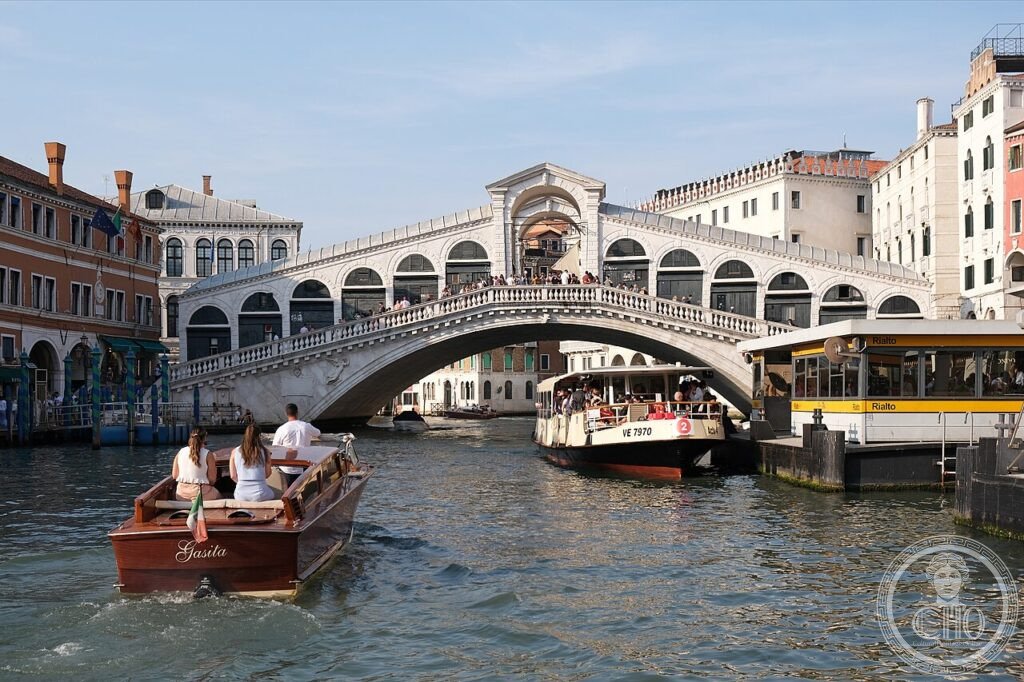
Ponte di Rialto e Mercato di Rialto — Il Cuore Commerciale di Venezia
The oldest of the four bridges across the Grand Canal, completed in 1591 by Antonio da Ponte after a competition that included Michelangelo, Palladio, Sansovino, and Vignola among the unsuccessful candidates — a single white Istrian stone arch of 28.8 metres span, carrying two rows of shops and three walkways across the busiest waterway in Venice, and beside it the oldest and most famous market in the city: the Mercato di Rialto, where Venice has sold fish and vegetables in the same logge since the eleventh century.
At a glance
The Rialto Bridge stands at the narrowest point of the Grand Canal, approximately at its midpoint, in the sestiere of San Polo on the west bank and San Marco on the east. The current stone bridge — there have been earlier bridges on this site since the late twelfth century, all in wood — was designed by Antonio da Ponte and constructed between 1588 and 1591. The competition for the design, held in 1525 and again in the 1550s–1580s, attracted proposals from some of the major architects of the century: Michelangelo, Andrea Palladio, Jacopo Sansovino, and Giacomo da Vignola all submitted designs, all of which were rejected. Antonio da Ponte’s winning design — an apparently conservative single-arch structure — was chosen over Palladio’s (which proposed three arches) partly for structural reasons and partly because the Venetian authorities were unwilling to modify the existing buildings and docks at the base of the bridge.
The bridge is 48 metres long, 22 metres wide, and rises 7.5 metres above the waterline at its crown. The single arch of 28.8 metres span — white Istrian stone, the same stone used for the quays and facades of Venice — rests on approximately 6,000 wooden piles driven into the canal bed on each side.
Key facts
- Construction: 1588–1591; architect Antonio da Ponte; builders: Antonio and Giovanni Contin (nephews)
- Dimensions: length 48 m; width 22 m; single arch span 28.8 m; height above water 7.5 m
- Competition finalists rejected: Michelangelo (c. 1525 proposal), Andrea Palladio (1554 and 1570s proposals), Jacopo Sansovino, Giacomo da Vignola
- Material: Istrian stone (white limestone from the Istrian peninsula; used for all Venetian quays and facades)
- Foundations: ~6,000 wooden piles each side; 12,000 total; oak and elm, preserved by anaerobic conditions
- Shops: 72 shops integrated into the two rows on either side of the central walkway; original function as market infrastructure
- Mercato di Rialto: market active on this site since 11th century; the loggia of the fish market (Pescheria) rebuilt 1907 in neo-Gothic style
- UNESCO: 1987, ref. 394 — “Venice and its Lagoon”
- GPS: 45.4380, 12.3359 — Google Maps
History
The Rialto district (from Rivo Alto, “high bank”) was one of the first areas of the Venetian lagoon to be inhabited — traditionally from 421 CE, though archaeological evidence suggests permanent settlement from the ninth century. The area’s commercial function developed in the eleventh century, when the sestiere of San Polo on the west bank of the Grand Canal became the principal market of Venice: the logge of the Rialto market were built between 1097 and the thirteenth century, and the area remained the commercial heart of Venice until the fall of the Republic in 1797.
The first bridge across the Grand Canal at Rialto was a wooden pontoon bridge, mentioned in 1180. It was replaced by a series of wooden bridges, which repeatedly collapsed or caught fire: the bridge collapsed in 1444 under the weight of crowds watching a procession; it burnt in 1510 during riots; it collapsed again in 1524. The decision to build a permanent stone bridge was taken in the 1520s, but was delayed for decades by disagreements about the design. The competition process in the 1550s–1580s produced a series of famous rejected designs, particularly Palladio’s (published in his Quattro Libri dell’Architettura in 1570), before Antonio da Ponte’s simpler design was finally approved and executed in 1588–1591.
What you see
The bridge is best seen from the water — from a vaporetto or gondola on the Grand Canal — where the geometry of the single arch, the colonnaded galleries on the two sides, and the shops rising above the arch are visible as an integrated composition. From the water, the bridge reads as a triumphal arch straddling the canal, with the white Istrian stone contrasting against the painted plaster facades of the palaces on each bank. The view upstream (toward the Ca’ d’Oro and Cannaregio) is one of the canonical views of Venice; the view downstream (toward the Salute and the lagoon) is equally extraordinary on clear mornings.
On the bridge itself, the experience is more compressed: the central walkway is 10 metres wide, flanked by two rows of souvenir and jewellery shops that have occupied the spaces since the seventeenth century. The lateral walkways (on the outside of the shops, against the parapets) offer views directly down to the water from a height of approximately 6 metres. The best view of the bridge from street level is from the Fondamenta del Carbon on the San Marco side or from the Ca’ d’Oro side on the San Polo bank.
Gallery
Practical information
- Bridge: Always open; free. Extremely crowded at midday in summer; uncrowded before 8:00 and after 20:00.
- Mercato di Rialto: Fish market (Pescheria) open Tuesday–Saturday 7:30–12:30; closed Sunday–Monday. Produce market (Erbaria) open Tuesday–Saturday. The market is authentic and primarily serves restaurants and local buyers; tourist prices are at the peripheral stalls.
- Shops on the bridge: Open daily 9:00–20:00 approximately; mostly souvenirs and jewellery. Prices are tourist-grade.
- Vaporetto view: Lines 1 and 2 stop at Rialto Mercato (west bank) and Rialto (east bank); a single crossing on line 1 (which stops at every station) gives the best view of the bridge from the water, ~5 minutes from either side.
Getting there
Rialto is approximately at the geographic centre of Venice, 15 minutes on foot from Piazza San Marco (via Mercerie) and 20 minutes from the railway station (via Lista di Spagna and the Cannaregio). Vaporetto: Line 1 or 2, stop Rialto or Rialto Mercato. On foot from San Marco: via Mercerie di San Zulian (passing the Clock Tower of San Marco) then across Campo San Bartolomio and Ruga dei Orefici to the bridge — this is the commercial spine of Venice, continuously lined with shops and market stalls. Water taxi: can land at the Rialto riva (dock at Ca’ d’Oro, 100 metres north of the bridge).
Nearby
- Ca’ d’Oro (Galleria Giorgio Franchetti) — 200 m north on the Grand Canal; the most elaborate Gothic palace facade in Venice (1428–1430); inside: Mantegna’s “St Sebastian” and the Franchetti collection of medieval goldsmith’s work
- Campo San Polo — 300 m west; Venice’s largest campo after Piazza San Marco; the site of the annual outdoor film festival in July–August
- Frari (Basilica di Santa Maria Gloriosa dei Frari) — 10 minutes west; Titian’s “Assumption of the Virgin” (1516–1518, in the apse, 690 × 360 cm) and “Pesaro Madonna” (1519–1526); Donatello’s “St John the Baptist” (1452)
Sources
- UNESCO: whc.unesco.org/en/list/394
- Wikipedia EN: Rialto Bridge
- Howard, Deborah: The Architectural History of Venice, Yale UP, 2002
- Palladio, Andrea: I Quattro Libri dell’Architettura, Venezia, 1570 (Book III, rejected Rialto design)
Find it on the map
See this place and what’s around it →📷 Diventa un fotografo di Cultural Heritage Online
Condividi le tue foto dei luoghi: restano pubblicate con la tua firma come autore. Più vengono viste, più ti fai conoscere — e presto un concorso premierà le foto più apprezzate.
Accedi o registrati gratis per aggiungere una foto