

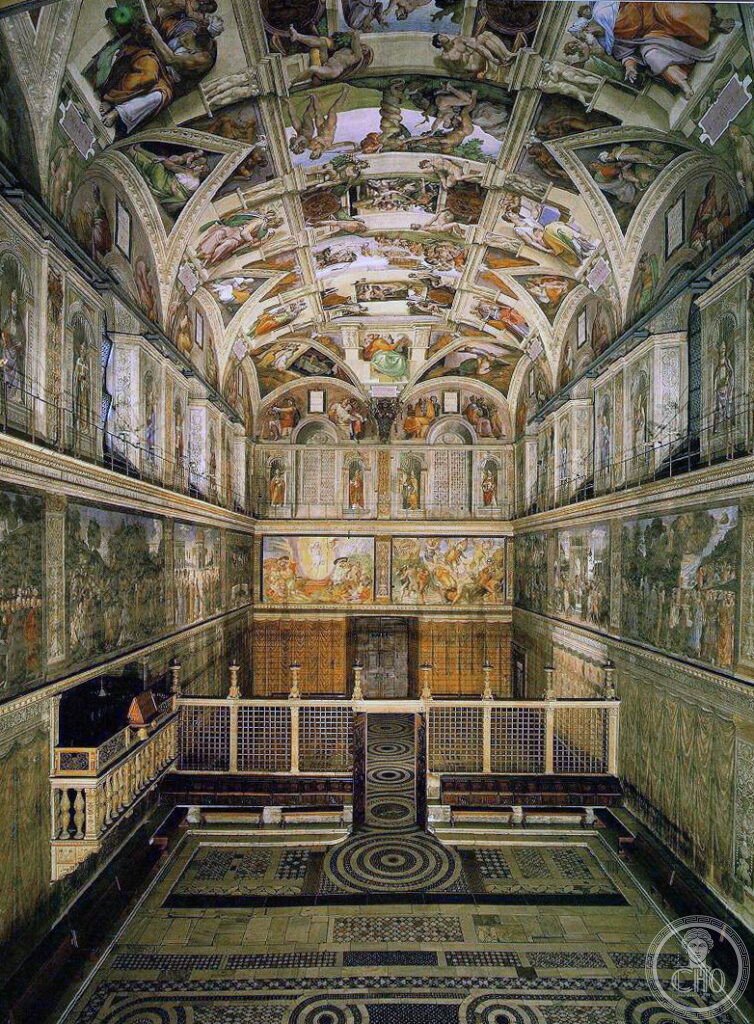
The most important painted space in Western art: a 40-by-13-metre rectangular chapel whose ceiling was painted by Michelangelo between 1508 and 1512 (commissioned by Pope Julius II, completed at the age of 37 after four years on scaffolding), and whose west wall was painted by the same artist between 1536 and 1541 with the “Last Judgment” — together constituting the most concentrated expression of the Italian High Renaissance in a single room, visited by more than five million people annually.
At a glance
The Cappella Sistina is the ceremonial private chapel of the popes in the Vatican Palace complex, built between 1477 and 1480 by Pope Sixtus IV (from whom it takes its name). Its dimensions — 40.93 metres long, 13.41 metres wide, 20.7 metres high — reproduce exactly those of the Temple of Solomon as recorded in the Old Testament. It is the site of the Papal Conclave (the meeting that elects a new pope) and of major liturgical ceremonies of the Catholic Church.
The lower walls were painted in 1481–1482 by a team of the finest Florentine and Umbrian painters of the period: Perugino, Botticelli, Domenico Ghirlandaio, Cosimo Rosselli, and Luca Signorelli — 12 scenes from the lives of Moses and Christ in parallel. Michelangelo was commissioned to paint the ceiling by Pope Julius II in 1508; he completed it in 1512. In 1534, he was commissioned by Pope Clement VII (later Paul III) to paint the Last Judgment on the altar wall; he completed it in 1541.
Key facts
- Chapel construction: 1477–1480, Pope Sixtus IV, architect Baccio Pontelli
- Dimensions: 40.93 × 13.41 m; height 20.7 m; proportions = Temple of Solomon (OT)
- Lower wall frescoes: 1481–1482; Perugino, Botticelli, Ghirlandaio, Rosselli, Signorelli; 12 scenes Moses + Christ
- Ceiling: 1508–1512; Michelangelo; 9 Genesis scenes + 12 Prophets and Sibyls; 4 corner spandrels
- Sistine ceiling area: ~465 m²; approximately 343 figures
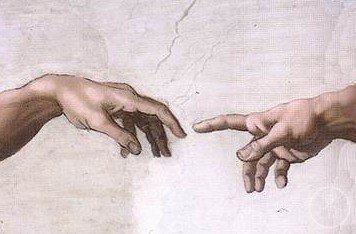
- Creazione di Adamo: the central panel of the ceiling; the most reproduced image in the history of art
- Giudizio Universale: 1536–1541; west wall; 400+ figures; 200 m²
- UNESCO: 1984, ref. 286 — “Vatican City”
- GPS: 41.9029, 12.4543 — Google Maps
History
The decision by Pope Julius II in 1508 to commission Michelangelo for the Sistine ceiling — rather than the specialised fresco painters who had painted the lower walls — was controversial and is still not fully explained. Michelangelo had no significant experience with fresco painting (his major works to date were the Pietà at San Pietro and the David in Florence); he reportedly protested that he was a sculptor, not a painter; and he may have been manoeuvred into the commission by his rival Bramante, who expected him to fail. He did not.
The programme that Michelangelo developed — which went far beyond what Julius II had originally proposed (merely the twelve Apostles in the pendentives) — covers the entire vault with 9 scenes from Genesis (from the separation of light and darkness to the drunkenness of Noah), 12 Prophets and Sibyls in the side bays, the ancestors of Christ in the lunettes, and four large narrative scenes in the corner spandrels (David and Goliath, Judith and Holofernes, the Brazen Serpent, and the Punishment of Haman). Working on scaffolding, painting in a technically demanding medium (buon fresco — painting on wet plaster), Michelangelo completed the approximately 465 square metres of ceiling in four years. The uncovering of the ceiling on 31 October 1512 was immediately recognised as a work of extraordinary quality.
What you see
The visit to the Sistine Chapel is the final destination of a one-way route through the Vatican Museums that takes 45 minutes to 2 hours depending on the pace. The chapel itself is, at first sight, smaller than its fame suggests: 40 by 13 metres, a rectangular room with a barrel vault 20 metres above. Benches run around the perimeter; guards enforce a strictly observed no-photograph policy (in practice not always enforced) and prohibit noise, as the space is technically a sacred place.
The ceiling is best read by lying on a bench or on the floor and looking straight up. From ground level, the perspective foreshortening that Michelangelo used — figures receding into the depth of the painted architectural frame, prophets and sibyls turning in space — reads as intended. The “Creation of Adam” (the ninth panel from the entrance, seventh from the altar) is in the centre of the ceiling, flanked by the other eight Genesis scenes. Standing under it and looking up: the extended finger of God about to touch the extended finger of Adam is at the apex of the barrel vault, 20 metres above the floor.
Gallery
Practical information
- Admission: Covered by the Vatican Museums ticket (~€17–20 online; €20–25 at the door; plus booking fee). No separate Sistine Chapel ticket exists — you must visit the museums to reach the chapel.
- Advance booking essential: museivisatiani.va; queues without a booking can be 2–3 hours in peak season. Book at least 2 weeks in advance for July–August.
- Opening: Mon–Sat 9:00–18:00 (last entry 16:00). Closed Sundays (except last Sunday of the month: free, extremely crowded).
- Dress code: Shoulders and knees covered; the code is enforced at the entrance.
- Time in the chapel: Visitors are not limited; in practice, crowds make 15–30 minutes the typical stay.
Getting there
Vatican Museums entrance: Viale Vaticano, Città del Vaticano (a 10-minute walk from St Peter’s Square, following the exterior Vatican walls north and then east). Metro Line A: Ottaviano, then 15 minutes on foot following signs. Bus: 23, 32, 49 to Lungotevere Vaticano or Viale Vaticano. The entrance queue without booking starts at the corner of Viale Vaticano and Via Leone IV; with booking, use the fast-track lane. Guided tours with skip-the-line access are available from approved operators outside the Vatican Museums entrance.
Nearby
- Stanze di Raffaello (Raphael Rooms) — immediately before the Sistine Chapel in the Vatican Museums circuit; four rooms painted by Raphael and his workshop (1509–1524), including the School of Athens, the most famous compositional drawing in the Western tradition
- Pinacoteca Vaticana — the Vatican picture gallery within the museum complex; Giotto’s polyptych (1320s), Leonardo’s unfinished St Jerome (c. 1480), Caravaggio’s Deposition (1604), Raphael’s Transfiguration (1520)
- Giardini Vaticani — the 23-hectare Vatican Gardens, visible from the dome of St Peter’s; accessible only on organised tours (separate ticket, book in advance)
Sources
- UNESCO: whc.unesco.org/en/list/286
- Wikipedia EN: Sistine Chapel
- Pietrangeli, Carlo et al.: The Sistine Chapel: The Art, the History and the Restoration, New York, Harmony Books, 1986
- King, Ross: Michelangelo and the Pope’s Ceiling, New York, Walker & Co., 2003
Find it on the map
See this place and what’s around it →Historical events at this place (1)
📷 Become a Cultural Heritage Online photographer
Share your photos of places: they stay published under your name as the author. The more they're seen, the more you get noticed — and soon a contest will reward the most appreciated photos.
Log in or sign up free to add a photoIs this page about you?
This page is read by travellers and heritage enthusiasts who find it on Google. Tell us how you are connected to this place and we will take it from there.