

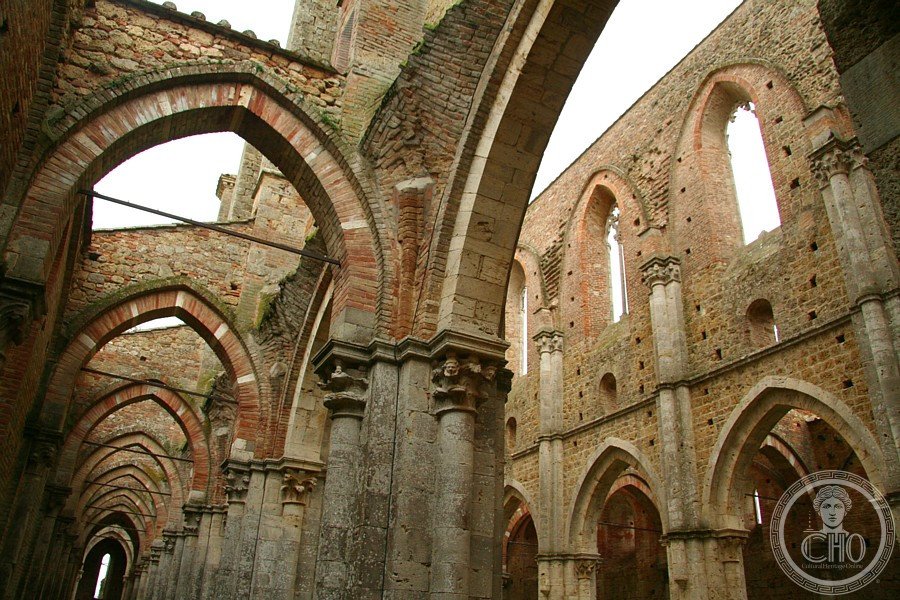
A Cistercian abbey in the Merse valley whose roof collapsed in the eighteenth century, leaving the nave open to the Tuscan sky — the most surreally beautiful ruin in Italy, photographed by everyone from Antonioni to every travel photographer since — and, on the hill above it, the round chapel of San Galgano where a medieval knight’s sword is still embedded in the stone.
At a glance
The Abbazia di San Galgano stands in the Merse valley south-west of Siena, surrounded by farmland in a landscape of gently rolling Crete Senesi hills. The abbey was founded in 1218 by Cistercian monks from the community of Casamari; the church was built between 1218 and 1288 in the Cistercian architectural manner — austere, harmonious, large. In the eighteenth century, lightning struck the bell tower, which fell on the roof of the nave; within a few years the roof had collapsed completely, leaving the walls and columns of the church standing in open air. The abbey was suppressed in 1789.
The result — a large Gothic church nave, open to the sky, its walls intact, the stone columns still in their rows, the lancet windows framing the Tuscan landscape — is one of the most photographed architectural images in Italy. On wet days, the puddles on the nave floor reflect the sky and the arches; in summer, the grass grows between the medieval flagstones.
Key facts
- Foundation: 1218, Cistercian monks from Casamari
- Church construction: 1218–1288 (Gothic, Cistercian)
- Roof collapse: collapsed in the 18th century after a lightning strike; abbey suppressed 1789
- Cappella di Monte Siepi: Rotunda chapel above the abbey, c. 1182; Galgano’s sword embedded in the rock; Lorenzetti frescoes
- Archaeological Park: Managed by the Diocese of Volterra
- Location: Chiusdino (SI), Toscana
- GPS: 43.1623, 11.1742 — Google Maps
History
Galgano Guidotti (1148–1181) was a Sienese knight who, after a vision of the Archangel Michael on Monte Siepi, plunged his sword into a rock as a symbol of his renunciation of military life and became a hermit. He was canonised in 1185, four years after his death — one of the fastest canonisations in medieval church history. The rotunda chapel was built over the rock with the sword in the same period. The sword itself — a genuine medieval iron blade embedded in stone, radiating its hilt above the surface — has been verified by scientific analysis (2001) as an authentic medieval artefact, consistent with the twelfth century. The legend of the sword in the stone predates the Arthurian traditions that popularised it in northern European literature; its Tuscan origin is sometimes argued to have influenced the development of those traditions through the Crusader networks of the twelfth and thirteenth centuries.
The Cistercian abbey was a major institution in thirteenth-century Tuscany — its monks were sought as accountants and financial administrators by the commune of Siena, and the abbey’s water-powered mills contributed significantly to the local economy. After the Black Death (1348), which devastated the abbey’s monastic population, it never fully recovered its earlier prosperity. The decision not to re-roof the church after the lightning strike was partly economic, partly the product of the late-18th-century suppression of monastic institutions.
What you see
The abbey church: the nave walls, 22 metres high, stand intact on three sides; the apse (east end) was partially rebuilt in the nineteenth century for structural stability. The triforium openings — the gallery level between the nave arcade and the clerestory — frame views of the sky and the surrounding hills. On clear days the light is extraordinary: the nave is a vast outdoor room with Gothic proportions and no roof. The nave floor is a mixture of original stone, grass, and puddles; the arrangement changes with the seasons.
The round chapel of Monte Siepi (15 minutes on foot up the hill): a twelfth-century rotunda, the oldest surviving element of the Galgano cult, with alternating bands of white and red brick on the exterior. Inside, the sword projects from the rock at the centre of the chapel floor, surrounded by a glass case (added in the 1990s following an attempted theft). Lorenzetti’s fragmentary fresco of the Virgin and Child (1344) survives on the chapel wall in partial condition. The combination of archaeological authenticity and mythological association makes this one of the strangest and most affecting small sacred spaces in Tuscany.
Gallery
Practical information
- Opening: Daily, all year; hours vary (roughly dawn to dusk for the abbey ruin; the rotunda chapel has its own hours, usually 9:00–17:30).
- Admission: ~€3–5 (small fee for the archaeological park and chapel).
- Duration: 1.5–2 hours for abbey and Monte Siepi chapel.
- Best conditions: Morning light (east-facing apse) or after rain (reflective floor). The abbey is extraordinarily photogenic; allow time.
- Nearby accommodation: Agriturismi in the Merse valley offer vineyard stays.
Getting there
The abbey is 34 km south-west of Siena on the SS73 via Roccastrada or via the SP73 from Brenna. By car: from Siena 40 minutes; from Grosseto 50 minutes; no direct public transport from Siena — a car or hire car is effectively required. By bicycle: a popular Strade Bianche cycling route passes the abbey (the white gravel roads of the Crete Senesi); approximately 80 km from Siena and back. From Florence: 110 km, 1h45 by car.
Nearby
- Siena — 35 km north-east; Piazza del Campo, Palazzo Pubblico, Duomo
- Massa Marittima — 30 km south-west; remarkable late medieval town with Romanesque-Gothic cathedral and “Tree of Fertility” fresco (c. 1265)
- Terme di Petriolo — 15 km south; natural hot springs in a medieval setting (open-access hot water pools on the Farma river bank)
Sources
- Wikipedia EN: San Galgano Abbey
- Maccari, Brunello: San Galgano, Siena, 2001
- Bagnoli, Alessandro: La spada nella roccia (Ambrogio Lorenzetti frescoes study), Siena, 2003
Find it on the map
See this place and what’s around it →📷 Become a Cultural Heritage Online photographer
Share your photos of places: they stay published under your name as the author. The more they're seen, the more you get noticed — and soon a contest will reward the most appreciated photos.
Log in or sign up free to add a photoIs this page about you?
This page is read by travellers and heritage enthusiasts who find it on Google. Tell us how you are connected to this place and we will take it from there.