
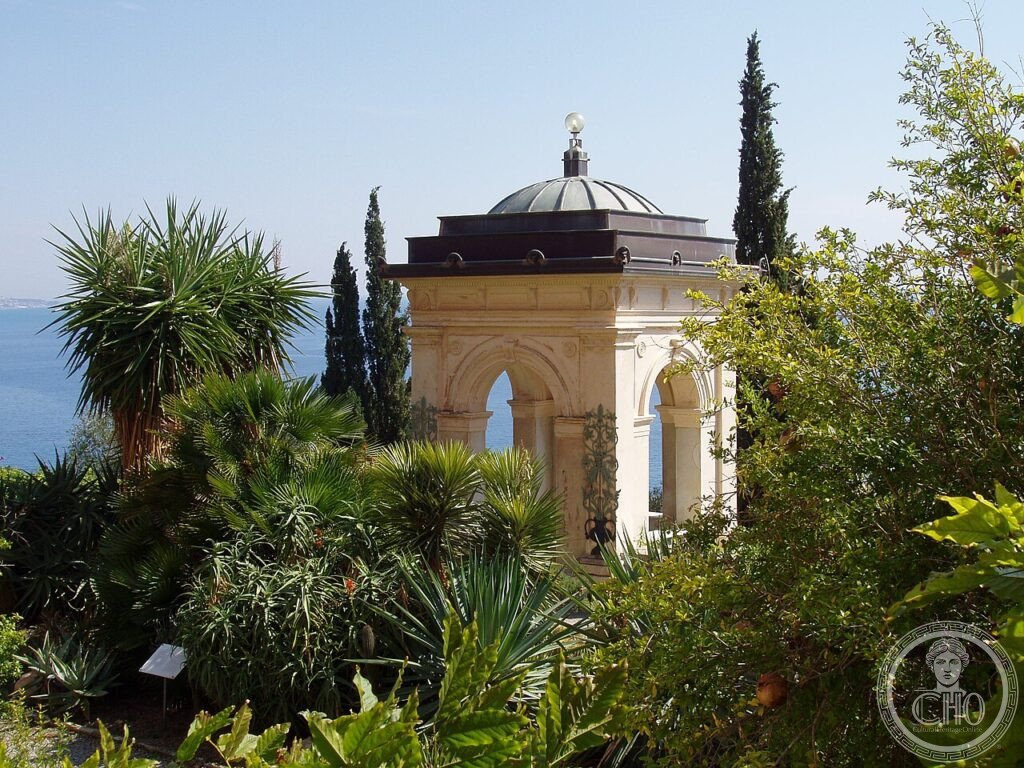
Giardini Botanici Hanbury, Mortola
A nineteenth-century acclimatisation garden on a sea-facing promontory above the Ligurian coast, founded in 1867 by British merchant Thomas Hanbury, where Mediterranean, subtropical, and Southern Hemisphere species colonise twelve terraced hectares overlooking the French border and the open sea.
At a glance
Giardini Botanici Hanbury occupy the Capo Mortola promontory immediately east of the French border, 6 km west of Ventimiglia. Thomas Hanbury, a British merchant who had made his fortune in Shanghai, purchased the property in 1867 and immediately began transforming it into a botanical garden of international importance, importing plants from South Africa, Australia, the Canary Islands, and Central America to test their acclimatisation in the mild Ligurian microclimate.
The gardens passed to the Italian state in 1960 and are now managed by the University of Genova, with FAI involvement in their promotion and restoration. The collection comprises approximately 3,500 species across twelve terraced hectares descending steeply to the sea, making it one of the most diverse Mediterranean botanical gardens in Italy.
Key facts
- Founded: 1867, Thomas Hanbury (1832–1907)
- Area: 12 hectares, 12 terraces
- Altitude: 0–120 m (sea-level to cliff top)
- Collection: ~3,500 species; Mediterranean, subtropical, Southern Hemisphere
- Management: University of Genova + FAI
- Location: Mortola Inferiore, Comune di Ventimiglia, Province of Imperia
- GPS: 43.7770, 7.5080 — Google Maps
History
Thomas Hanbury had accumulated a substantial fortune through his trading house in Shanghai and retired to the Ligurian coast in 1867, attracted by the climate. His brother Daniel, a pharmacist and botanist, advised on the scientific programme; Thomas provided the capital and the collecting energy. Over the following forty years, the garden acquired species from every subtropical climate zone, tested for their behaviour in the Ligurian mild-winter conditions. Hanbury maintained correspondence with Kew Gardens and distributed seeds to institutions across Europe.
Thomas died at Mortola in 1907; his widow Katherine and son Cecil continued the garden until World War I. After periods of neglect during both wars and subsequent to the family’s departure, the Italian state purchased the garden in 1960. The University of Genova took management in 1961 and has maintained it as a research garden and public attraction since, with substantial FAI support for restoration from the 2000s onward. The Roman Via Julia Augusta passes through the lower garden — a reminder that the promontory was used for millennia before Hanbury.
What you see
The garden is experienced as a descent from the entrance at the top of the promontory to the sea. The twelve terraces are connected by stone stairways passing through distinct climate zones: the upper terraces shelter succulents from the Canary Islands and South Africa — euphorbia, aloe, agave — in an open arid section with views across to Monaco. The middle terraces become more lush, with cycads, bananas, palms, and a notable collection of citrus and Old Mediterranean species. The lower terraces approach the rocky foreshore where the Via Julia Augusta crosses a surviving stretch of Roman pavement above the sea.
The pavilion at the centre of the garden — a loggia with ochre render facing south-west — is the postcard image of Hanbury, and the view from its terrace extends over the coast toward Cap Martin and Monte Carlo. The planting is at its most spectacular between February and May, when the almond and mimosa come into flower before the Mediterranean summer heat.
Gallery
Practical information
- Opening: March–October daily 9:30–17:00 (high season to 18:00); November–February Thursday–Monday 10:00–16:00.
- Admission: ~€9 adult; reduced for students and seniors; free for University of Genova and FAI members.
- Duration: 1.5–3 hours; the full descent to the sea and return takes 2h on steep terrain.
- Footwear: Closed shoes essential (stone steps on steep terraces).
- Best time: February–May for flowers; October for Mediterranean autumn colours and reduced crowds.
Getting there
The garden entrance is on the SS1 (Via Aurelia) at Mortola Inferiore, 6 km west of Ventimiglia. By car: from Ventimiglia follow SS1 west toward the French border, ~10 min. Parking is limited at the gate; use the small car park on the SS1. By bus: local bus from Ventimiglia to Mortola Inferiore, ~20 min. By train: nearest station Ventimiglia (Trenitalia, on the Genova–Nice line), then bus or taxi (6 km). From Nice: Montpellier–Ventimiglia TER train (40 min), then bus to Mortola.
Nearby
- Ventimiglia — old town with Roman theatre, 6 km east; Friday market (largest on the Riviera)
- Balzi Rossi caves — Palaeolithic site on the Franco-Italian border, 1.5 km west; collections at Museo delle Origini
- Monaco — 15 km west; Oceanographic Museum + Exotic Garden
Sources
- FAI – Fondo Ambiente Italiano: fondoambiente.it/luoghi/giardini-botanici-hanbury
- Wikipedia EN: Giardini Botanici Hanbury
- Hanbury, Thomas: Papers and correspondence, Kew Gardens Archive, London
- Minghetti, Andrea: Il Giardino Hanbury, Ventimiglia, 2003
Find it on the map
See this place and what’s around it →📷 Diventa un fotografo di Cultural Heritage Online
Condividi le tue foto dei luoghi: restano pubblicate con la tua firma come autore. Più vengono viste, più ti fai conoscere — e presto un concorso premierà le foto più apprezzate.
Accedi o registrati gratis per aggiungere una foto