
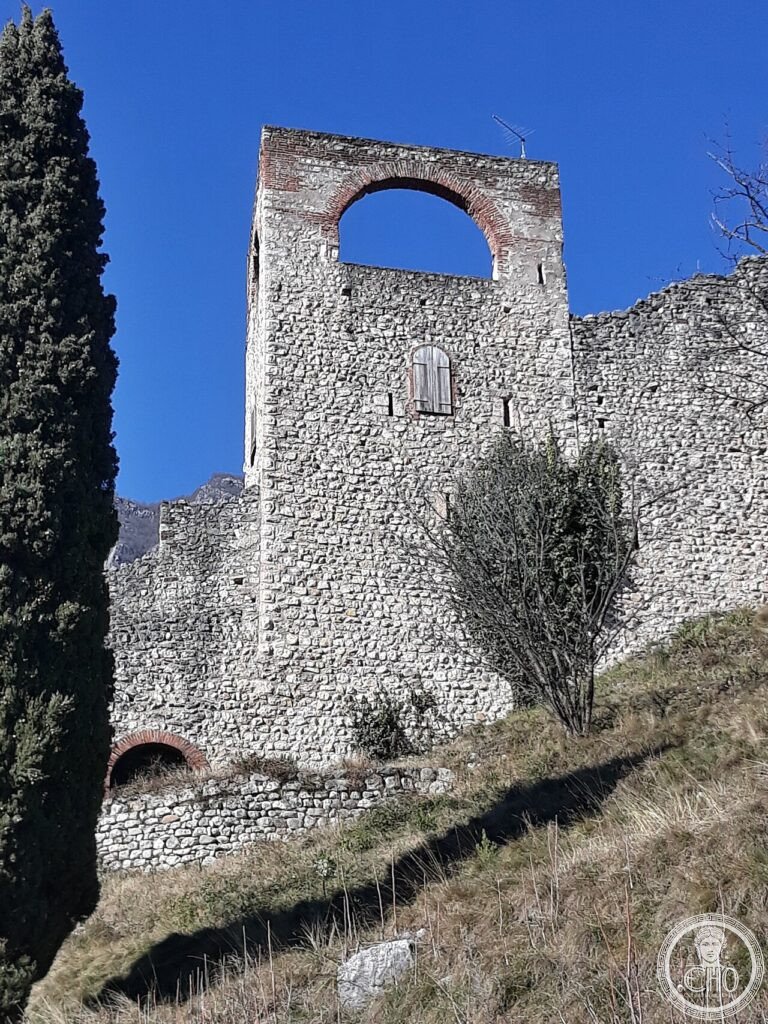
A high medieval castle above the Vallagarina gorge, raised on a limestone spur between the twelfth and fourteenth centuries and preserving a cycle of secular frescoes — jousting scenes and a Garden of Love — that rank among the rarest surviving examples of medieval courtly painting in the Italian Alps.
At a glance
Castello di Avio stands on a rocky promontory at Sabbionara, above the Adige valley south of Rovereto, controlling the main road between Trentino and the Venetian plain. Originally built by the counts of Castelbarco around 1100, it passed to the Venetian Republic in 1411 and was progressively enlarged through the fourteenth century, when the principal residential buildings — the Casa delle Guardie and the Casa dei Galeotti — were constructed with their distinctive painted interiors.
The FAI acquired Castello di Avio in 1977, the first castle ever donated to the Foundation, and has managed conservation and public access ever since. The site receives approximately 40,000 visitors per year and is one of the best-preserved high medieval castle complexes in northern Italy accessible to the general public.
Key facts
- Original construction: c. 1100 CE, counts of Castelbarco
- Fresco cycle: Casa delle Guardie / Casa dei Galeotti, c. 1350–1370
- Venetian period: 1411–1509
- FAI donation: 1977 (first castle donated to FAI)
- Annual visitors: ~40,000
- Province: Trento, Trentino-Alto Adige
- GPS: 45.7283, 10.9264 — Google Maps
History
The castle’s strategic position at the mouth of the Vallagarina gorge — the principal passage between the Brenner route and the Po plain — made it a prize contested between the prince-bishops of Trento, the Scaligeri of Verona, the Visconti of Milan, and finally the Venetian Republic, which held it from 1411 until the Napoleonic reorganisation. The counts of Castelbarco, who founded the castle around 1100, reached their greatest power in the thirteenth and early fourteenth centuries, expanding the fortifications and commissioning the painted halls that survive.
The frescoes of the Casa delle Guardie, attributed to local painters active c. 1350–1370, represent a secular programme exceptional in the medieval Alps: scenes of jousting, battle, and a Giardino d’Amore (Garden of Love) with ladies and knights, closely related to contemporary chivalric literature. This is not religious or dynastic painting — it is decorative secular art for a military residential building, and its survival in such good condition is unusual even by European standards.
After Napoleon’s 1797 campaigns, the castle fell out of military use and passed to various private owners before declining into ruin. Donated to FAI in 1977 by the Doris and Antonio Dell’Angelo family, it underwent a twenty-year conservation campaign before reopening fully in the 1990s.
What you see
The approach follows a path through the vineyard terraces that cover the south-facing slope below the castle — an agrarian landscape essentially unchanged since the medieval period. The castle entrance is through a small keep, with the courtyard beyond. The main frescoed hall — the Casa delle Guardie — is on the upper level; the painted surfaces cover three walls with scenes that reward sustained looking: knights in armour with identifiable heraldry, women in high-waisted gowns, a tournament field, and a garden pavilion. The draughtsmanship is accomplished, the colours still vivid where protected from light.
From the tower of Soccorso at the southern corner, the view extends over the Vallagarina to the vine terraces of Mori and Brentonico, and on clear days to Lake Garda. The scale of the castle is modest — this is a residential and military complex, not a courtly palace — but the combination of frescoed interiors and alpine landscape is striking.
Gallery
Practical information
- Opening: March–November, Tuesday–Sunday 10:00–18:00 (last entry 17:00); closed Monday except public holidays. Check FAI website for winter hours.
- Admission: Standard FAI rates; free for FAI members. Reduced for children and groups.
- Duration: 1.5–2 hours including fresco hall and tower.
- Footwear: Sturdy shoes recommended (unpaved path to entrance, ~300m uphill).
- Shop/café: Small FAI shop at entrance; no café on site. Bar in Sabbionara village (5 min walk).
Getting there
Avio is 8 km south of Rovereto on the SS12 (Brenner–Verona road). From Rovereto: 15 min by car; follow signs to “Sabbionara di Avio” then “Castello”. Parking at the base of the hill (free, small lot). By train: Sabbionara-Avio station on the Rovereto–Verona line (30 min from Verona, 15 min from Rovereto); the station is 2 km from the castle by foot or taxi. From the A22 Brennero motorway: exit Avio/Rovereto Sud, follow SS12 north 3 km.
Nearby
- Rovereto — Museo Storico Italiano della Guerra + MART (museo arte moderna Depero), 8 km north
- Lago di Garda — Riva del Garda, 18 km west
- Palazzo Thun, Calliano — Palazzo Lodron (Castel Beseno), largest castle ruin in Trentino, 12 km north
Sources
- FAI – Fondo Ambiente Italiano: fondoambiente.it/luoghi/castello-di-avio
- Wikipedia EN: Avio Castle
- Castelfranchi Vegas, Liana: Gli affreschi medievali in Italia, Bergamo, 1999
Find it on the map
See this place and what’s around it →📷 Become a Cultural Heritage Online photographer
Share your photos of places: they stay published under your name as the author. The more they're seen, the more you get noticed — and soon a contest will reward the most appreciated photos.
Log in or sign up free to add a photoIs this page about you?
This page is read by travellers and heritage enthusiasts who find it on Google. Tell us how you are connected to this place and we will take it from there.