
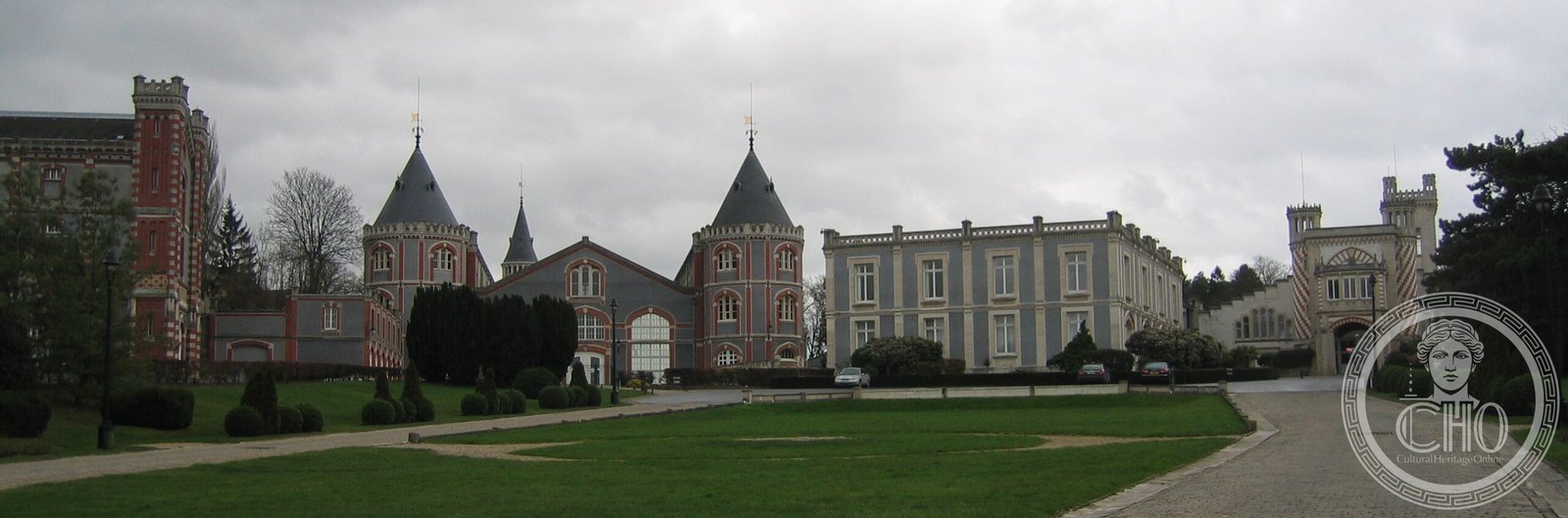
Pommery is the champagne house that invented Extra Brut — the dry, food-friendly style that defines modern champagne — and it did so under the direction of a widowed businesswoman, Louise Pommery, who in 1874 transformed both the taste of champagne and the economic future of a struggling house into one of the most dramatic estates in Reims.
At a glance
Maison Pommery sits on the Butte Saint-Nicaise, a chalk hill on the eastern edge of Reims, where the neo-Tudor Gothic estate designed by architect Gosset rises theatrically above 18 kilometres of Gallo-Roman crayères. The estate is one of the most visually distinctive in Champagne: its castellated buildings, clock tower, and formal courtyards resemble an English country house transplanted to the French countryside — a deliberate aesthetic choice made by Louise Pommery to appeal to her primary export market in Victorian Britain. Since 2002, the cellars have hosted “Experience Pommery,” a programme of large-scale contemporary art installations by international artists, blending viticulture with contemporary culture in an annually renewed exhibition space.
History
The house was founded in 1856 as a partnership between Narcisse Greno, a wine merchant, and Louis Alexandre Pommery, a wool trader diversifying into champagne. Louis Pommery died just two years later in 1858, and his widow Louise Pommery — then 38 years old — took sole control of the business. She proved to be one of the most consequential figures in champagne history. Recognising that the heavily sweetened champagne fashionable at the time was falling out of favour with English consumers, Louise experimented with reducing the dosage (the sugar added at disgorgement) to near zero. In 1874 she released the first commercial Extra Brut champagne, establishing the dry style that would eventually dominate global taste. She also commissioned the construction of the neo-Gothic estate on the Butte Saint-Nicaise, completed in the 1880s, transforming what had been a working warehouse into a showcase destination.
What you see
The estate on the Butte Saint-Nicaise presents a striking neo-Tudor Gothic facade that was inspired by English country architecture — a deliberate tribute to Pommery’s most important export market in the 19th century. The clock tower, arched gateway, and steeply pitched rooflines are complemented by formal courtyards and gardens. On the estate stands the Villa Demoiselle (1904), a listed historic monument in the Art Nouveau style, restored and open to visitors as a cultural space. Beneath the grounds, 18 kilometres of Gallo-Roman chalk galleries — inscribed as UNESCO World Heritage in 2015 — form the cellar network. The largest chamber in the crayères, the Salon des Crayères, has been carved with monumental bas-reliefs and hosts the annual contemporary art installations of Experience Pommery.
Cultural significance
Pommery occupies a rare position as both a technological pioneer and a cultural institution. Louise Pommery’s invention of Extra Brut champagne in 1874 was not a minor product variation — it fundamentally changed what champagne was, establishing the dominant taste profile still preferred today. The estate architecture represents a calculated act of soft power: by building in a neo-Gothic English style, Louise Pommery was communicating directly to her British customers that her champagne was made for them. The Experience Pommery contemporary art programme, launched in 2002, has become one of the most respected site-specific art series in France, with past participants including Pablo Picasso’s estate, Andy Warhol Foundation, and contemporary artists including Huang Yong Ping and Joana Vasconcelos.
Key facts
- Founded: 1856 by Narcisse Greno and Louis Pommery
- Transformation: Louise Pommery took control 1858 after her husband’s death
- Innovation: invented Extra Brut champagne in 1874 — the first commercial dry champagne
- Cellars: 18 km of Gallo-Roman crayères beneath the Butte Saint-Nicaise
- UNESCO: crayères listed 2015 as Champagne World Heritage Site
- Architecture: neo-Tudor Gothic by architect Gosset, 1880s
- Art Nouveau: Villa Demoiselle (1904) — listed historic monument on the estate
- Art programme: Experience Pommery — annual site-specific contemporary art since 2002
Practical information
Maison Pommery offers guided tours of the cellars and estate throughout the year. Standard tours cover the crayères, the Salon des Crayères with its bas-reliefs, and the Experience Pommery contemporary art installation currently on display, concluding with a tasting of two cuvées. Premium tours include access to the Villa Demoiselle and extended tastings from the prestige range. Tours operate in French and English; booking is recommended, especially in summer and during the October harvest season. The estate shop sells the full Pommery range, branded accessories, and merchandise related to the current Experience Pommery artist. The grounds and gardens are partially accessible outside tour hours. Accessibility provisions for mobility-impaired visitors are available on request.
Getting there
Reims is served by direct TGV from Paris Gare de l’Est in under 45 minutes, making the city easily accessible as a day trip from the capital. By car from Paris, take the A4 motorway; the journey takes approximately 1 hour 30 minutes. The Pommery estate on the Butte Saint-Nicaise is located in the eastern quarter of Reims, about 25 minutes on foot from the train station or 10 minutes by taxi. Reims city centre — with its Gothic cathedral, the Palais du Tau, and the Basilica of Saint-Remi (both UNESCO sites) — is an easy walk or cycle from the estate, making Pommery a natural component of a broader cultural itinerary through the city. Several other major champagne houses, including Taittinger and Mumm, are also within the city limits.
Sources & resources
- Maison Pommery official website: pommery.com
- UNESCO World Heritage Centre — Champagne Hillsides, Houses and Cellars: whc.unesco.org
- Experience Pommery contemporary art programme: experiencepommery.com
Find it on the map
See this place and what’s around it →📷 Become a Cultural Heritage Online photographer
Share your photos of places: they stay published under your name as the author. The more they're seen, the more you get noticed — and soon a contest will reward the most appreciated photos.
Log in or sign up free to add a photoIs this page about you?
This page is read by travellers and heritage enthusiasts who find it on Google. Tell us how you are connected to this place and we will take it from there.