
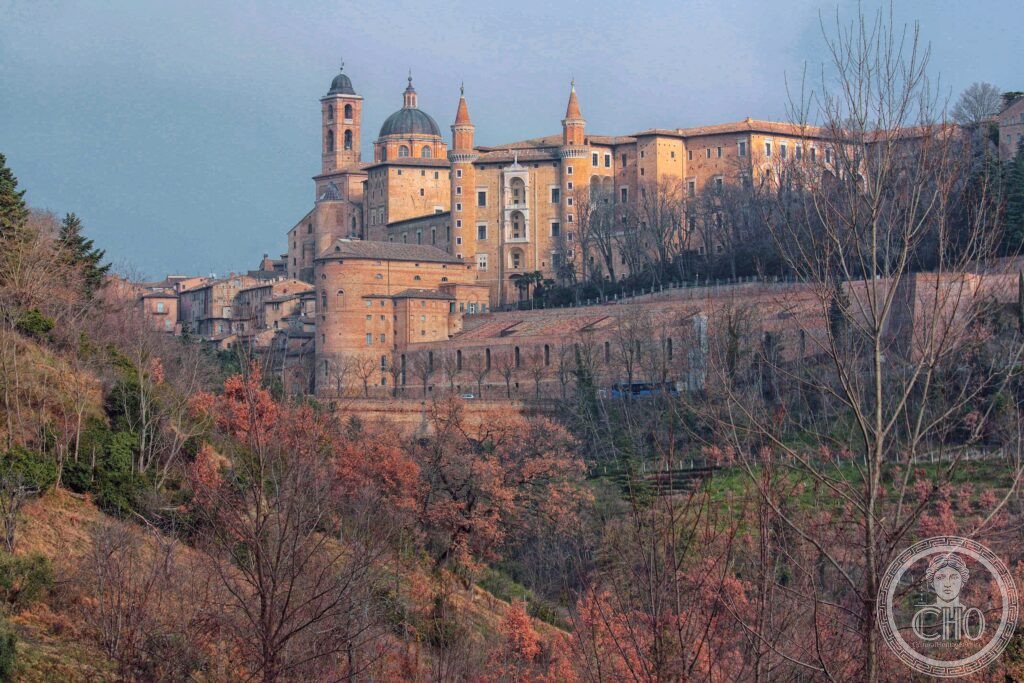
The Palazzo Ducale in Urbino is one of the most complete Renaissance courts to survive in Italy, built by the condottiere-duke Federico da Montefeltro. Behind its twin towers lie Federico’s intarsia study and Piero della Francesca’s Flagellation, still debated by scholars centuries later.
At a glance
Urbino’s historic centre sits on a hill in the Marche Apennines, at 485 metres, and is inscribed on the UNESCO World Heritage List (1998, reference 828) as one of the best-preserved Renaissance towns in the world. At its heart stands the Palazzo Ducale, built between 1450 and 1482 for Federico da Montefeltro, the condottiere who ruled Urbino from 1444 and never lost a battle in more than two decades of command.
Federico was as celebrated for his learning as for his generalship. He read Latin, Greek and Hebrew, played the lute, studied mathematics and astronomy, and assembled a manuscript library second in Italy only to the Vatican’s. That combination of scholar and soldier shaped the palace he commissioned, and above all the small private study known as the Studiolo.
Key facts
- Studiolo: Federico’s private study, roughly 3.6 by 3.4 metres, on the ground floor of the Palazzo Ducale, completed around 1473-1476 with work attributed to Benedetto da Maiano and Giuliano da Sangallo.
- Intarsia technique: the walls are covered in wood inlay using walnut, pear, ash, maple, oak, cherry and beech, creating trompe l’œil scenes without paint.
- The Flagellazione: Piero della Francesca’s panel painting, about 58.4 by 81.5 centimetres, painted around 1455-1460 and held in the Galleria Nazionale delle Marche.
- Architects: Luciano Laurana (c.1420-1479) and Francesco di Giorgio Martini (1439-1501) worked on the palace for Federico.
- UNESCO status: the historic centre of Urbino was inscribed as a World Heritage Site in 1998, reference 828.
History
The Montefeltro had ruled Urbino as a minor lordship since 1234, but it was Federico da Montefeltro who turned it into one of the great cultural centres of the Renaissance. He built his reputation and his fortune as a condottiere, hired successively by the Papacy, by Florence against Milan, and by Naples during the Pazzi War of 1478-1480, gaining a name for never breaking a contract or betraying an employer.
That income funded his court and his library, which at his death in 1482 was the second largest in Italy after the Vatican’s. It passed to his son Guidobaldo I, and after the papal annexation of Urbino in 1631 Pope Alexander VII had the manuscripts transferred to the Vatican Library, where many remain.
Urbino was also the birthplace of Raphael in 1483. His father, Giovanni Santi, was court painter to Federico, and Raphael grew up within the orbit of the Palazzo Ducale before his own career took him elsewhere.
What you see
The Palazzo Ducale spreads across five floors and around 250 rooms. The Cortile d’Onore, laid out around 1470, is admired for the proportions of its stone colonnade, and the twin cylindrical towers of the Torricini on the west front give the palace its best-known silhouette, visible across the town.
Inside, the Galleria Nazionale delle Marche occupies the piano nobile and holds Piero della Francesca’s Flagellazione and Madonna di Senigallia alongside Raphael’s La Muta, painted around 1507. Federico’s Studiolo survives below the state apartments, its walls entirely inlaid with illusionistic bookshelves, musical and scientific instruments, a cupboard with a squirrel peering from a half-open door, and a window opening onto an imagined landscape.
Elsewhere in the town, the Duomo was rebuilt in neoclassical style in 1789 to designs by Giuseppe Valadier and contains the Cappella Albani with works by Federico Barocci. The house where Raphael was born, on Via Raffaello, is now a museum and keeps frescoes attributed to his father Giovanni Santi in its ground-floor rooms.
Practical information
- Galleria Nazionale delle Marche: housed within the Palazzo Ducale; check the official site for current opening times and admission.
- Casa Natale di Raffaello: open to visitors on Via Raffaello; consult the museum’s own channels for hours and tickets.
- Getting around: the historic centre is entirely uphill, with steep streets leading to the rocca at 485 metres, so comfortable walking shoes are advisable. Public escalators run from the Parcheggio Mercatale.
Getting there
Urbino has no direct rail link; the nearest station is Pesaro, around 34 kilometres away, with connecting buses into the town. By road it is about 45 minutes from Rimini. The nearest airport is Ancona Falconara.
Nearby
- Pesaro — about 34 km away, birthplace of Gioacchino Rossini, with a house museum dedicated to him and a civic museum holding Pesaro maiolica from the 15th and 16th centuries.
- San Marino — about 60 km away, the small republic on Monte Titano, with its three medieval towers, Guaita, Cesta and Montale, dating from the 12th to 14th centuries.
Sources
- UNESCO World Heritage List: “Historic Centre of Urbino”, ref. 828
- Clough, Cecil H.: “Federico da Montefeltro: The Good Christian Prince”, Bulletin of the John Rylands Library, 1985
- Field, J.V.: “Piero della Francesca: A Mathematician’s Art”, Yale University Press, New Haven 2005
Find it on the map
See this place and what’s around it →📷 Become a Cultural Heritage Online photographer
Share your photos of places: they stay published under your name as the author. The more they're seen, the more you get noticed — and soon a contest will reward the most appreciated photos.
Log in or sign up free to add a photoIs this page about you?
This page is read by travellers and heritage enthusiasts who find it on Google. Tell us how you are connected to this place and we will take it from there.