
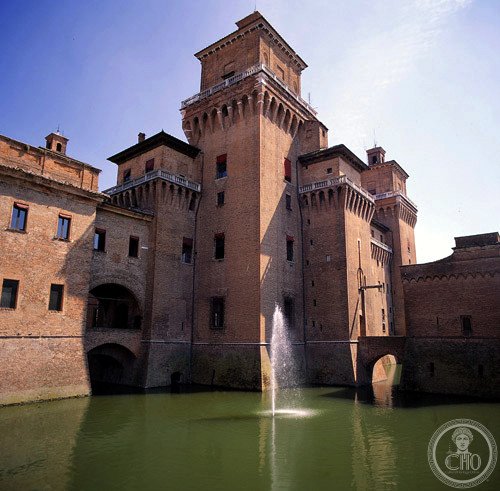
Ferrara — La prima città rinascimentale pianificata d’Europa
Ferrara (UNESCO 1995, rif. 733) è la prima città europea la cui espansione urbana fu pianificata da un singolo architetto: l’Addizione Erculea (1492 CE, Biagio Rossetti) triplicò la superficie di Ferrara con una griglia ortogonale di strade larghe, cortili ariosi e palazzi rinascimentali — un modello che anticipò l’urbanistica razionalista di 400 anni.
At a glance
Ferrara Emilia-Romagna Italy (44.8381 N 11.6198 E UNESCO WHS 1995 reference 733: the most precisely Ferrara zone Emilia-Romagna Italy: the site (the historic centre of Ferrara (the “Ferrara, City of the Renaissance, and its Po Delta”: the UNESCO site was initially inscribed in 1995 for the historic centre of Ferrara; extended in 1999 to include the Po Delta landscape): the Este dynasty (the “Casa d’Este”: the lords of Ferrara from 1264 to 1598 CE: one of the most important Renaissance dynasties in Italy: under the Estensi, Ferrara became one of the cultural capitals of Europe (1450-1550 CE): the Este court attracted: Ludovico Ariosto (1474-1533 CE: author of “Orlando Furioso”, the longest poem in Italian literature: 38,736 verses: written in Ferrara at the Este court); Torquato Tasso (1544-1595 CE: “Gerusalemme Liberata”); Cosmè Tura (c.1430-1495 CE: the founder of the Ferrara School of painting); the humanist Leon Battista Alberti (1404-1472 CE: visited the Este court; his “De Re Aedificatoria” (1452 CE) was the first architectural treatise of the Renaissance)): the Papal period (1598 CE: the Este were expelled by Pope Clement VIII; Ferrara became a Papal State; this ended the golden age of the Este court).
Key facts
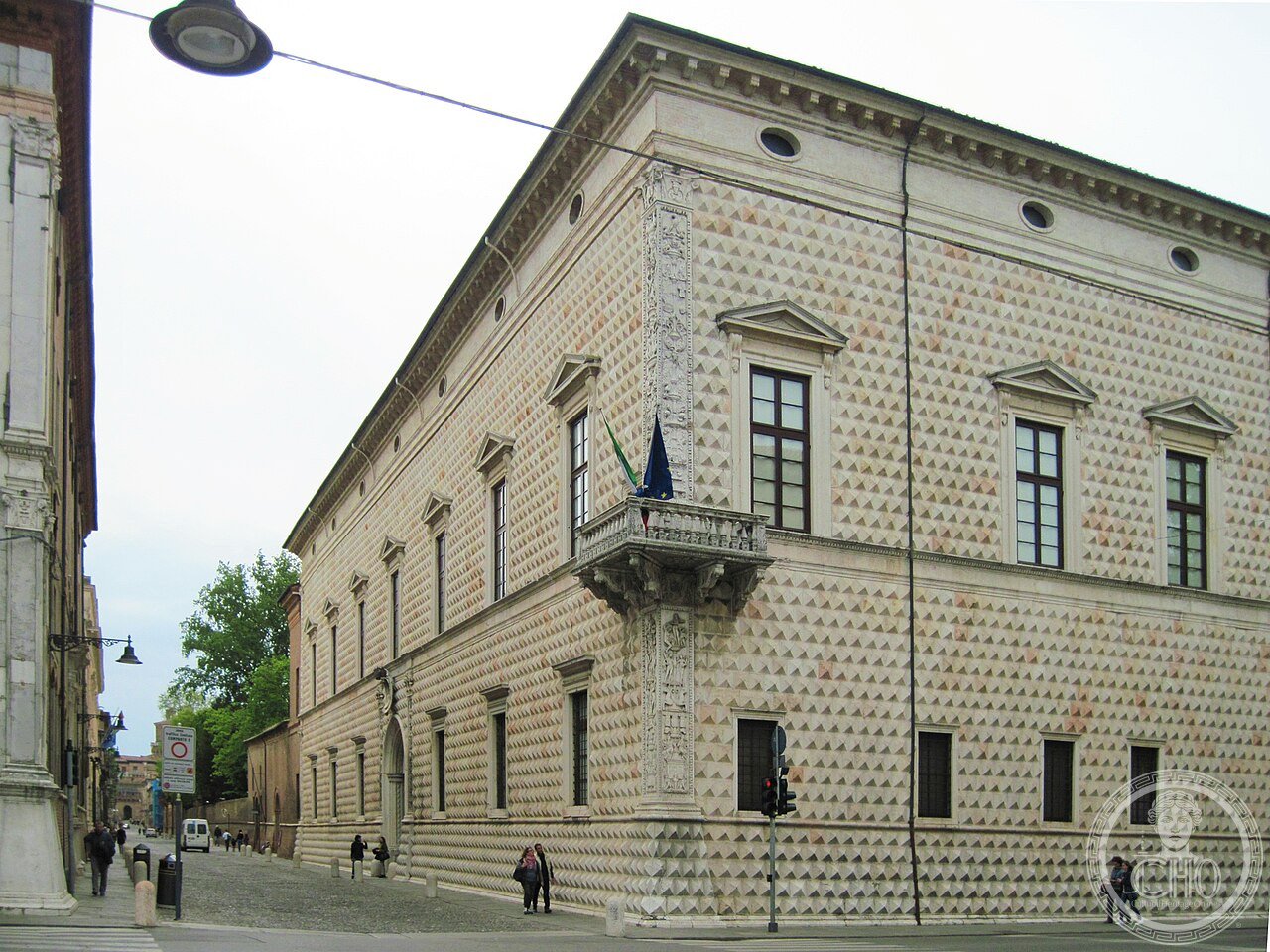
- Palazzo dei Diamanti (1493–1567 CE, Biagio Rossetti e Girolamo da Carpi) e l’Addizione Erculea: the Palazzo dei Diamanti (the “Palace of Diamonds”: named after its façade): the facade (the 8,500 diamond-pointed blocks of white marble that cover the 2 main street-facing façades: each block is cut in a pyramidal shape with a 4-sided diamond point: the arrangement is not a simple grid but a curved arrangement (the blocks are not all aligned in the same direction: some are rotated at different angles, creating a moiré optical effect as the viewer moves along the street): 3 different orientations of blocks were used on the facade; no 2 adjacent blocks are rotated in the same direction: the result is a vibrating, shimmering surface): the purpose (the Palazzo dei Diamanti was originally built as the private residence of Sigismondo d’Este (c.1433-1507 CE), the brother of Duke Ercole I (1431-1505 CE): today it is the seat of the Pinacoteca Nazionale di Ferrara (the national art gallery of Ferrara: works by Cosmè Tura, Ercole de’Roberti, Dosso Dossi, Garofalo — the Ferrara School of painting)): the Addizione Erculea (the “Herculean Addition”: the urban expansion planned by Ercole I d’Este in 1492 CE and designed by Biagio Rossetti (c.1447-1516 CE): the Addizione tripled the area of the medieval city; the new northern quarter was planned as a rationalist grid of wide straight streets intersecting at right angles: Corso Ercole I d’Este (the main axis: 1.2 km long, 25 m wide: running from the Castello Estense to the new northern city walls) × Corso Biagio Rossetti (the cross-axis))
- GPS: 44.8381° N, 11.6198° E (Ferrara centro, Castello Estense)
History
Da Ercole I d’Este 1492 CE a UNESCO 1995 (the most precisely Ferrara history: the Este signoria (the “Signoria degli Este”: Ferrara had been ruled by the Este family since 1264 CE: the longest-running Italian signoria outside the Papacy; Niccolò III d’Este (1383-1441 CE): the reconciler of the Papacy and the Holy Roman Empire (the Councils of Ferrara and Florence: 1438-1445 CE: the attempt to reunite the Eastern (Greek Orthodox) and Western (Roman Catholic) churches: the Greek Emperor John VIII Palaiologos visited Ferrara in 1438 CE): Leonello d’Este (1407-1450 CE: the first humanist ruler in Italy: his portrait by Pisanello (1441 CE) is one of the first realistic portraits of the Italian Renaissance); Borso d’Este (1413-1471 CE: commissioned the “Bibbia di Borso d’Este” (1455-1461 CE): the most richly illuminated manuscript of the Italian Renaissance: 1,200 miniature paintings by Taddeo Crivelli and Franco dei Russi); Ercole I d’Este (1431-1505 CE: the patron of the Addizione Erculea: married Eleanor of Aragon (1450-1493 CE): the commissioner of the first complete opera in history (the “Orfeo” of Angelo Poliziano (1480 CE) was not an opera by modern definition; the “Clizia” of Machiavelli was performed at the Este court; the Este court was the centre of the commedia erudita (the learned comedy))): the Papal annexation (1598 CE: Clement VIII Aldobrandini (1535-1605 CE): the Este male line had died out; the Papacy claimed Ferrara as a “devolved” fief; the Este court moved to Modena; Ferrara never recovered its cultural pre-eminence): the UNESCO inscription (1995 CE, reference 733, for the historic centre; extended to the Po Delta landscape in 1999 CE).
What you see
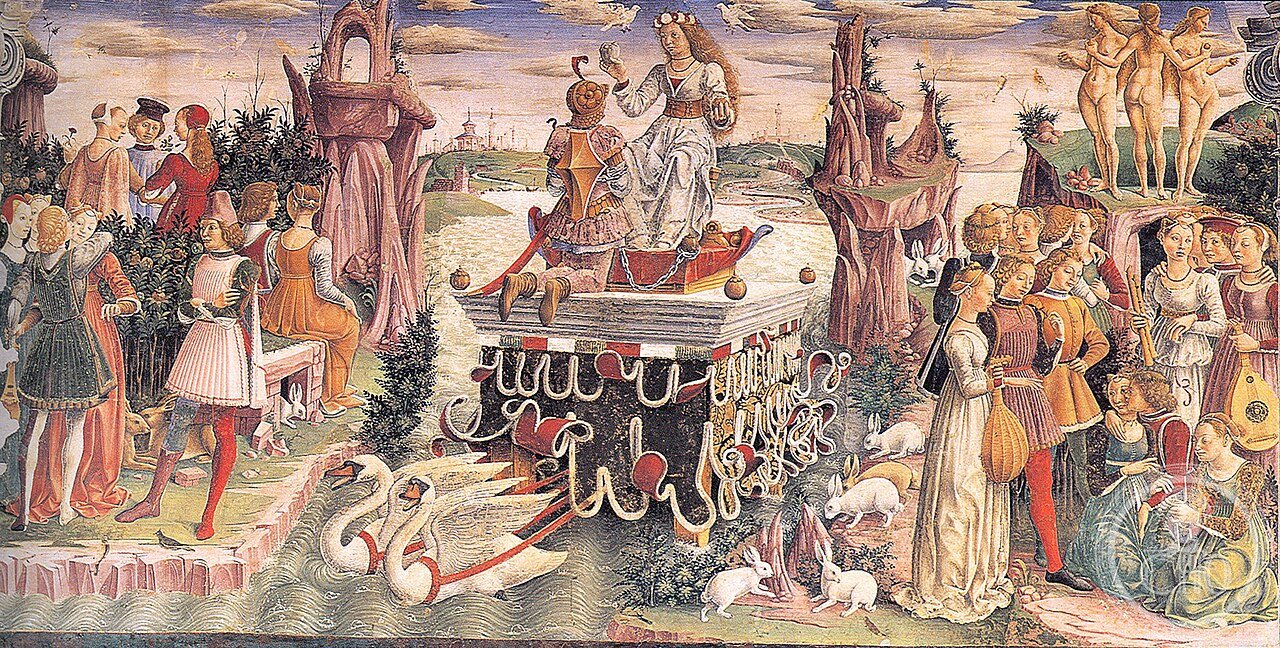
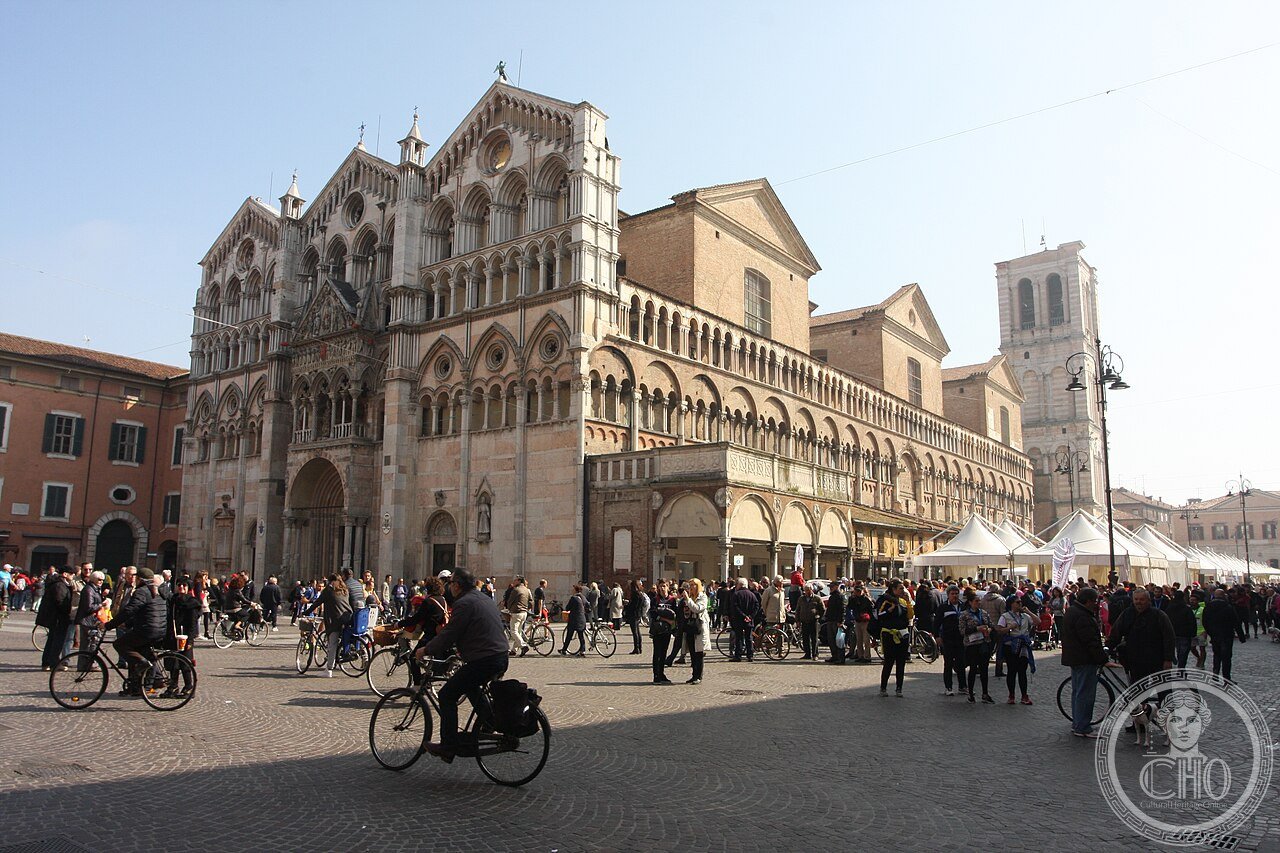
Il percorso di visita: Castello Estense (1385 CE: il fossato; le prigioni; le cucine; il giardino pensile): Via delle Volte (la via medievale con volte di passaggio tra i palazzi: la strada dei commercianti nel XII-XV sec.): Palazzo dei Diamanti (1493-1567 CE: la Pinacoteca Nazionale; la facciata dei diamanti): Corso Ercole I d’Este (l’asse principale dell’Addizione Erculea: Palazzo Prosperi-Sacrati all’incrocio con Corso Rossetti): Cattedrale di Ferrara (1135 CE, Nicolò: la facciata romanico-gotica; il campanile rinascimentale 1451-1621 CE): Palazzo Schifanoja (1385 CE: gli affreschi del Salone dei Mesi di Francesco del Cossa (1469-1470 CE): il calendario iconografico umanista + Palazzo Costabili (1502-1563 CE, Biagio Rossetti: l’incompiuto capolavoro rinascimentale).
Practical information
- Castello Estense: 9:30-17:30 (lun-ven), 9:30-19:00 (sab-dom); biglietto €10
- Palazzo dei Diamanti / Pinacoteca: 9:00-14:00 (mar-dom); biglietto €6
- Bicicletta: Ferrara è una delle città più ciclabili d’Italia (100 km di piste ciclabili in pianura); noleggio bici diffuso nel centro storico
Getting there
Treno da Bologna (25 min, frequenza ogni 30 min): treno da Venezia (1h30): l’aeroporto più vicino è Bologna Guglielmo Marconi (BLQ, 50 km, 45 min di treno fino a Ferrara con cambio a Bologna FS).
Nearby
- Delta del Po (30 km): le valli di Comacchio; le saline; le anguille; il monastero di Pomposa (1063 CE)
- Bologna (50 km): le Due Torri (1109-1119 CE); la Basilica di San Petronio (1390 CE); i Portici (42 km; UNESCO WHS 2021)
- Ravenna (75 km): i mosaici paleocristiani del V-VI sec. CE; UNESCO WHS 1996 (rif.788)
Gallery
Sources
- UNESCO World Heritage List: “Ferrara, City of the Renaissance, and its Po Delta”, rif. 733 (whc.unesco.org/en/list/733)
- Tuohy, Thomas: “Herculean Ferrara: Ercole d’Este, 1471-1505, and the Invention of a Ducal Capital”, Cambridge University Press, 1996
- Solerti, Angelo: “Vita di Torquato Tasso”, Loescher, Torino 1895
Find it on the map
See this place and what’s around it →📷 Diventa un fotografo di Cultural Heritage Online
Condividi le tue foto dei luoghi: restano pubblicate con la tua firma come autore. Più vengono viste, più ti fai conoscere — e presto un concorso premierà le foto più apprezzate.
Accedi o registrati gratis per aggiungere una foto