
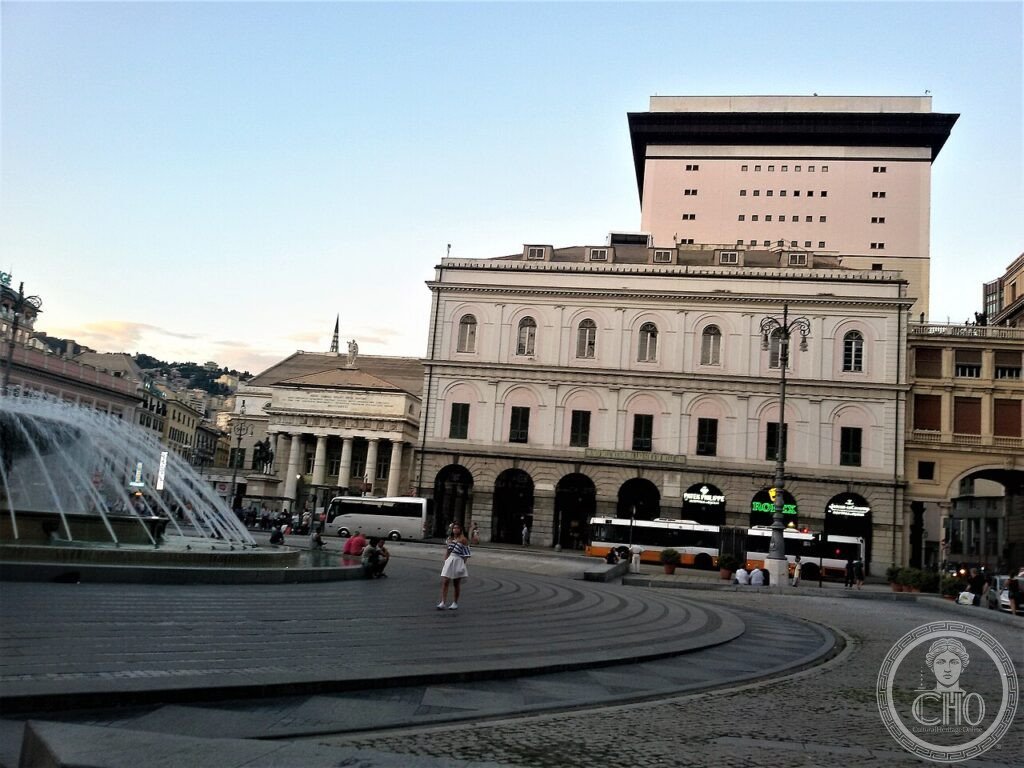
Via Garibaldi and its sister streets form the first planned residential development conceived as a unified architectural system in a European city. Its noble palaces, once drawn by lottery to host visiting dignitaries, still hold the paintings, frescoes and furnishings that made Genoa’s private grandeur famous across Europe.
At a glance
The Strade Nuove are three parallel streets built in Genoa’s historic centre between 1558 and 1583, of which Via Garibaldi, formerly known as Via Aurea, is the principal example. Along with Via Cairoli and Via Balbi they form the first residential street development in a European city planned as a single architectural ensemble.
The palaces along these streets belonged to the Sistema dei Palazzi dei Rolli, a body of noble residences in Genoa graded by quality and listed on rotating registers known as rolli. When a foreign dignitary visited the city, the Republic drew lots from the appropriate register to decide which palace would host them, a lottery known as il bussolo. The system operated between 1576 and 1664 and hosted guests including Philip II of Spain, the Infanta Maria of Spain, Queen Margherita of Austria and Cardinal Barberini.
Key facts
- Architects: Galeazzo Alessi, who moved to Genoa in 1548 and designed Via Aurea along with many of its palaces, working with Bernardino Cantone.
- Key palaces on Via Garibaldi: Palazzo Bianco, Palazzo Rosso and Palazzo Doria-Tursi, the last of which now serves as the city hall.
- Rubens connection: Peter Paul Rubens stayed in Genoa in 1607 and drew the facades and interiors of eighteen Genoese palaces, publishing them in Antwerp in 1622 as Palazzi di Genova.
- Rolli system: the first official rollo was decreed by the Genoese Senate on 9 September 1576; the last was issued in 1664.
- Recognition: inscribed as a UNESCO World Heritage Site in 2006, reference 1211.
History
The Republic of Genoa reached its peak between 1528 and 1797 under the influence of Andrea Doria, when Genoese bankers financed the Spanish Crown and effectively controlled its finances for much of the late sixteenth and early seventeenth centuries. The Palazzi dei Rolli stand as the physical expression of that financial power.
The Strade Nuove project answered the need to expand the city onto the steep hillside once occupied by monasteries and gardens. Galeazzo Alessi designed Via Aurea in 1558 as a straight street cut into the hillside, a sharp departure from Genoa’s winding medieval alleys, known as caruggi. The first palace built on the street was Palazzo Lercari-Spinola, also of 1558, its three-storey facade arranged with a ground-floor loggia for commerce, a piano nobile for the family, and servants’ quarters above. The ensemble was inscribed on the UNESCO World Heritage List in 2006, reference 1211.
What you see
Palazzo Rosso holds a collection built around Rubens and Van Dyck, including two portraits Rubens painted in Genoa in 1606 and 1607, an equestrian portrait of Giovanni Carlo Doria and a portrait of the Marchesa Veronica Spinola Doria. Its piano nobile salone has a frescoed ceiling by Gregorio de Ferrari from 1705.
Palazzo Bianco holds a Caravaggio collection including an Ecce Homo whose attribution is contested, with some scholars assigning it instead to Mattia Preti, alongside six portraits painted by Van Dyck during his two years in Genoa between 1621 and 1622.
Palazzo Doria-Tursi has served as the seat of the municipality since 1848 and houses the Guarneri violin known as Il Cannone, made in 1743 and bequeathed to the city by Niccolò Paganini in 1840. It is played once a year, on 27 October, Paganini’s birthday, by the winner of the Premio Paganini competition. Nearby, the Porto Antico was redesigned by the Genoa-born architect Renzo Piano for the 1992 Columbus Exposition and includes the Bigo, a panoramic lift structure, and the Genoa Aquarium.
Practical information
- Combined ticket: a single ticket covers the three Musei di Strada Nuova, Palazzo Rosso, Palazzo Bianco and Palazzo Doria-Tursi; check the museums’ official site for current prices and hours.
- Best light: Via Garibaldi runs east-west, so the north-facing facades are best seen in the morning.
- Suggested order: visit the three museums in sequence, Palazzo Rosso, then Palazzo Bianco, then Palazzo Doria-Tursi.
- Local food: the Caruggi district between Via San Lorenzo and Via Cairoli is the place for focaccia di Recco and trofie al pesto.
Getting there
Genoa is reached by Trenitalia services from Milan, Turin and Rome, arriving at Genova Piazza Principe; timetables and fares are best checked directly with Trenitalia. Via Garibaldi and the Caruggi are explored on foot from the city centre.
Nearby
- Cinque Terre — about 90 km away, five fishing villages on the Ligurian coast, a UNESCO World Heritage Site inscribed in 1997, reference 826, reached by train from Genova Brignole to La Spezia and then a local connection; the Sentiero Azzurro footpath links Riomaggiore to Monterosso.
Sources
- UNESCO
- Musei di Strada Nuova
- Trenitalia
Find it on the map
See this place and what’s around it →📷 Become a Cultural Heritage Online photographer
Share your photos of places: they stay published under your name as the author. The more they're seen, the more you get noticed — and soon a contest will reward the most appreciated photos.
Log in or sign up free to add a photoIs this page about you?
This page is read by travellers and heritage enthusiasts who find it on Google. Tell us how you are connected to this place and we will take it from there.