
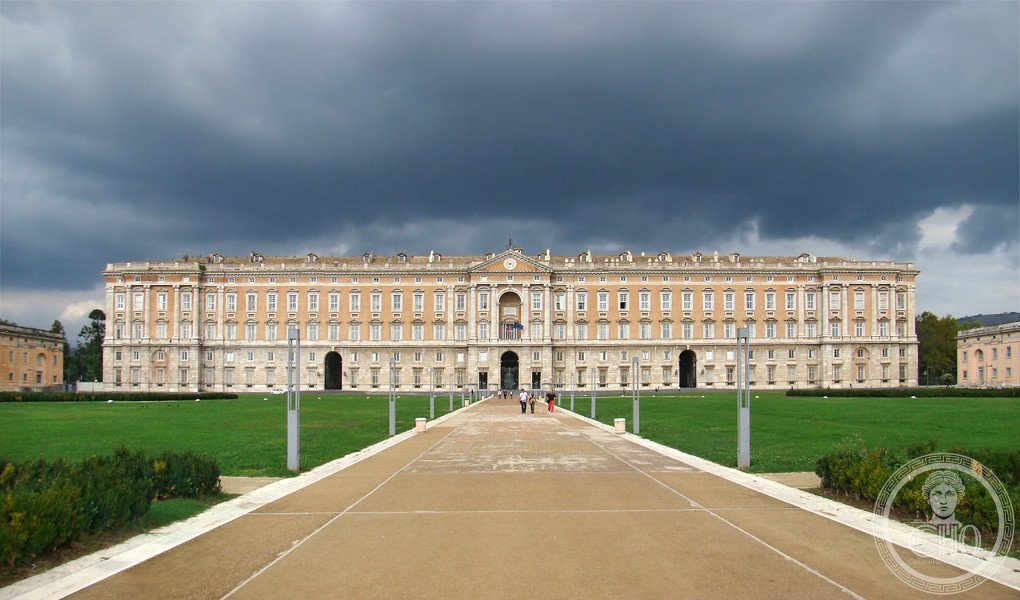
Reggia di Caserta
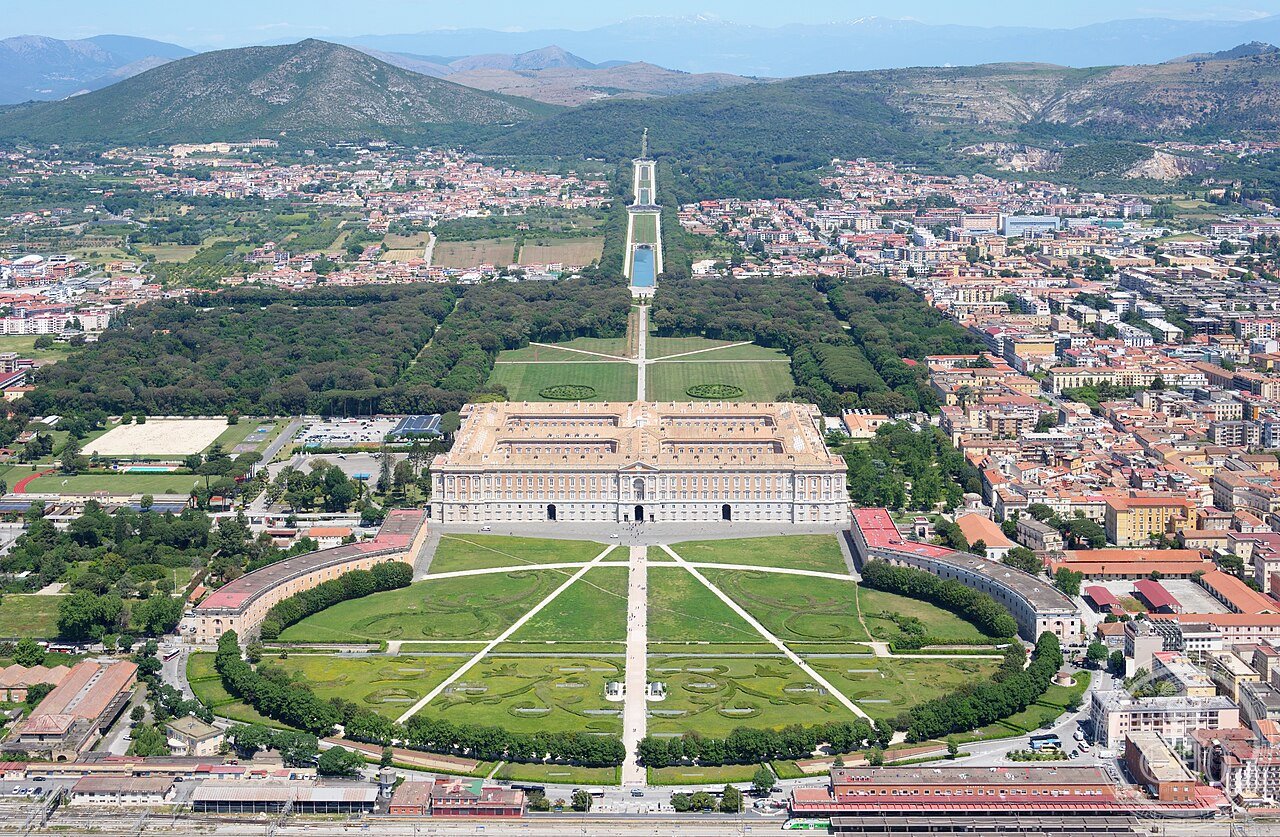
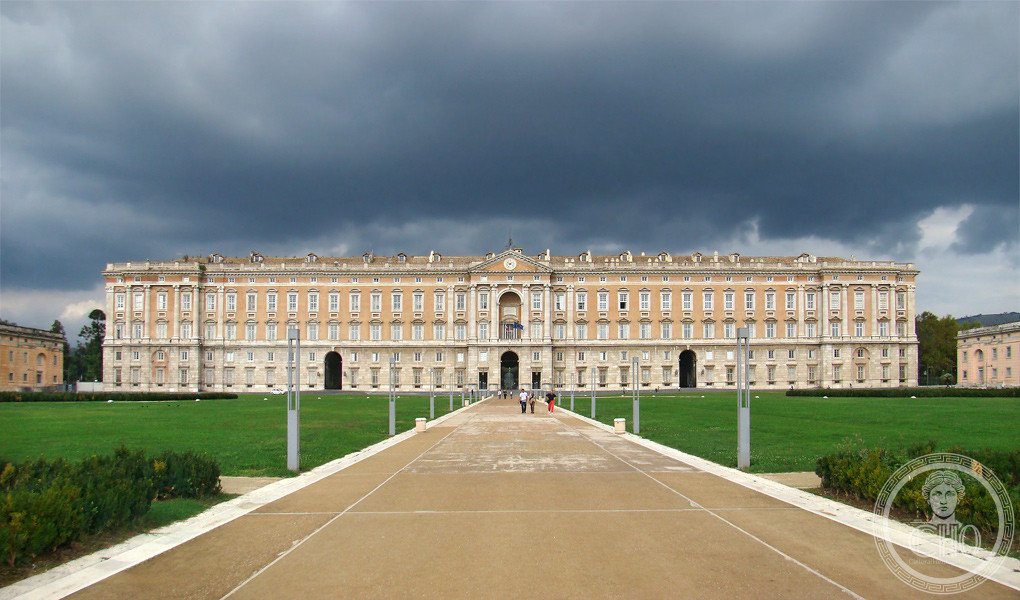
La Reggia di Caserta (UNESCO 1997, rif. 549) è il più grande palazzo reale del mondo per volume — 2.600.000 m³ progettati da Luigi Vanvitelli nel 1752 per Carlo III di Borbone con una cascata di 78 metri, 3 km di parco assiale e un Giardino Inglese che anticipò il paesaggismo romantico europeo.
At a glance
Reggia di Caserta Campania (the most precisely Reggia di Caserta zone Caserta Campania Italy 41.0742 N 14.3239 E UNESCO WHS 1997 reference 549: the site (the Royal Palace of Caserta (Reggia di Caserta): the largest royal palace in the world by volume (2,600,000 m³): ranking: (1) Reggia di Caserta: 2,600,000 m³ (2) Versailles: 2,300,000 m³ (3) Louvre: 1,350,000 m³ (4) Buckingham Palace: 560,000 m³)); the commission (the Royal Palace was commissioned by Carlo III di Borbone (King Charles III of Spain from 1759; King of Naples as Charles VII 1734-1759 CE): the specific commission: in 1751 CE, Carlo III held a competition for the new royal palace of the Kingdom of Naples; the winner: Luigi Vanvitelli (1700-1773 CE; born Napoli; son of the Dutch painter Gaspar van Wittel); the competing architects: Nicola Salvi (the architect of the Trevi Fountain, 1762 CE) submitted a design that was rejected; the foundation stone: January 20, 1752 CE (the 52nd birthday of Carlo III)); the Acquedotto Carolino (the hydraulic infrastructure: the Carolino Aqueduct (Luigi Vanvitelli, 1753-1770 CE): 38 km of underground stone conduit + 3 Roman-style aqueduct bridges (the largest: the Ponti della Valle, 1762 CE: 3 arched tiers, 529 m long, 55 m high: a direct reference to the Pont du Gard of Nimes) from the Fizzo springs (Bucciano, BN; 31 m above sea-level (the spring altitude establishes the hydraulic head for the 78 m waterfall: the 78 m fall height requires the source to be at ≥78 m above the waterfall pool to have positive pressure)).
Key facts
- Il Giardino Inglese della Reggia di Caserta: perché fu il primo giardino all’inglese d’Italia e come Carlo III lo usò come modello diplomatico: the English Garden (the “Giardino Inglese” of the Royal Palace of Caserta: the history (the English Garden was commissioned not by Carlo III but by his son Ferdinando IV of Naples (Ferdinando I of the Two Sicilies; 1751-1825 CE) and designed by the English botanist John Andrew Graefer (1746-1802 CE) on a commission from Maria Carolina of Austria (wife of Ferdinando IV): Maria Carolina was the sister of Marie Antoinette of France and of the Austrian Emperor Joseph II; the design (Graefer’s garden: 24 hectares laid out in the “picturesque” English landscape style (William Kent / Capability Brown school): irregular paths, artificial ruins, exotic plants, a bathing pool with a marble Venus (the “Bagno di Venere”: a pool fed by a natural spring; the marble Venus (1.7 m; workshop of Tommaso Solari; 1780 CE) stands in a grotto above the pool)); the first (the Giardino Inglese of Caserta (1786-1795 CE): one of the earliest “giardini all’inglese” in continental Europe; the first in Italy (the Orti Botanici and the Villa Mansi at Lucca were laid out in the English style after 1800 CE)); the famous visitors (Lord Nelson (1798 CE: Nelson stayed at Caserta as a guest of Ferdinando IV after the Battle of the Nile; he visited the English Garden with Emma Hamilton and declared it “the finest garden in Europe”))
- GPS (Reggia di Caserta, ingresso principale): 41.0742° N, 14.3239° E
History
Da Carlo III 1752 CE al UNESCO 1997 (the most precisely Reggia di Caserta zone history: the construction (the construction of the Royal Palace took 93 years (1752-1845 CE); the principal phases: Phase 1 (1752-1773 CE): Vanvitelli père — the 4 courtyards + the main facade + the grand staircase + the chapel + the theater + the waterfall infrastructure; Phase 2 (1773-1780 CE): Luigi Vanvitelli il Giovane (Carlo Vanvitelli, 1740-1821 CE; the son who continued after his father’s death in 1773 CE) — the completion of the royal apartments + the Palatine Chapel + the Fountain of Diana and Actaeon; Phase 3 (1780-1845 CE): Carlo Vanvitelli + subsequent Bourbon architects — the English Garden, the belvedere, the completion of the carriage museums); the French Revolution aftermath (Napoli 1799 CE: the Parthenopean Republic (January-June 1799 CE) briefly nationalized the palace (the royal family fled to Palermo on December 23, 1798 CE on Nelson’s flagship HMS Vanguard; Nelson played a role in the escape)); the post-unification (after 1861 CE: the palace became state property; during WWII (1943-1945 CE): the Allied headquarters in Italy was established at the Reggia di Caserta (General Mark Clark of the US Fifth Army used the palace as his HQ from October 1943; the German surrender in Italy was signed at Caserta on May 2, 1945 CE (the Instrument of Surrender of the German forces in Italy))); the UNESCO inscription (1997 CE: reference 549 — the Palace + the Park + the English Garden + the Complex of San Leucio + the Carolino Aqueduct).
What you see
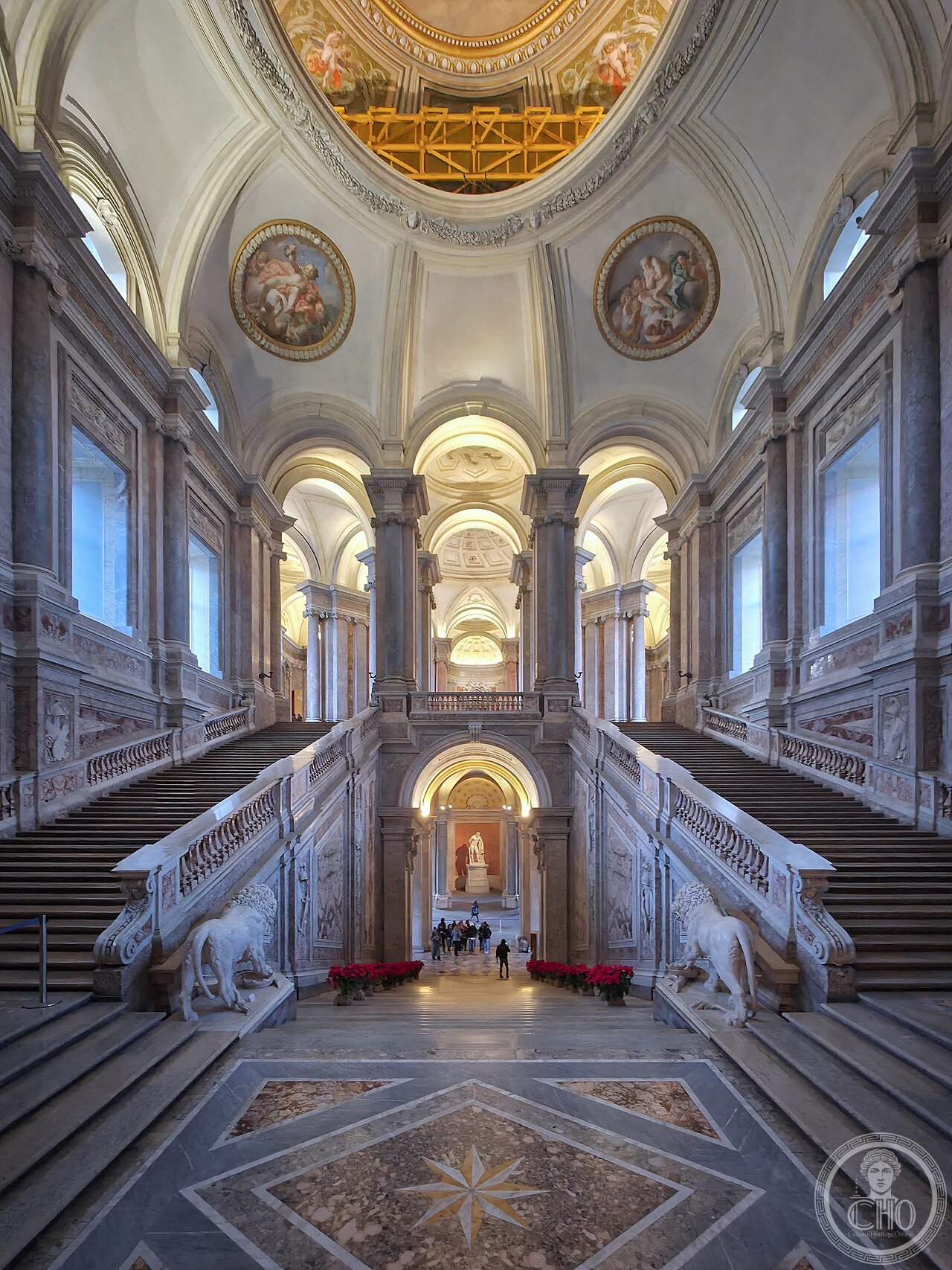
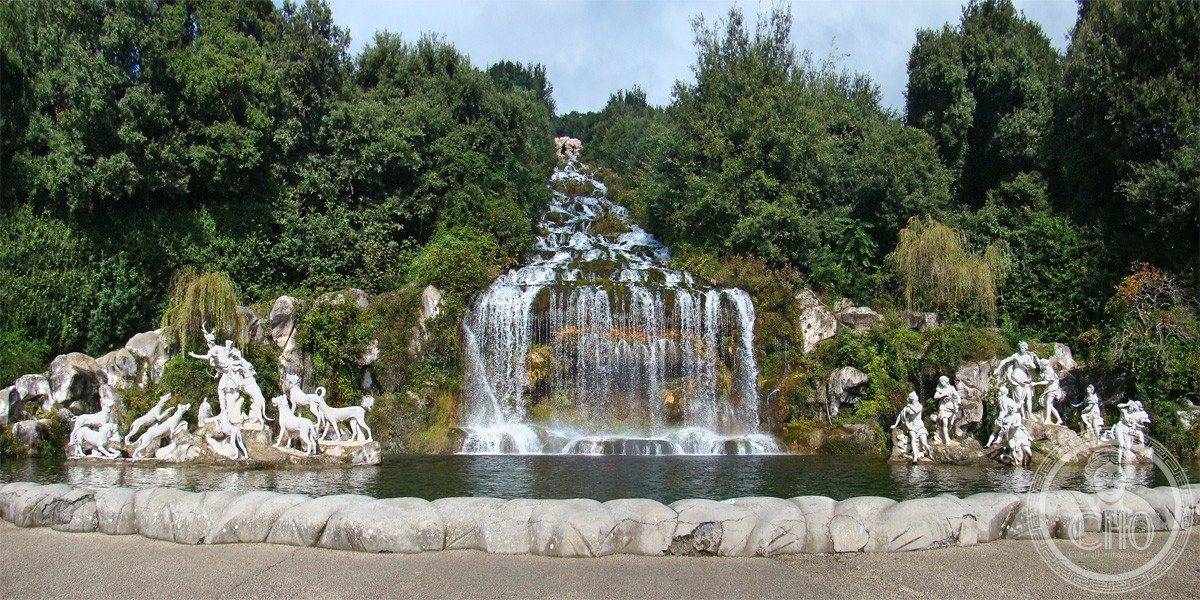
La facciata, lo scalone d’onore, la cappella palatina, il parco, la cascata, il Giardino Inglese (the most precisely Reggia di Caserta zone visit (3–4 hours for the full circuit; the standard visitor sequence): the facade (the north facade: 247 m × 36 m; the limestone from the Mondragone quarry (Caserta Vecchia area); the 5-bay central projection with 4 Corinthian pilasters + attic storey; the royal coat of arms above the central portal); the Grand Staircase (the “Scalone d’Onore”: the showpiece of Vanvitelli’s design (it is located in the center of the 4 courtyards at the principal crossing axis); the staircase dimensions: 41 m × 14 m; 2 ramps of 40 steps each leading to a balustraded landing; the barrel vault (the “volta a botte”: painted by Giuseppe Cammarano (1766-1850 CE) with the allegory of “La Gloria della Dinastia Borbonica” (8 m × 23 m painted surface; 1837 CE)); the Royal Apartments (the 24 state rooms of the 3rd floor north wing: the Sala del Consiglio (the Council Chamber: the inlaid marble floor (opus sectile) in 4 types of marble: verde di Genova, giallo di Siena, portasanta rosso, bianco di Carrara); the Throne Room (39 m × 13 m; the throne dias in carved gilded wood; the floor: 4,000 m² of Neapolitan majolica tiles 1762 CE); the waterfall (the Gran Cascata: 3 km walk from the main palace (or bicycle rental at the park entrance €5/h); the viewing sequence: Fountain of Margherita → Fountain of Eolus → Fountain of Ceres → Fountain of Venus and Adonis → Fountain of Diana and Actaeon (the marble group at the base of the waterfall: Diana transforms Actaeon into a stag (the 9 marble figures; workshop of Gaetano Salomone 1785 CE; the best detail: Actaeon’s face (left profile) mid-transformation, with the first antler erupting from his right temple)).
Practical information
- Come raggiungere la Reggia da Napoli e come organizzare la visita tra palazzo, parco e cascata in una giornata: il trasporto (Napoli Centrale → Caserta: Trenitalia Regionale (40 min; €3.80; ogni 15-20 min); dalla stazione di Caserta: la Reggia è a 300 m (visibile dall’uscita della stazione); il biglietto (il biglietto unificato Reggia (€16 intero; €8 ridotto; gli appartamenti reali + il parco + il Giardino Inglese; aperto 9:00-19:00 mar-dom); la bicicletta nel parco (€5/h al noleggio nell’ingresso del parco): consigliata per raggiungere la cascata (3 km da corsa a piedi; 10 min in bici); la sequenza della giornata: partenza Napoli 9:00 → arrivo Caserta 9:40 → Scalone d’Onore + Cappella + Appartamenti (9:50-12:00) → pranzo alla Caffetteria della Reggia (12:00-12:45) → bici al parco (12:45; noleggio) → Cascata di Diana e Atteone (1h30) → Giardino Inglese (30 min) → rientro 16:30 → treno Napoli 17:10))
Getting there
Trenitalia da Napoli Centrale (40 min, €3.80). Reggia a 300 m dalla stazione. GPS: 41.0742, 14.3239. Biglietto €16 (palazzo + parco + Giardino Inglese). Mart-dom 9 AM–7 PM.
Nearby
- Napoli (UNESCO 1995 rif. 726 — centro storico) — 40 km treno (il centro storico greco-romano-borbonico; la Cattedrale di San Gennaro; la Cappella Sansevero con il Cristo Velato; il Museo Nazionale Partenopeo)
- Ercolano (UNESCO 1997 rif. 829 — Vesuvio) — 45 km (il sito ercolanese è a Ercolano, non Napoli; gli scavi di Ercolano: conservati meglio di Pompei (90% delle strutture originali al di sopra del piano terra); Trenitalia Caserta–Ercolano 1h; €5)
Gallery
Sources
- Wikipedia, Royal Palace of Caserta; Luigi Vanvitelli; Carolino Aqueduct, accessed June 2026
- UNESCO, 18th-Century Royal Palace at Caserta, WHS reference 549, inscribed 1997
- Vanvitelli, Luigi. Dichiarazione dei disegni del Real Palazzo di Caserta. Napoli, 1756 (facsimile: Caserta, 1994)
Find it on the map
See this place and what’s around it →📷 Diventa un fotografo di Cultural Heritage Online
Condividi le tue foto dei luoghi: restano pubblicate con la tua firma come autore. Più vengono viste, più ti fai conoscere — e presto un concorso premierà le foto più apprezzate.
Accedi o registrati gratis per aggiungere una foto