
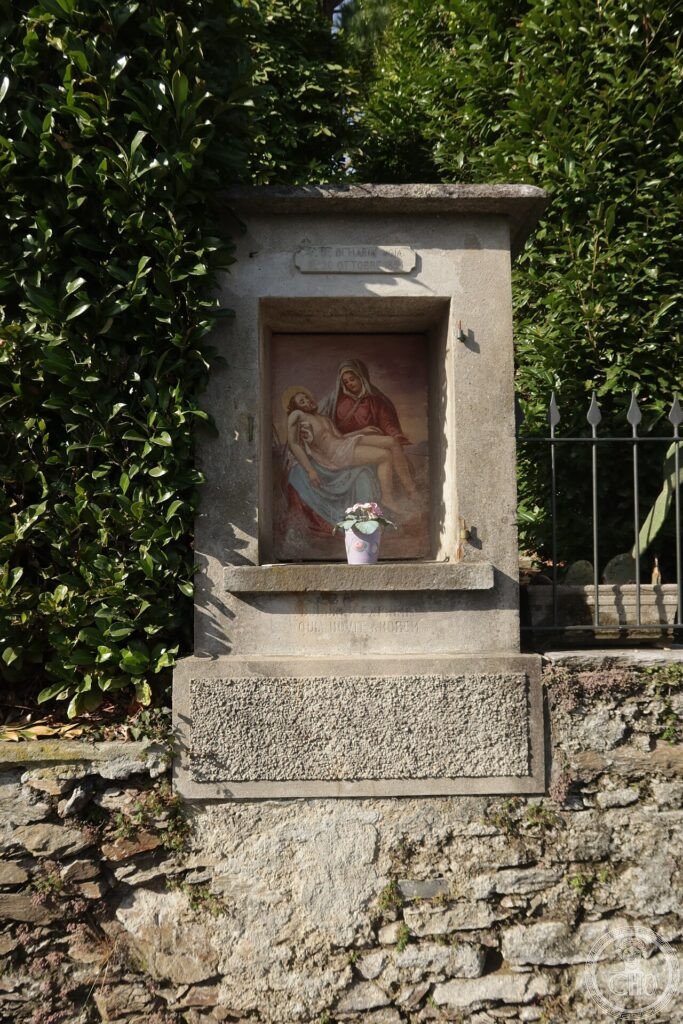
Three chapels stand in an unpaved chestnut wood above Lago Maggiore, reached on foot as pilgrims have done since the early seventeenth century. It is the smallest and, by its own account, the least altered of the nine Sacri Monti of Piedmont and Lombardy inscribed by UNESCO.
At a glance
The Sacro Monte di Ghiffa sits on the slope of Monte Carmine above the lakeside village of Ghiffa, on the western shore of Lago Maggiore. It consists of just three chapels dedicated to the Holy Trinity, a modest number set against the forty-four at Varallo or the twenty at Oropa, but the site is valued precisely for what it lacks: paved paths, electric lighting or any commercial development within the sacred wood.
The chapels form the so-called complesso della Santissima Trinità, with each of the three Persons of the Trinity given its own chapel, a devotional arrangement said to be unusual among the nine Sacri Monti, most of which centre on a single subject such as the Virgin at Oropa or Francis of Assisi at Orta.
Key facts
- Location: Monte Carmine, above Ghiffa, on Lago Maggiore’s western shore
- Founded: 1605, by the Franciscan tertiary Fra Giovanni Battista Zacchetti
- Chapels: three, dedicated to the Trinity, the Passion and the Adoration of the Magi
- Figures: polychrome terracotta statues attributed to the atelier of Carlo Beretta
- Status: part of the serial UNESCO World Heritage listing of the Sacri Monti of Piedmont and Lombardy, inscribed in 2003 (reference 1068)
History
Devotion on this hillside predates the chapels themselves. A will held in the Archivio Notarile di Verbania, dated 1405, records a Ghiffa resident leaving money for what it calls the chapel on the hill, evidence of an older tradition of Marian devotion at the site.
The formal Sacro Monte was founded in 1605 by Fra Giovanni Battista Zacchetti, who had visited the Sacro Monte of Varallo, founded by Fra Bernardino Caimi in 1490, and sought to establish a similar Monte Santo at Ghiffa. He wrote to the Bishop of Novara requesting permission, which was granted in 1601. The first two chapels, the Trinità and the Passione, were completed in 1605, and a third, the Adorazione dei Magi, was added in 1640. The complex was restored in 1760 by the Confraternita di Santa Trinità, a lay brotherhood that had maintained the site since 1620. In 2003 the nine Sacri Monti of Piedmont and Lombardy, including Ghiffa, were inscribed together as a serial UNESCO World Heritage property.
What you see
A waymarked path leaves the village of Ghiffa and climbs through a wood of mature chestnut trees, some estimated at three to four hundred years old, whose canopy closes over the path for much of the year. The path itself remains unpaved, a matter of deliberate policy rather than neglect.
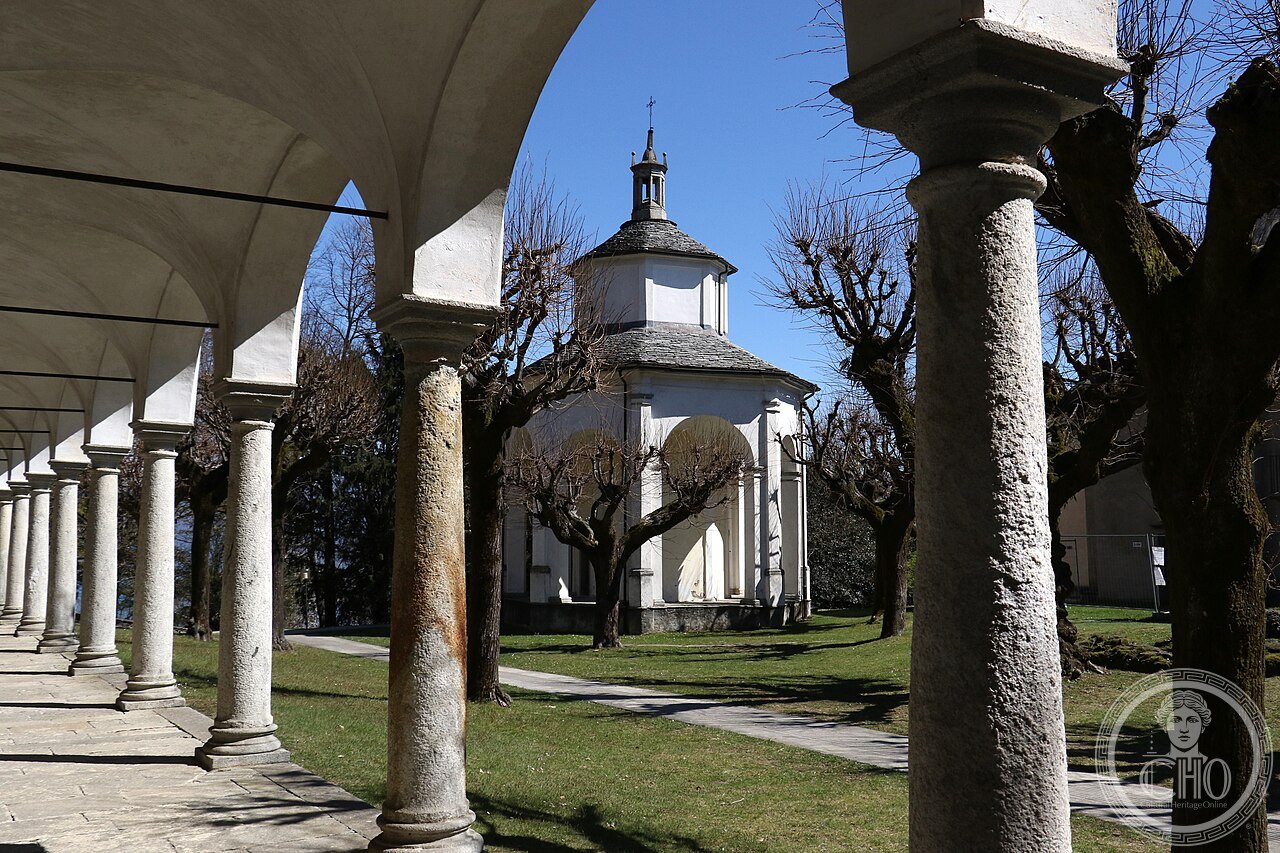
The first and largest chapel, dedicated to the Santissima Trinità, has a plain gabled facade in local grey stone and houses eight polychrome terracotta figures attributed to the Beretta workshop, including a seated God the Father, a crucified Christ and a painted wooden dove suspended from the vault. The second and smallest chapel, devoted to the Passion, contains six figures grouped around the crucified Christ. The third, added later and dedicated to the Adoration of the Magi, holds five figures whose surface paint dates to the eighteenth-century restoration rather than to the original seventeenth-century campaign, a contrast visible against the older paint that survives in protected areas of the figures in the first chapel. From the terrace before the Trinità chapel the view opens south across Lago Maggiore towards the Borromean Islands.
Practical information
- Access on foot: the site is reached only by an unpaved forest path from the village; sturdy, non-slip footwear is advisable, particularly after rain
- Combining with the lake: Ghiffa is served by passenger boats on Lago Maggiore, making it possible to combine a visit with Verbania-Pallanza or other lakeside towns
- Opening arrangements: visitors should check current access and any chapel opening times through the official Sacri Monti or local tourism channels before travelling
Getting there
Ghiffa lies on the western shore of Lago Maggiore and is reached by passenger boat from towns such as Arona or Stresa, or by train to Stresa followed by a short ferry crossing. From the village a marked path leads up through the woods to the chapels; there is no vehicle access to the site itself.Nearby
- Verbania-Pallanza — a short boat trip along the shore, with the botanical Giardini di Villa Taranto
- Stresa — lakeside town with connections to the Borromean Islands
- The other Sacri Monti — Ghiffa forms part of the same UNESCO serial listing as Varallo, Orta, Oropa, Varese, Ossuccio, Crea, Domodossola and Belmonte
Sources
- UNESCO
- Soprintendenza ai Beni Culturali del Piemonte
- Archivio Notarile di Verbania
- Archivio Storico di Intra
- Confraternita di Santa Trinità archive
Gallery
Find it on the map
See this place and what’s around it →📷 Become a Cultural Heritage Online photographer
Share your photos of places: they stay published under your name as the author. The more they're seen, the more you get noticed — and soon a contest will reward the most appreciated photos.
Log in or sign up free to add a photo