

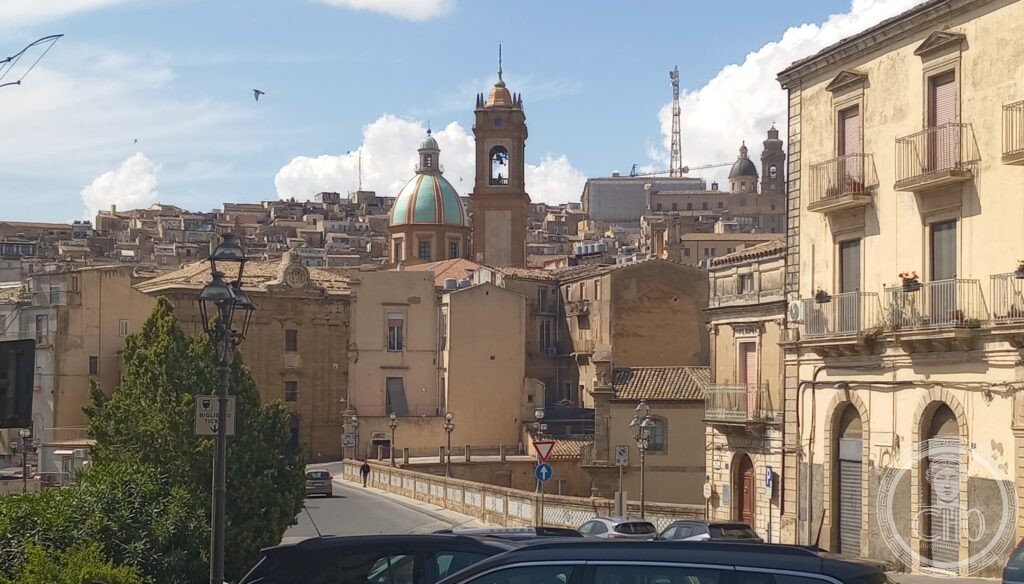
A staircase of 142 glazed steps climbs through the heart of Caltagirone, each one decorated by a different local ceramicist in a different historical style. Rebuilt in ornate Baroque after the 1693 earthquake, the town remains Sicily’s centre of maiolica craft, with dozens of working ceramic studios lining its streets.
At a glance
Caltagirone is one of eight towns in south-eastern Sicily inscribed by UNESCO in 2002 under the reference “Late Baroque Towns of the Val di Noto”, recognised for the quality of its Baroque rebuilding after the 1693 earthquake. It is also the historic centre of Sicilian ceramics, a craft the town traces back thousands of years, refined under Arab and Norman rule and later protected as a geographical indication.
The town’s best-known monument is the Scala di Santa Maria del Monte, a monumental staircase whose steps are faced with hand-painted maiolica tiles, each one different, tracing the evolution of local decorative styles from Arab-Norman motifs to contemporary designs.
Key facts
- Monument: Scala di Santa Maria del Monte, a staircase of 142 steps plus landings connecting the lower town to the church of Santa Maria del Monte.
- Decoration: ceramic tiles added between 1953 and 1960, following a 1951 design competition; each step carries a different motif from a different local ceramicist.
- Style sequence: steps 1–47 in Arab-Norman patterns, 48–95 in Aragonese-Baroque style, 96–142 in contemporary design.
- Craft designation: Ceramica di Caltagirone received Italy’s first European geographical indication (IGP) for ceramics in 1993.
- UNESCO status: Caltagirone is inscribed as part of the “Late Baroque Towns of the Val di Noto”, reference 1024, listed in 2002.
History
The name Caltagirone is generally traced to Arabic roots, though scholars disagree on the exact origin; one reading links it to the kilns visible from the Arab-era castle on the hill. The Arab period, from the ninth to the eleventh century, is credited with introducing tin-glaze technique to local potters, a method the Normans continued and to which they are said to have added the cobalt blue that remains the town’s signature colour.
Under Spanish Aragonese rule, the potters organised into a formal guild, the Arte dei Figolai, founded by statute in the sixteenth century to regulate clay quality, firing and vessel grading. This guild structure lasted for centuries before dissolving in the early nineteenth century.
The earthquake of January 1693 devastated much of eastern Sicily and struck Caltagirone hard, destroying a substantial share of its buildings. The town was rebuilt on its existing medieval street plan rather than relocated, under the Spanish governor of the time, with architect Giovanni Battista Vaccarini, later known for his work in Catania, contributing designs for the town hall and several churches. The Baroque character of the rebuilt town, together with seven other towns of the Val di Noto, was inscribed by UNESCO in 2002.
What you see
The standard approach to the Scala begins at its base near Piazza Municipio and climbs the full run of steps toward the church of Santa Maria del Monte at the top. The ceramic tiles change in style as the visitor ascends, moving from Arab-Norman geometric patterns through Aragonese-Baroque ornament to twentieth and twenty-first century designs near the summit. From the upper steps the view opens over the plain toward the Val di Noto, and on clear days extends toward the coast in the distance.
Opposite the base of the staircase stands the Duomo di San Giuliano, a Baroque cathedral rebuilt after the earthquake, notable for a facade faced in continuous yellow-and-white ceramic tile, an unusual treatment among Sicilian church exteriors.
The Museo Regionale della Ceramica, on Via Roma, holds an extensive collection spanning several thousand years of local ceramic production, including Greek red-figure pieces and Arab-Norman tiles from the cloister of San Giuliano. Around the historic centre, working ceramic studios continue to produce hand-painted maiolica in the traditional manner.
Practical information
- Visiting the Scala: the staircase is open to the public at all times; the climb takes roughly twenty to thirty minutes at an unhurried pace.
- The Illuminazione: on the nights around the feast of San Giacomo in July and the feast of the Assumption in August, thousands of oil lamps are set out along the steps and lit after dark; dates should be confirmed with the town’s official tourism channels, as they vary by year.
- Museo Regionale della Ceramica: located on Via Roma; current opening times and admission should be checked with the museum directly.
- Ceramic studios: dozens operate around the historic centre and are generally open to browsers and buyers during the day.
Getting there
Caltagirone lies in the Città Metropolitana di Catania, in south-eastern Sicily, within the Val di Noto area. The base of the Scala di Santa Maria del Monte sits in the historic centre near Piazza Municipio. Visitors arriving from Catania or other Val di Noto towns should check current road and rail connections with local transport operators, as the town is best reached by car or scheduled bus service.
Nearby
- Duomo di San Giuliano — directly opposite the base of the Scala, notable for its ceramic-tiled facade.
- Museo Regionale della Ceramica — in the historic centre, holding ceramics from across the town’s long production history.
- Morgantina archaeological site — roughly 30 km away, source of Greek red-figure ceramics displayed in Caltagirone’s museum.
- Val di Noto towns — Militello in Val di Catania, Modica, Noto, Palazzolo Acreide, Ragusa and Scicli share the same 2002 UNESCO inscription for late Baroque architecture.
Sources
- UNESCO (Late Baroque Towns of the Val di Noto, reference 1024)
- Museo Regionale della Ceramica, Caltagirone
Gallery
Find it on the map
See this place and what’s around it →📷 Become a Cultural Heritage Online photographer
Share your photos of places: they stay published under your name as the author. The more they're seen, the more you get noticed — and soon a contest will reward the most appreciated photos.
Log in or sign up free to add a photo