
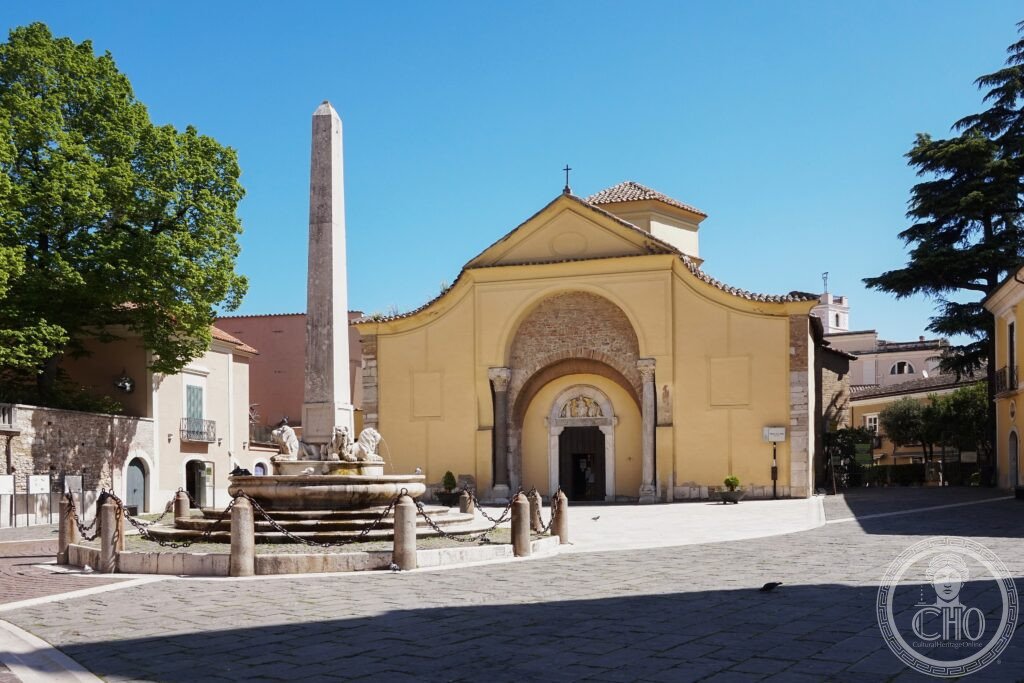
Benevento: Chiesa di Santa Sofia
La Chiesa di Santa Sofia di Benevento (UNESCO 2011, rif. 1318) è la più straordinaria chiesa longobarda dell’Italia meridionale — fondata nel 762 CE dal Duca Gisulfo II di Benevento come chiesa funeraria dynastica con una pianta stellare irregolare a sei lati unica nell’architettura medievale europea, con affreschi longobardi dell’VIII secolo e un chiostro romanico di XII-XIII secolo che ospita oggi il Museo del Sannio.
At a glance
Benevento Santa Sofia Longobards (the most precisely Benevento zone Benevento Campania Italy 41.1305 N 14.7872 E UNESCO WHS 2011 reference 1318: the church (the Chiesa di Santa Sofia di Benevento: the building (the church is a UNESCO serial site within the inscription “Longobards in Italy. Places of Power” (rif. 1318; inscribed 2011); the 7 serial sites: (1) Cividale del Friuli: the “Tempietto Longobardo” (c.730 CE); (2) Brescia: Santa Giulia e San Salvatore (753 CE); (3) Castelseprio-Torba: the Monastero di Torba + Battistero Santa Maria Foris Portas (c.700 CE); (4) Spoleto: Basilica di San Salvatore (5th–8th century CE); (5) Campello sul Clitunno: the Tempietto del Clitunno (c.740 CE); (6) Benevento: Santa Sofia (762 CE); (7) Monte Sant’Angelo: Santuario di San Michele Arcangelo (490 CE; the oldest Lombard sanctuary in Italy)); the plan (the plan of the Santa Sofia is the most original surviving element of the Longobard architecture: it is a stellate irregular hexagonal plan (the “pianta stellare”): 6 sides, of which 4 are concave and 2 are rectilinear; the 6 sides are not equal; the asymmetry is intentional: it reflects the fusion of 3 different architectural traditions in the Lombard Benevento duchy in 762 CE: (1) the Early Christian circular martyrium plan (the 5th–6th century CE tradition of the round memorial church: the Santa Costanza in Rome (c.337 CE) is the model; (2) the Byzantine centralized plan (the octagonal plan of San Vitale, Ravenna (547 CE) which was known to the Lombard architects via the Byzantine exarchate contact); (3) the Islamic star-plan (the influence of Islamic architecture (the Umayyad period: 661–750 CE) via the Arab-Byzantine interface in Sicily and southern Italy)); the dimensions (the exterior diameter of the hexagonal plan: 25 m; the height of the nave: 12 m; the diameter of the central space (the “corona” or inner ring of columns): 13.5 m; the number of columns in the inner ring: 6 (original Lombard columns in grey cipollino marble from Euboea, Greece: they are believed to be spoliated from a Roman building in Benevento (the theatre of Hadrian? the baths?); the capitals: Corinthian (antique spoliated pieces) alternating with Lombard basket capitals (new work, 762 CE).
Key facts
- Gli affreschi longobardi dell’VIII sec. CE nella controfacciata: l’unico ciclo pittorico longobardo integro sopravvissuto in Europa: the Santa Sofia frescoes (the paintings on the counter-facade (the interior west wall) and apse of Santa Sofia: 8th century CE (the fresco campaign is dated 762–794 CE based on stylistic comparison with the Tempietto Longobardo di Cividale; the specific dating: a dedicatory inscription in the apse mentions “the time of Arichis II” (Arichis II was Duke then Prince of Benevento 758–787 CE; son-in-law of the Lombard king Desiderius)); the subjects (the counter-facade: the Annunciation (the angel Gabriel with a long white robe; the Virgin Mary with a blue maphorion); the north wall of the apse: the Visitation, Nativity, and Presentation in the Temple; the south wall: scenes of the Baptism of Christ and the Resurrection of Lazarus); the style (the figures are painted in the “maniera langobardica” (a specific late-antique style with Byzantine influence but distinct elongated proportions and frontal rigidity; the eyes are large and staring; the drapery has rigid parallel folds; the gold background is typical of the Byzantine tradition but the faces show a more plastic modelling closer to early medieval Italian work than to contemporary Byzantine icons); the state of preservation (the apse frescoes are about 60% intact; the counter-facade is 40% intact; the north wall scenes are 70% intact; the overall condition is among the best-preserved of any 8th-century Italian fresco cycle outside of Rome))
- GPS (ingresso Chiesa di Santa Sofia): 41.1305° N, 14.7872° E
History
Dal ducato Longobardo di Benevento alla fondazione 762 CE ai Normanni al UNESCO 2011 (the most precisely Benevento zone history: the Lombard duchy (the Duchy of Benevento (the “Langobardia minor”): the southernmost Lombard duchy in Italy: established c.570 CE when the Lombard king Alboin (died 572 CE) appointed Zotton as first duke of Benevento; the duchy survived the Frankish conquest of northern Italy (774 CE; when Charlemagne conquered the Lombard kingdom and deposed the last Lombard king Desiderius at Pavia) as the only independent Lombard political entity in Italy: the duchy (then principality) of Benevento remained independent until 1077 CE when the Normans captured it under Robert Guiscard; the period of maximum power (Arichis II, 758–787 CE): the duke who elevated Benevento to a “principality” (the first Lombard use of the title “princeps” outside of the royal title) and who may have supervised the fresco programme of Santa Sofia); the foundation (762 CE: Gisulfo II Duke of Benevento (758–763 CE) founded Santa Sofia as his dynastic memorial church; the specific motivation: the duke wanted a church dedicated to the Holy Wisdom (Haghia Sophia) of Constantinople (which he had visited or knew from reports of Byzantine-Lombard diplomatic contacts): the name “Santa Sofia” directly echoes the Haghia Sophia of Constantinople (537 CE) — an intentional prestige claim); the Norman conquest (1077 CE: Robert Guiscard (1015–1085 CE) captured Benevento from the Lombards and converted the principality into a Norman duchy; the church of Santa Sofia was transferred to Benedictine monks; the cloister (the Benedictine cloister: XII–XIII century CE: built by the Benedictine monks using antique columns from the Roman city of Benevento (the Roman columns are still visible in the cloister loggia: 30 columns of different materials and orders — an index of the richness of Roman Beneventum)); 2011 CE UNESCO serial inscription reference 1318.
What you see
La pianta stellare, il chiostro romanico, e il Museo del Sannio (the most precisely Benevento zone visit (1.5–2 hours): the visit (the church is open Tue–Sun 9 AM–7 PM; the adjacent Museo del Sannio (in the Benedictine cloister) is open Tue–Sat 9 AM–7 PM, Sun 9 AM–1 PM; the combined ticket €6 (church + museum)); the church visit (the entry (the church entrance from Piazza Santa Sofia: the doorway (the 12th-century Romanesque portal with twisted-column jambs)); the plan (the hexagonal star plan is immediately perceptible from the interior: the 6 concave bays of the outer wall create a distinctive spatial rhythm as you walk around the inner circle of columns; the effect is of alternating expansion and contraction of space); the apse frescoes (the main reason to visit: the 8th-century CE frescoes (the counter-facade shows the Annunciation; the apse vault shows Christ in Majesty with the Apostles; the condition: lit by a halogen spotlight (the 1986 CE lighting installation; now partially replaced by LED in 2019 CE); the apse can be approached up to 2 m from the altar rail; use the provided binoculars (ask the custodian) to see the facial details of the Apostles)); the cloister (the Benedictine Romanesque cloister (12th–13th century CE): 36 double columns with historiated capitals; the most important capital (northeast corner): the “Daniel in the Lions’ Den” capital (12th century CE): Daniel stands between 2 lions with his hands raised; the lions are depicted with human faces (the Lombard artistic tradition of the “bestiary” (the manuscript tradition of fantastic animals with human features that was popular in Lombard monasteries from the 8th century CE onward))); the Museo del Sannio (the archaeology and medieval museum in the cloister galleries: the Lombard objects (helmet, sword fittings, personal ornaments from 6th–8th century CE Lombard burials found in Benevento province); the Roman bronzes (the famous “Isis triad” from the Temple of Isis at Beneventum (1st century CE; Beneventum had one of the largest Isis cults outside Egypt in Italy))).
Practical information
- Viaggio da Napoli a Benevento e combinazione con gli altri siti Longobardi in Italia meridionale: il trasporto (Napoli Centrale → Benevento: Trenitalia regionale da Piazza Garibaldi 40 min €5.60 (5 treni/giorno; non tutti sono diretti; i diretti sono nelle ore di punta mattutina 7:30, 8:40 e nel pomeriggio 15:30, 17:20); il bus Flixbus Napoli-Benevento (partenza da Autostazione Napoli (Piazza Garibaldi lato est); 1h; €5–8; 3 corse/giorno); la combinazione con Monte Sant’Angelo (l’altro sito Longobardi UNESCO in Campania/Puglia): (1) Benevento → Foggia (Trenitalia 1h20 €9.90); (2) Foggia → Manfredonia (bus SITA 40 min €2); (3) Manfredonia → Monte Sant’Angelo (bus SITA 45 min €2); oppure da Bari (servizio SITIBUS diretto da Bari a Monte Sant’Angelo 2h30); il tempo minimo per Benevento (il museo + chiesa + arco di Traiano + teatro romano: pianificare 4 ore); il tempo minimo aggiuntivo per il circuito completo Longobardi in Italia meridionale (Benevento 4h + Monte Sant’Angelo 3h + Spoleto day trip da Roma 4h + Campello Clitunno 2h): circa 3–4 giorni)
Getting there
Trenitalia da Napoli Centrale a Benevento (40 min, €5.60). Da Roma: Trenitalia diretto Roma Termini–Benevento (2h20, €15.90). Auto: A16 Napoli–Canosa, uscita Benevento. GPS: 41.1305, 14.7872.
Nearby
- Arco di Traiano di Benevento (114 CE) — 800 m est (il più ben conservato arco trionfale romano dopo quello di Tito a Roma; eretto per commemorare la via Traiana (la strada Traiana da Benevento a Brindisi inaugurata nel 114 CE); i bassorilievi (il ciclo di bassorilievi narrativi più ricco di un arco trionfale romano: 26 pannelli su 3 lati; lo stato di conservazione è eccezionale grazie alla pietra locale (il calcare appenninico) e alla posizione riparata; ingresso libero)
- Monte Sant’Angelo: Santuario di San Michele Arcangelo (UNESCO 2011) — 130 km est (il sito Longobardi UNESCO più vicino; Trenitalia Benevento–Foggia 1h20 poi bus SITA; la grotta di San Michele (490 CE; la prima apparizione mariana dell’arcangelo Michele in Occidente; il pellegrinaggio di San Benedetto nel 490 CE; l’ingresso (le 86 scale scavate nella roccia calcarea fino alla grotta a 68 m di profondità)); la Tomba di Rotari (XII sec. CE; il battistero normanno a forma di torre adiacente alla grotta))
Gallery


Sources
- Wikipedia, Church of Santa Sofia, Benevento; Duchy of Benevento; Arichis II, accessed June 2026
- UNESCO, Longobards in Italy. Places of Power (568–774 A.D.), WHS reference 1318, inscribed 2011
- Rotili, Mario. La necropoli longobarda di Benevento. Napoli: Arte Tipografica, 1977
Find it on the map
See this place and what’s around it →📷 Diventa un fotografo di Cultural Heritage Online
Condividi le tue foto dei luoghi: restano pubblicate con la tua firma come autore. Più vengono viste, più ti fai conoscere — e presto un concorso premierà le foto più apprezzate.
Accedi o registrati gratis per aggiungere una foto