
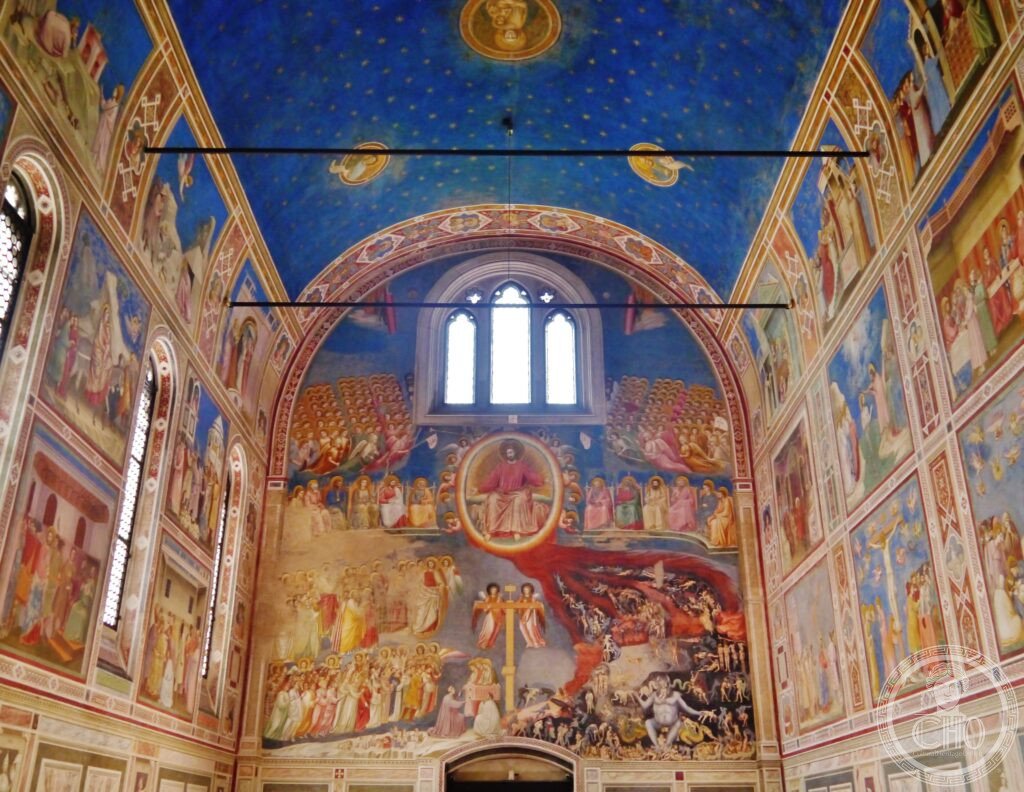
Inside a plain brick shell on the site of Padua’s Roman arena, Giotto covered every surface with 38 painted scenes that changed Western art. Faces show grief and fear, bodies gain weight and turn in space, and a starry blue vault arches overhead like a tent of sky.
At a glance
The Cappella degli Scrovegni, also known as the Arena Chapel, holds a fresco cycle painted by Giotto di Bondone between 1303 and 1305. A deep blue vault studded with gold stars covers the ceiling, with Christ Pantocrator at the centre and the four evangelists in the spandrels of the arches. The walls carry 38 narrative scenes across three registers: stories of Joachim and Anna and of Mary along the top, the life of Christ in the middle, and the Passion below, with painted figures of the Virtues and Vices in grisaille along the base.
The chapel forms part of a wider group of painted monuments in Padua known collectively as the Urbs Picta, inscribed on the UNESCO World Heritage list in 2021 under reference 1623, covering fourteenth-century fresco cycles across eight further building complexes in the city besides the Scrovegni itself.
Key facts
- Location: Padua, Veneto, Italy
- Artist: Giotto di Bondone, painted 1303–05
- Patron: Enrico Scrovegni, who built the chapel on the site of Padua’s ancient Roman arena
- Scenes: 38 narrative frescoes across three wall registers, plus painted Virtues and Vices
- Heritage status: part of the Padua Urbs Picta group inscribed by UNESCO in 2021 (ref. 1623)
- Coordinates: 45.4111° N, 11.8803° E
History
Enrico Scrovegni built the chapel in 1303 on the site of Padua’s ancient Roman arena, from which it takes its alternative name. His father Reginaldo degli Scrovegni had been a moneylender notorious enough to be placed by Dante among the usurers in the seventh circle of Hell in the Inferno, where he is described by the heraldic device of a purse bearing a white sow on an azure field, matching the Scrovegni coat of arms. Enrico’s chapel is understood as an act of atonement for his father’s sin, and the building was consecrated on 25 March 1305, the Feast of the Annunciation. In the chapel’s Last Judgement, Enrico himself appears kneeling among the saved, offering a model of the chapel to the Virgin.
Padua in this period was a free commune with its own statutes from 1194 and a university founded in 1222, the second oldest in Europe after Bologna. The city’s medical faculty later built a permanent anatomy theatre at the Palazzo del Bo, described as the first purpose-built structure of its kind. Galileo Galilei taught mathematics at the university from 1592 to 1610, his longest single teaching post, and it was in Padua that he improved the refracting telescope and, in August 1609, demonstrated Jupiter’s moons to Venetian senators from the Campanile di San Marco.
Later in the fourteenth century, Giusto de’ Menabuoi painted the vault and walls of the city’s Baptistery, working in a more Byzantine palette than Giotto but introducing greater use of crowd scenes and architectural settings. In 2021 UNESCO inscribed the Scrovegni Chapel together with eight other painted monuments across Padua as a single site under the name Urbs Picta.
What you see
The chapel’s vault is painted deep blue and scattered with gold stars, with Christ Pantocrator at the centre and the four evangelists set in the spandrels. The walls below carry the 38 narrative scenes in three registers, running from the stories of Joachim and Anna and of the Virgin at the top, through the life of Christ in the middle register, to the Passion sequence nearer eye level. Giotto’s figures show foreshortening, individualised faces and a sense of physical weight that departs sharply from the flatter conventions of earlier Byzantine painting: the donkey in the Flight into Egypt turns its head at an angle with a modelled, muscular neck, and the mourners in the Lamentation of Christ show distinct, individual grief rather than a standardised type. The west wall carries a large Last Judgement, with Christ in a mandorla, the saved gathered on one side including the kneeling figure of Enrico Scrovegni, and the damned and a scene of Hell on the other. Along the dado beneath the main scenes run painted personifications of the Virtues and Vices in grisaille.
Elsewhere in the city, the Baptistery of the Cathedral holds Giusto de’ Menabuoi’s fresco cycle of 1374–78, including a gold-ground vault known as the Celestial Paradise. The Basilica del Santo contains Donatello’s bronze reliefs and an altarpiece associated with Mantegna in the south transept, and the Palazzo della Ragione, known locally as il Salone, is among the other painted buildings grouped under the Urbs Picta inscription.
Practical information
- Booking: visits to the Scrovegni Chapel are strictly timed and must be booked in advance through the chapel’s official website; independent walk-up entry is not normally possible.
- Visit format: visitors wait in a climate-controlled vestibule before entering the chapel itself, as part of the conservation system introduced in 2001, and time inside the chapel is limited.
- Group size: numbers inside the chapel are capped to protect the frescoes from humidity and heat produced by visitors; check current limits and slot lengths with the official booking channel.
- Evening visits: an evening opening uses artificial light designed to recreate the effect of the original south-facing window; check the official site for current availability.
Getting there
The Cappella degli Scrovegni stands within the city of Padua, in the Veneto region of north-east Italy, and is reached on foot within the historic centre; the Baptistery, Palazzo della Ragione and Basilica del Santo, also part of the Urbs Picta group, are all within walking distance of one another in the same city.
Nearby
- Battistero della Cattedrale — in the city centre, with Giusto de’ Menabuoi’s late fourteenth-century fresco cycle and gold-ground vault.
- Palazzo della Ragione — the city’s medieval civic hall, known as il Salone, part of the Urbs Picta group.
- Basilica del Santo — home to Donatello’s bronze reliefs and an altarpiece linked to Mantegna in the south transept.
- Oratorio di San Giorgio — decorated by Altichiero between 1379 and 1384, another element of the painted Padua group.
Sources
- UNESCO
- Dante, Inferno
Find it on the map
See this place and what’s around it →📷 Become a Cultural Heritage Online photographer
Share your photos of places: they stay published under your name as the author. The more they're seen, the more you get noticed — and soon a contest will reward the most appreciated photos.
Log in or sign up free to add a photoDo you manage this place?
This page is read by travellers and heritage enthusiasts who find it on Google. Keep it accurate — and make it work for you. Free for non-profit heritage institutions.