
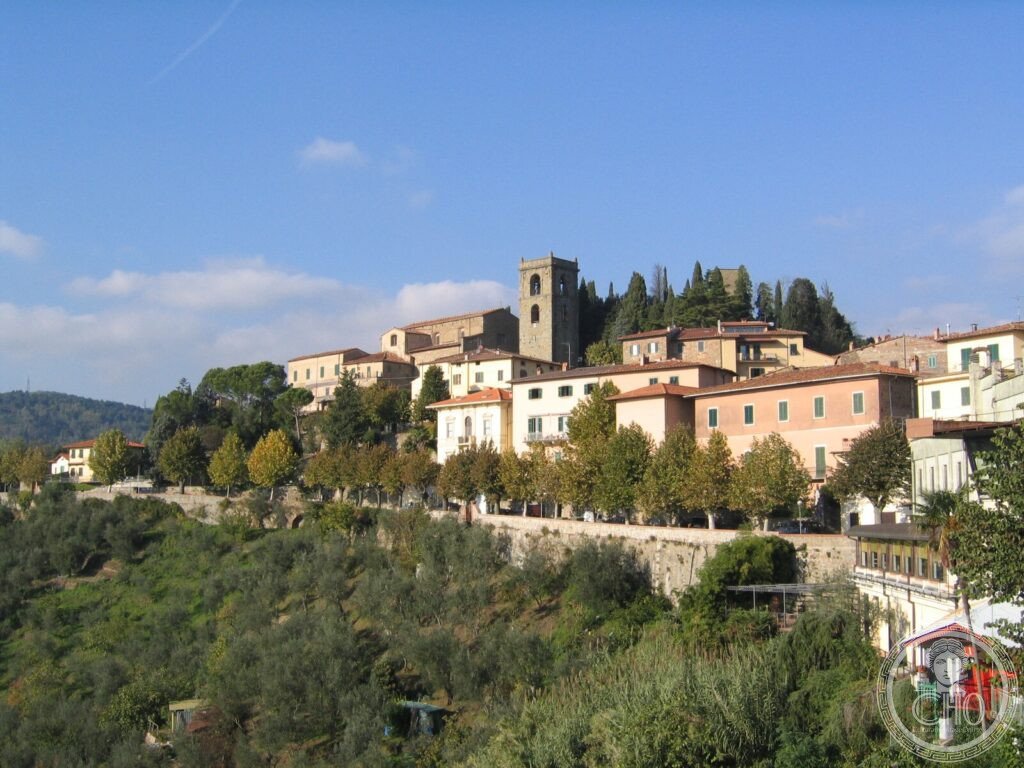
Montecatini Terme

Montecatini Terme stabilimento Tettuccio Liberty Art Nouveau acque termali Great Spa Towns Europe UNESCO 2021
Stabilimento Termale Tettuccio, Viale Verdi 71, Montecatini Terme, Province of Pistoia, Toscana, Italy. The Tettuccio facade (1927–1928 CE; architects Ugo Giovannozzi and Pietro Pacci; the Neo-Liberty/Neo-Renaissance facade: the 3-arched central portal with mosaic lunettes; the colonnaded loggia wings with ceramic panels depicting allegorical figures of Health, Prosperity, and the Four Seasons; the rotunda (the domed circular hall to the left of the main entrance: the most theatrical interior in any European spa, with 4 fountain nozzles dispensing the sulphate water in different concentrations; the polychrome marble floor; the frescoed ceiling with a “sky” of clouds and putti)). UNESCO World Heritage Site 2021 (reference 1667: Great Spa Towns of Europe; the 11 spa cities serial inscription; Montecatini Terme is the only Italian component). Photo via Wikimedia Commons.
Montecatini Terme, Province of Pistoia, Toscana, Italy · Thermal springs documented 1417 CE; Grand Duke Leopold II development 1771 CE; Stabilimento Tettuccio (1927–28 CE; Neo-Liberty); serial UNESCO WHS with 10 other European spa towns 2021 (ref 1667)

Montecatini Terme

Montecatini Terme (UNESCO 2021, Great Spa Towns of Europe) is Italy’s only component in the 11-city European spa serial inscription — the most complete surviving ensemble of Liberty-era thermal architecture in the peninsula, where the Stabilimento Tettuccio (1928 CE) and the Excelsior, Leopoldine, and La Salute establishments together preserve the full typology of the therapeutic-landscape city that Leopoldine Tuscany pioneered in the 1770s.

At a glance

Montecatini Terme stabilimenti termali (the most precisely Montecatini zone Montecatini Terme Toscana Italy 43.8853 N 10.7726 E UNESCO WHS 2021 reference 1667: the Great Spa Towns of Europe (the 11-city serial inscription inscribed July 2021: the 11 cities are: Bath (UK), Bad Ems (Germany), Baden-Baden (Germany), Spa (Belgium), Vichy (France), Montecatini Terme (Italy), Franzensbad/Františkovy Lázně (Czech Republic), Marienbad/Mariánské Lázně (Czech Republic), Carlsbad/Karlovy Vary (Czech Republic), Baden bei Wien (Austria), Bad Kissingen (Germany); the common criterion: all 11 cities developed a distinct urban typology around therapeutic mineral springs between the 17th and early 20th century CE — the “spa city” plan with its therapeutic parks, kursaals, pump rooms, and grand hotels); the Montecatini waters (the specific therapeutic properties (the waters of Montecatini come from 8 distinct springs on the edge of the Valdinievole alluvial plain; the chemical composition varies by spring: the Tettuccio (the most famous) is a sodium sulphate water (Na2SO4 dominant; 3.8 g/L total dissolved solids; the specific therapeutic use: purgative / bile-stimulating / hepatic function; the cure (the thermal cure): the traditional Montecatini cure is taken over 21 days; the visitor arrives at the Tettuccio at 8 AM, drinks the prescribed dose (200–400 ml, depending on the prescription), walks in the park for 45–60 min (to allow the water to transit the system), repeats 2–3 times, then takes a 2-hour rest in the hotel; the cure is then repeated for 21 consecutive days; the claimed effect: improved liver and bile function, reduced cholesterol, improved digestive regularity); the historical clientele (the most famous visitors: Giuseppe Verdi (11 visits between 1865 and 1892 CE; his table at the Ristorante Palme is preserved as a museum piece); Giacomo Puccini (local Tuscan; visited Montecatini repeatedly; composed parts of Turandot during a 1924 cure); Igor Stravinsky (1927 CE); Henry James (1890 CE); the Duke and Duchess of Windsor (1934 CE; after the abdication)).

Key facts

  • The Tettuccio stabilimento (1928 CE) and why its architecture is an unusual blend of Neo-Liberty and Neo-Renaissance that reflects the specific therapeutic ideology of the Fascist era: the Tettuccio (the Stabilimento Tettuccio (the name: “tettuccio” = “little roof” in Italian; the original 17th-century spring was sheltered by a wooden roof; the name survived the subsequent rebuildings); the 1928 construction (the current building was designed by architects Ugo Giovannozzi and Pietro Pacci in 1925–1928 CE; the commission came from the Azienda Autonoma delle Terme di Montecatini, a public entity created by the Fascist government in 1926 CE to nationalize the spa establishments (which had previously been owned by a private company, the Società delle Terme di Montecatini)); the architectural programme: the Giovannozzi-Pacci design is a deliberate hybrid: (a) the Neo-Renaissance exterior (the 3-arched portal + colonnaded wings + classical proportions) references the Italian humanist past (appropriate for a Fascist-era commission: the “Roman revival” aesthetic); (b) the Neo-Liberty/Neo-Art Nouveau interior (the mosaic floors + ceramic decorative panels + frescoed rotunda) references the pre-war liberal prosperity of the Belle Époque thermal boom (when the original Tettuccio building (1779 CE; by Salvatore Gherardesca) was the most fashionable in Europe); the deliberate combination was intended to signal both Italian grandeur (ancient) and Italian modernity (early 20th century) without acknowledging the break of the 1914–1918 war); the Leopold II development (1771–1781 CE: Grand Duke Leopold II of Habsburg-Lorraine (1747–1792 CE; later Emperor Leopold II; described as the most enlightened reforming ruler in 18th-century Europe) commissioned the Venetian architect Nicola Gasparo Paoletti (1727–1813 CE) to develop the thermal park and the town around it; the Leopoldine stabilimenti (the thermal buildings built in the 1770s–1780s CE) are the oldest surviving elements of the Montecatini complex)
  • GPS (Stabilimento Tettuccio): 43.8853° N, 10.7726° E

History

From the 1417 CE thermal spring document to the Medici patronage to the Leopold II urban development to the Belle Époque boom to the Fascist-era rebuilding to UNESCO 2021 (the most precisely Montecatini zone history: the earliest documentation (the springs of Montecatini are first documented in a 1417 CE notarial deed recording the sale of the sulphate spring rights to the Comune di Pescia; the Medici patronage (Cosimo de’ Medici the Elder (1389–1464 CE) visited the springs in 1415 CE (2 years before the 1417 document); the family physician recommended the cure; the Medici continued to fund small-scale development of the springs through the 15th and 16th centuries CE; the Grand Duchy of Tuscany period (1569 CE: Cosimo I de’ Medici was elevated to Grand Duke by Pope Pius V; the therapeutic use of the springs became associated with the Medici court); the Leopold II transformation (1771–1781 CE: Leopold II commissioned the “bagni vecchi” (old baths) complex — the Leopoldine stabilimento (1773 CE) and the Excelsior (1776 CE) — and the town plan (the long straight Viale Verdi and the parallel Viale Puccini and Viale Bicchierai were designed by Paoletti as the primary axes of the new thermal town; this urban design (a formal allée system terminating in the thermal park) became the model for all subsequent European spa city plans)); the Belle Époque boom (1870–1914 CE: the railway (the Pistoia–Lucca line reached Montecatini in 1857 CE; the specific effect: the train made Montecatini accessible to the growing Italian and northern European middle classes; visitors increased from approximately 3,000/year in 1830 to 60,000/year in 1900 CE)); 2021 CE UNESCO inscription reference 1667.

What you see

The Tettuccio, the Excelsior, the Leopoldine, and the Funicular to Montecatini Alto (the most precisely Montecatini zone visit (2–3 hours): 1) Stabilimento Tettuccio (Viale Verdi 71; open Apr–Nov, daily 9 AM–1 PM; €7 entry; the rotunda (the most dramatic single space: the polychrome mosaic floor + the frescoed sky ceiling + the 4 fountain nozzles dispensing water in graduated concentrations; the 200–400 ml thermal dose is dispensed by an attendant into a small ceramic cup branded “Montecatini Terme”; the standard cure dose is 200 ml at 7:45 AM on an empty stomach, repeated at 8:30 AM and 9:15 AM); the colonnaded loggia (130 m long; the ceramic decorative panels by Galileo Chini (1873–1956 CE): the most important Italian ceramic artist of the Liberty/Art Nouveau period; the panels show allegorical female figures in sinuous Art Nouveau poses with botanical borders)); 2) Funicular to Montecatini Alto (the Funicolare di Montecatini (the oldest funicular in Tuscany; first operation 1898 CE; cable-operated; from Viale Diaz; €4 roundtrip; 10 min; runs 10 AM–7 PM Apr–Oct): the medieval village of Montecatini Alto (260 m elevation; the Romanesque Pieve di Montecatini (11th century CE; the oldest structure in the municipality); the panoramic view of the Valdinievole); 3) Terme Excelsior (Viale Verdi 61; the oldest surviving stabilimento (Leopoldine foundation, rebuilt 1920 CE); the “mud bath” (fango) treatment (for arthritic and rheumatic conditions: a semi-solid clay with thermal water at 38–40°C applied to joints and limbs for 20 min)).

Practical information

  • Getting to Montecatini Terme from Florence and combining with Lucca and the Pistoia botanical garden: transport (Trenitalia from Florence Santa Maria Novella: 1h (€8; the Viareggio regional line; trains every 30–60 min); from Pisa: 45 min (€7)); the Lucca combination (Lucca: 30 km west of Montecatini on the same rail line: the best-preserved Renaissance city walls in Italy (4.2 km circuit walkable or cycleable on top; 30 min by bike; the Piazza dell’Anfiteatro (a piazza in the exact oval footprint of the Roman amphitheatre of the 2nd century CE; the medieval buildings ring the exact perimeter of the ancient seating tiers); the Villa Reale di Marlia (10 km east of Lucca; the Elisa Baciocchi (sister of Napoleon) garden: the 17th-century CE Italian garden with the Teatro di Verzura — a garden theater carved in living laurel and box hedges))); the Pistoia Orto Botanico (the second-oldest botanical garden in Europe (after Padova UNESCO 1997); founded 1545 CE by Cosimo I de’ Medici; 20 km from Montecatini; the Platanus orientalis planted by Cosimo in 1550 CE (still living; the oldest surviving tree in Tuscany))

Getting there

Trenitalia from Florence (1h, €8) or Pisa (45 min, €7). Tettuccio: €7, open Apr-Nov, 9am-1pm. Funicular to Montecatini Alto: €4 roundtrip, 10 min. GPS: 43.8853, 10.7726.

Nearby

  • Lucca — 30 km west (Renaissance city walls 4.2 km cycleable on top; Piazza dell’Anfiteatro on Roman amphitheatre footprint; Galileo Galilei was born in Lucca in 1564 CE; Giacomo Puccini was born here in 1858 CE; Trenitalia 25 min from Montecatini)
  • Pistoia — 20 km east (Orto Botanico 1545 CE (Cosimo I Medici); the Piazza del Duomo (the Duomo + Battistero + Ospedale del Ceppo (1277 CE: the loggia with 7 terracotta roundels by Giovanni della Robbia (1521 CE) showing the 7 Works of Mercy — the largest surviving frieze by the della Robbia workshop)); Trenitalia 15 min from Montecatini)

Sources

  • Wikipedia, Montecatini Terme; Great Spa Towns of Europe; Galileo Chini, accessed June 2026
  • UNESCO, Great Spa Towns of Europe, WHS reference 1667, inscribed 2021
  • Bartolozzi, Marco. Montecatini e le sue acque. Montecatini: Azienda delle Terme, 1978 (the standard history of the spa)

Hero image: Stabilimento Tettuccio, Montecatini Terme, Toscana, Italy, Wikimedia Commons. Editorial text © Cultural Heritage Online, 2026.

📷 Diventa un fotografo di Cultural Heritage Online

Condividi le tue foto dei luoghi: restano pubblicate con la tua firma come autore. Più vengono viste, più ti fai conoscere — e presto un concorso premierà le foto più apprezzate.

Accedi o registrati gratis per aggiungere una foto
📋 Copy & share on social
Scroll to Top