
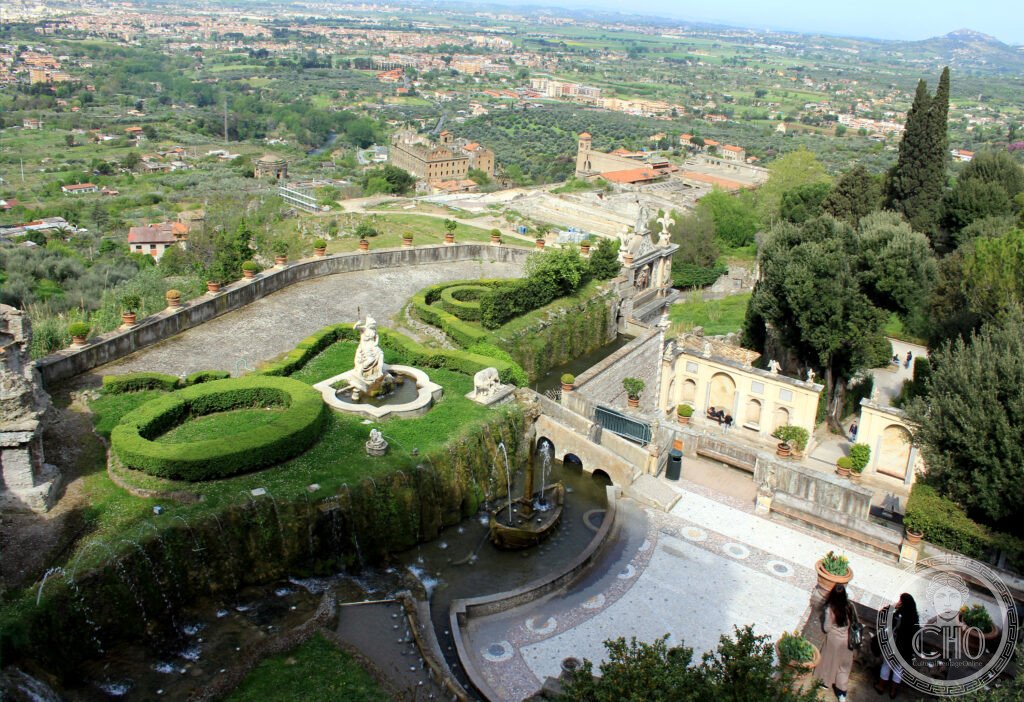
Villa d’Este, Tivoli
The Villa d’Este (UNESCO 2001) is the definitive late-Renaissance garden — designed from 1550 CE by Pirro Ligorio for Cardinal Ippolito II d’Este on a steep hillside above Rome using the hydraulic pressure of the Aniene river to power 500+ fountains simultaneously, producing the most sophisticated water-theatre in European garden history and the model for every subsequent Baroque garden in France, Germany, and England.
At a glance
Villa d’Este Tivoli (the most precisely Villa d’Este zone Tivoli Lazio Italy 41.9630 N 12.7963 E UNESCO WHS 2001 reference 1025: the hydraulic system (the specific engineering achievement: the entire fountain system of the Villa d’Este runs on gravity pressure alone — no pump; the water source is the Aniene river 3 km north of Tivoli, taken off at a weir and carried to the top of the hillside via an underground aqueduct; the specific pressure: the difference in height between the intake weir and the lowest fountain in the garden is approximately 50 m; this 50 m of gravitational head (approximately 5 atmospheres of pressure) powers all 500+ fountains simultaneously; the original hydraulic engineer: Curzio Maccarone (active 1550s CE); the specific innovation (Maccarone devised the system of pressure-relief tanks and calibrated pipe diameters to divide the flow among 500+ outlets simultaneously with no single fountain starving the others of pressure)); the garden design philosophy (Pirro Ligorio (c.1513–1583 CE): the humanist architect, antiquary, and garden designer; Ligorio was simultaneously excavating Hadrian’s Villa (200 m from the Villa d’Este) and transferring sculptures found there to the Cardinal’s collection; the design principle (the garden as an allegory of the Virtuous Life: the visitor’s path from the villa (comfort, worldly pleasure) down the garden terraces (progressive enlightenment) to the lowest terrace (the fountain-theater of the Rometta: a miniature representation of ancient Rome) mirrors the Neoplatonic journey from earthly to divine; the specific Neoplatonism (Ligorio used Plotinus and Ficino as design sources — not explicitly but as shared humanist culture between the Cardinal, Ligorio, and their circle)).
Key facts
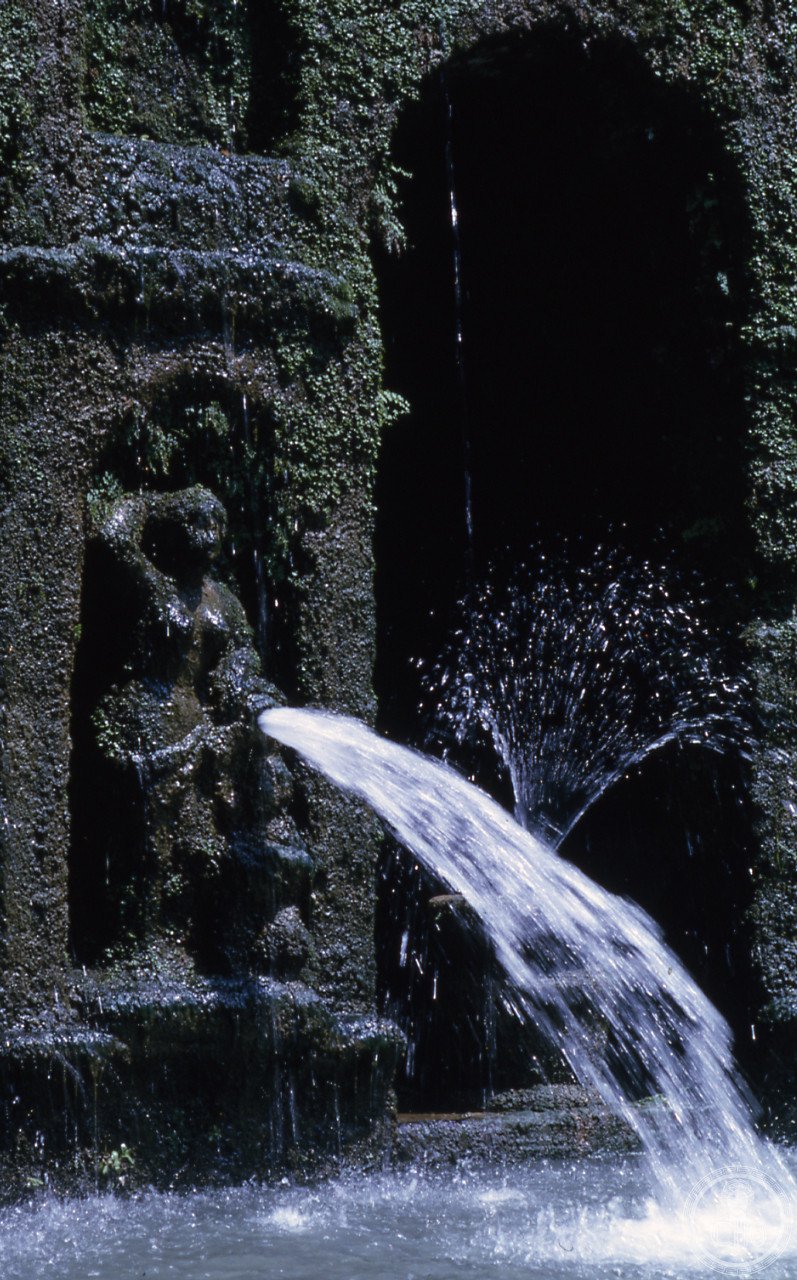
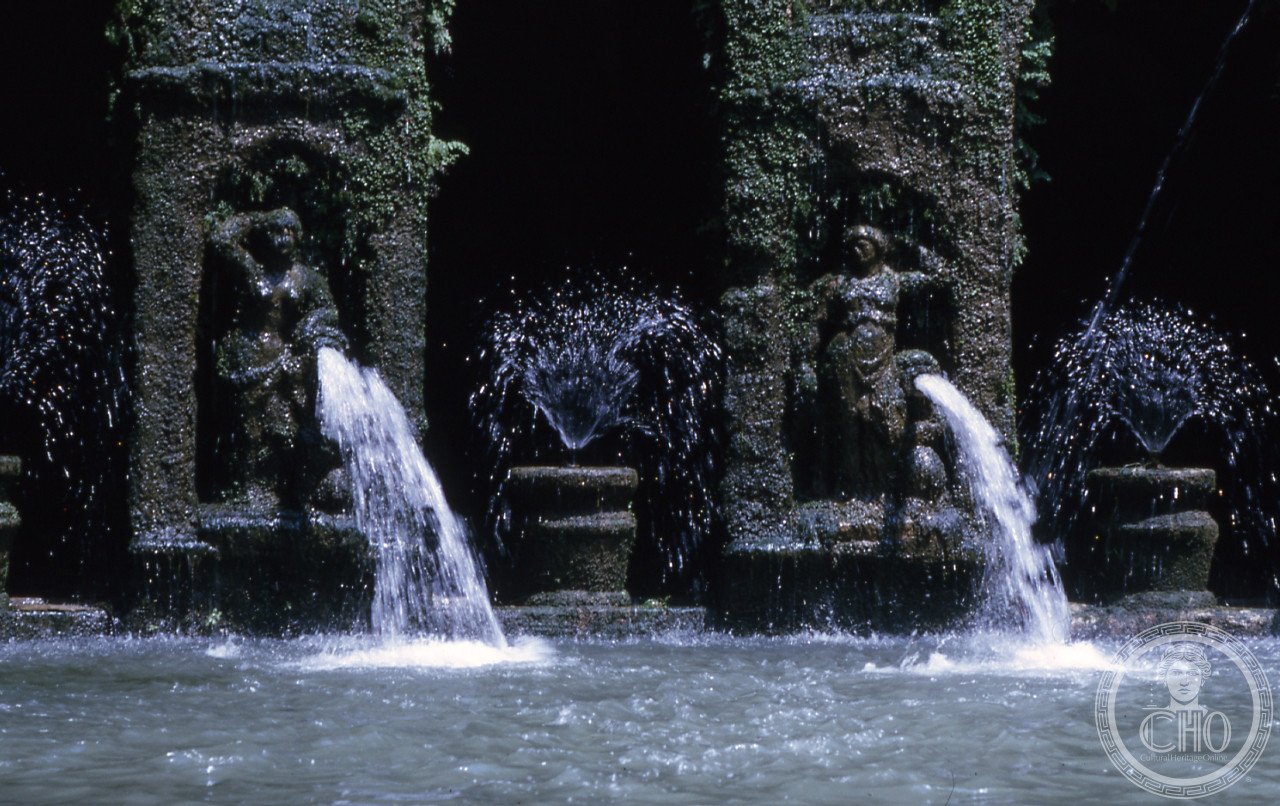
- The Fontana dell’Organo Idraulico and the hydraulic organ technology that made it the most admired technical spectacle of Renaissance Europe: the Fontana dell’Organo Idraulico (the Hydraulic Organ Fountain; on the cross-axis at the center of the garden; the 3-part composition: (a) the water theater semicircle (the curved stone retaining wall with 4 arched niches containing allegorical figures; the specific iconography: the nymph in the central niche represents the Goddess of Nature, holding 2 water-organs (a reference to the ancient hydraulis — the pipe organ powered by water pressure)); (b) the organ chamber (behind the central niche of the fountain: a sealed stone chamber approximately 5 m × 3 m; the specific mechanism: the flowing water enters the chamber through a calibrated pipe and compresses the air in a sealed cylinder above the water (the “wind chest”); the compressed air is then channeled through organ pipes of calibrated lengths; as the water level in the cylinder fluctuates, the air pressure fluctuates, producing musical tones; the specific advantage over a standard bellows organ: no external power source required — the water falling through the garden powers the music); (c) the specific history (the hydraulic organ was designed by the French engineer Luc Leclerc and Claude Venard in 1568 CE and completed in 1580 CE; the mechanism broke down in the 17th century and was rebuilt with a mechanical bellows system in 1661 CE by the engineer Bernini (not Gian Lorenzo Bernini but his son); the current organ (restored 1996 CE) plays a 16th-century CE piece at the top of each hour (9 AM–7 PM May–Sep))); Franz Liszt (1811–1886 CE): Liszt lived at the Villa d’Este during his later years as an Abbot of the Catholic Church (1867–1886 CE); he composed “Les Jeux d’eaux à la Villa d’Este” (1877 CE; the piece that invented the impressionist water-music pianistic idiom later developed by Ravel, Fauré, and Debussy) while listening to the fountain sounds from his room above the garden
- GPS (Villa d’Este): 41.9630° N, 12.7963° E
History
From the Benedictine convent to Cardinal Ippolito to Cardinal Luigi to the Este inheritance loss to the Liszt residence to UNESCO 2001 (the most precisely Villa d’Este zone history: the pre-Este history (the site: a Benedictine convent on the hillside above Tivoli, built on the substructures of a late-Roman villa; the specific structure reused by Ligorio: the convent arcade (the loggia on the upper terrace) incorporates the original Roman opus reticulatum (diamond-pattern brick) walls of the substructure)); the Ippolito II d’Este period (1550–1572 CE: Ippolito II d’Este (1509–1572 CE; son of Alfonso I d’Este, Duke of Ferrara, and Lucrezia Borgia; Cardinal of Ferrara 1539 CE; governor of Tivoli 1550 CE): he commissioned Pirro Ligorio to design the garden in 1550 CE and spent 22 years and approximately 250,000 scudi on the project; the specific frustration: Ippolito had expected to become Pope (he was a papabile at the conclaves of 1549–50 and 1559) and used the Villa d’Este as his consolation project (a garden worthy of a pope, built by a cardinal who never became one)); the decline and abandonment (1600–1800 CE: after the Este line lost control of the villa in 1740 CE, the garden was progressively abandoned; the fountains fell silent (the aqueduct silted up); the grounds became a romantic ruin; the French artist Jean-Honoré Fragonard painted the overgrown garden in the 1760s CE, producing the iconic “The Gardens of the Villa d’Este at Tivoli” series that made the ruined garden as famous as the working garden had been); the restoration (1925–1930 CE: the Italian government restored the hydraulic system and reopened the garden to the public); 2001 CE UNESCO inscription reference 1025.
What you see
The Viale delle Cento Fontane, the Organo Idraulico, the Rometta, and the Liszt apartment (the most precisely Villa d’Este zone visit (2 hours): the visit direction (the standard entry is from the villa building at the top and proceeds down the terraces; the alternative entry at the bottom (Largo Garibaldi) is possible but the experience is better top-to-bottom because the garden is designed as a descent); the key fountains: (a) Viale delle Cento Fontane (Terrace of the Hundred Fountains; 130 m long; the most photogenic feature; the 3 rows of outlets: eagles (above), obelisks (center), barques (below); the specific acoustic effect: the continuous background of running water at different pressures and heights creates a white-noise screen that excludes the ambient sound of Tivoli; walk slowly along the terrace to let the ear adjust); (b) Fontana di Nettuno (the bottom axis; the most theatrical single fountain: 3 spray basins + 1 large central basin + the noise of the water dropping 8 m from the upper tier to the lower basin; the rainbow visible in the spray on sunny mornings); (c) Fontana della Rometta (the miniature Rome fountain: the Capitoline Wolf, Tiber and Aniene as reclining river gods, a miniature Isola Tiberina in the shape of a boat, and the 7 hills of Rome compressed into one stone tableau); (d) Fontana dell’Organo (the musical performance: hourly at 10 AM, 12 PM, 2 PM, 4 PM, 6 PM May–Sep; approximately 4 minutes of 16th-century CE pieces played by the hydraulic mechanism); the Liszt apartment (in the villa building; open when the villa is not in use for concerts; the room in which he composed “Les Jeux d’eaux”).
Practical information
- Getting to Tivoli from Rome and combining with Hadrian’s Villa (Villa Adriana) to create the ideal day-trip: transport (Cotral bus from Ponte Mammolo (Metro B, line to Tivoli; 1h15; buses every 20–30 min; the express (gialla; yellow line) is faster than the local; the Rome-Tivoli bus is a reference trip for Italian architecture students: the bus passes the Travertine quarries on the Via Tiburtina (the Travertine used to build the Colosseum (100,000 m³) came from the Tivoli quarries; 300 km of travertine were transported by oxcart to Rome)); the combined visit (Villa Adriana UNESCO 1999: the complex of 30 buildings covering 120 ha built by Emperor Hadrian (117–138 CE) starting in 118 CE; 2 km from the center of Tivoli; Cotral bus from Tivoli center (15 min; 6 buses per day)); the recommended order (Hadrian’s Villa 9 AM (the largest ancient building complex in Italy; arrive at opening to avoid tour groups); Villa d’Este 1 PM (the afternoon light on the Cento Fontane is better than morning because the sun is from the west-northwest); dinner in Tivoli centro (the Ristorante Cinque Sensi on Via del Colle has the best local lamb (abbacchio scottadito + cacio e pepe) in the area))
Getting there
Cotral bus from Ponte Mammolo (Metro B Roma) 1h15. €14 entry. Open Tue-Sun 8:30am to 1hr before sunset. Organ plays hourly 10am-6pm (May-Sep). GPS: 41.9630, 12.7963.
Nearby
- Villa Adriana, Tivoli — 2 km (UNESCO WHS 1999; Hadrian 117–138 CE; 120 ha, 30 buildings; Canopus canal, Pecile, Teatro Marittimo; the most complete Roman imperial residence outside Rome; Cotral bus from Tivoli 15 min)
- Palestrina — 30 km southwest (ancient Praeneste; the Sanctuary of Fortuna Primigenia (2nd century BCE: the largest Republican-period temple complex in Italy; 6 terraces cut into the hillside; the Barberini mosaic (c.80 BCE): the most complex surviving ancient Roman mosaic (5.85 m × 4.31 m; a Nilotic landscape with detailed Egyptian fauna and vegetation); in the Museo Nazionale Archeologico di Palestrina)
Gallery
Sources
- Wikipedia, Villa d’Este; Pirro Ligorio; Ippolito II d’Este; Franz Liszt, accessed June 2026
- UNESCO, Villa d’Este, Tivoli, WHS reference 1025, inscribed 2001
- Coffin, David R. The Villa d’Este at Tivoli. Princeton: Princeton University Press, 1960 (the definitive scholarly monograph)
Find it on the map
See this place and what’s around it →📷 Diventa un fotografo di Cultural Heritage Online
Condividi le tue foto dei luoghi: restano pubblicate con la tua firma come autore. Più vengono viste, più ti fai conoscere — e presto un concorso premierà le foto più apprezzate.
Accedi o registrati gratis per aggiungere una foto