
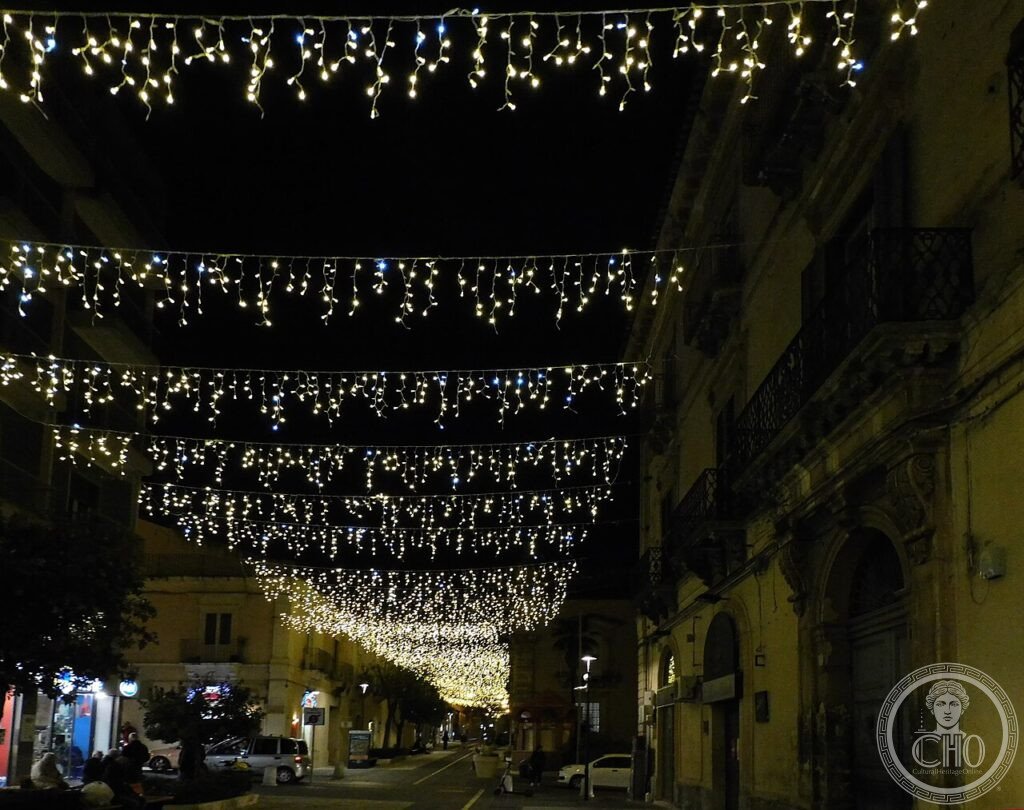
Ragusa Ibla is the most theatrical of the eight Val di Noto towns rebuilt after the 1693 earthquake, its medieval promontory reborn in convex, sculpted Baroque stone. Rosario Gagliardi’s Duomo di San Giorgio crowns a townscape of stepped streets and terracotta roofs, still legible against the Hyblean plateau below.
At a glance
Ragusa Ibla is the lower, older half of Ragusa, built on a rocky promontory between two valleys in the Hyblean plateau of south-eastern Sicily. Almost entirely destroyed by the earthquake of 11 January 1693, it was rebuilt over the following decades in a distinctive local Baroque idiom, alongside a new upper town, Ragusa Superiore, laid out on a grid on the plateau above.
Ragusa Ibla belongs to the UNESCO World Heritage Site known as the Late Baroque Towns of the Val di Noto, a serial inscription of eight towns, listed in 2002 under reference 1024bis. The other towns are Caltagirone, Militello in Val di Catania, Catania, Modica, Noto, Palazzolo Acreide and Scicli, all rebuilt after the same earthquake in the same regional style.
Key facts
- Location: Ragusa Ibla, Province of Ragusa, Sicily, on the Hyblean (Iblean) plateau.
- UNESCO status: part of the Late Baroque Towns of the Val di Noto, inscribed 2002, reference 1024bis, a serial listing of eight towns.
- Key building: Duomo di San Giorgio, built 1738–1775, designed by Rosario Gagliardi.
- Architect: Rosario Gagliardi, active in Noto and Ragusa, developer of the three-tiered, convex-concave Sicilian Baroque facade.
- Defining event: the earthquake of 11 January 1693, which destroyed the town and triggered its rebuilding between 1693 and 1780.
History
The site of Ragusa Ibla was settled in antiquity, first by the Sicels and later by the Greeks, who knew it as Hybla Heraia; a Greek-period necropolis has been found there. Under Rome it appears as Hybla Heraea in the writings of Pliny and Cicero. In the Norman period Roger I granted the county of Ragusa to his nephew Goffredo in 1091, and from 1296 the Chiaramonte family held the town and built the original church of San Giorgio, destroyed in 1693. Ragusa later formed part of the County of Modica, one of the largest feudal holdings in the Spanish Empire, passing between Spanish and Genoese noble families until the county was abolished in 1819.
The earthquake of 11 January 1693 devastated the Val di Noto region, killing an estimated sixty thousand people and destroying the urban fabric of Ragusa and seven neighbouring towns in a single night. In its aftermath, survivors chose to rebuild Ibla on its old street plan while founding a second, gridded town, Ragusa Superiore, on the plateau above. Reconstruction across the region, funded by the surviving nobility and the Church, ran from 1693 to 1780 and gave rise to a distinct Baroque style shaped chiefly by Gagliardi. Rivalry between the noble families of Ibla and Superiore kept the two towns administratively separate until they were merged into a single municipality in 1926. The Val di Noto towns, including Ragusa, were inscribed on the UNESCO World Heritage List in 2002.
What you see
The heart of Ragusa Ibla is the Piazza del Duomo, an elongated square lined with stone benches that leads the eye to the steps and facade of San Giorgio. The church, built between 1738 and 1775, shows Gagliardi’s mature style: a convex central bay flanked by concave sections, three tiers narrowing and growing more ornate as they rise, and a bell tower above. Inside, the columns are carved stone rather than marble, the floor is laid with numerous marble types drawn from Sicilian and mainland sources, and the sacristy holds an altar painting attributed to Vito D’Anna.
Beyond the Duomo, the Giardino Ibleo forms the public garden at the far end of Ibla; from its terrace the Cava d’Ispica ravine is visible to the south, with Byzantine rock-cut churches set into its walls. A stepped route, the Passo della Croce, climbs from Ibla to Ragusa Superiore, the eighteenth-century upper town laid out on a grid after the earthquake, whose own cathedral, San Giovanni Battista, shows the same Gagliardi-influenced Baroque handling.
Practical information
- Access within Ragusa: Ibla and Superiore are linked by stepped streets and by lifts and local buses; the walking route between them takes roughly a quarter of an hour.
- Visiting the Duomo: opening times and any admission arrangements are best checked with the church or the local tourist office before travelling.
- Best light: the west-facing facade of San Giorgio is most legible later in the day; check seasonal conditions locally.
Getting there
Ragusa is reached from Catania by regional train or by bus from Catania airport, both routes running with reasonable frequency; current timetables and fares are best checked directly with Trenitalia or the relevant bus operator before setting out.
Nearby
- Modica — a short distance away, with its own Gagliardi-attributed Duomo di San Giorgio, taller and more austere than its Ragusa counterpart, and known for its traditional chocolate-making.
- Noto — one of the other Val di Noto towns, with Gagliardi’s Chiesa di San Domenico among its Baroque churches.
- Cava d’Ispica — a deep ravine south of Ragusa Ibla, visible from the Giardino Ibleo, with Byzantine rock-cut churches carved into its walls.
- Ragusa Superiore — the upper town built on a grid after 1693, directly above Ibla and linked to it by the Passo della Croce steps.
Sources
- UNESCO
- Pliny
- Cicero
Find it on the map
See this place and what’s around it →📷 Become a Cultural Heritage Online photographer
Share your photos of places: they stay published under your name as the author. The more they're seen, the more you get noticed — and soon a contest will reward the most appreciated photos.
Log in or sign up free to add a photo