
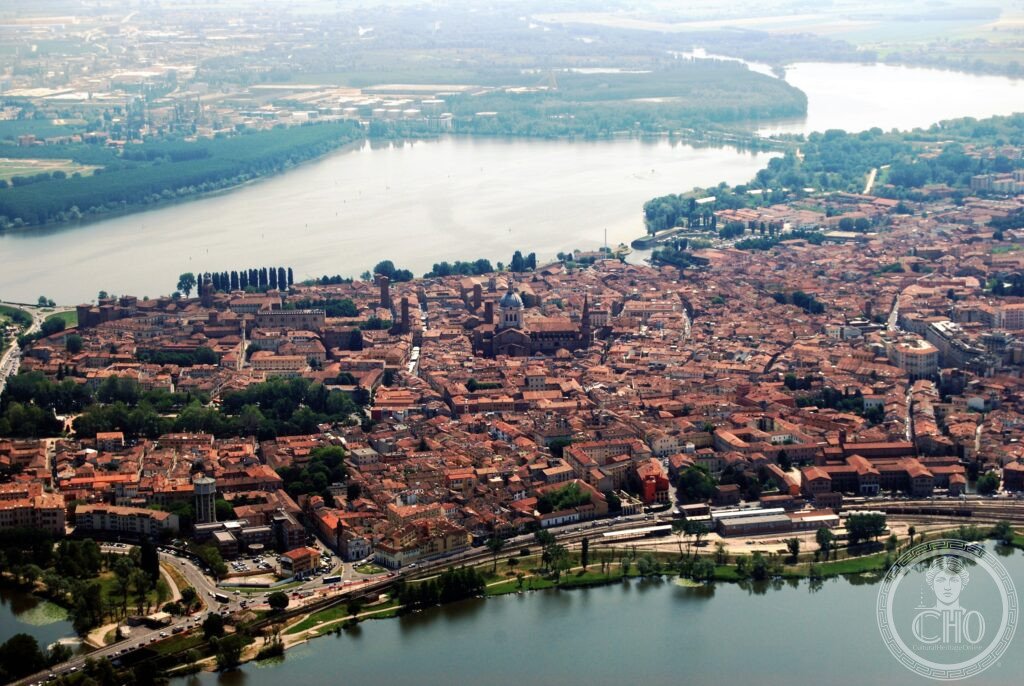
Mantova e Sabbioneta
Mantova (UNESCO 2008) contains the greatest surviving cycle of princely court frescoes in all of Italian Renaissance painting — the Camera degli Sposi (1474 CE) by Andrea Mantegna in the Castello di San Giorgio, where the first Renaissance illusionistic ceiling (the oculus with figures looking down from a balcony above the viewer’s head) was painted 17 years before Columbus landed in the Americas, setting the precedent for every painted illusionistic ceiling in subsequent Italian art.
At a glance
Mantova (the most precisely Mantova single Mantova Lombardia Italy 45.1564 N 10.7914 E UNESCO WHS 2008 reference 1370: the Gonzaga context: the Gonzaga family ruled Mantua from 1328 CE (when Luigi I Gonzaga overthrew the Bonacolsi lords) to 1708 CE (when the last Gonzaga duke died without heirs and the Spanish succession of 1708 CE transferred Mantua to Austria); 380 years of continuous Gonzaga rule made the Gonzaga court the most stable Renaissance princely court in northern Italy; their specific cultural achievement: they were the patrons of (1) Andrea Mantegna (the court painter from 1459 CE to 1506 CE; 47 years of continuous employment; the Camera degli Sposi (1474 CE; Room 8 of the Castello di San Giorgio; the first painted room in western art history to use a comprehensive illusionistic system: the painted architecture (pilasters, arches, curtains) extends the real architecture of the room seamlessly into painted space; the ceiling oculus (the roundel showing the sky with figures looking down from a balcony) was the first such illusionistic ceiling in western art)); (2) Leon Battista Alberti (1404–1472 CE; the most important architectural theorist of the 15th century; Alberti designed 2 churches in Mantua: the Basilica di Sant’Andrea (begun 1472 CE; the barrel-vaulted nave is the most direct revival of the ancient Roman baths (thermae) basilica type in 15th-century architecture; the proportions are derived from Alberti’s theoretical analysis of the Pantheon) and the Tempio di San Sebastiano (begun 1460 CE; the first building in Renaissance architecture to use the ancient temple front (a pediment raised on a high base) as the entire building facade)); (3) Giulio Romano (1499–1546 CE; Raphael’s most gifted pupil; came to Mantua in 1524 CE after Raphael’s death in 1520 CE; designer of the Palazzo Te (1524–1534 CE; a summer pleasure palace outside the city walls; the specific programme: the Sala dei Giganti (the Room of the Giants: a complete room painted on all 4 walls and the ceiling with the fall of the giants from Olympus — the viewer stands in the center of the room surrounded by giants falling and rocks crashing from all sides; the most vertiginous interior space in Italian Renaissance architecture)).
Key facts
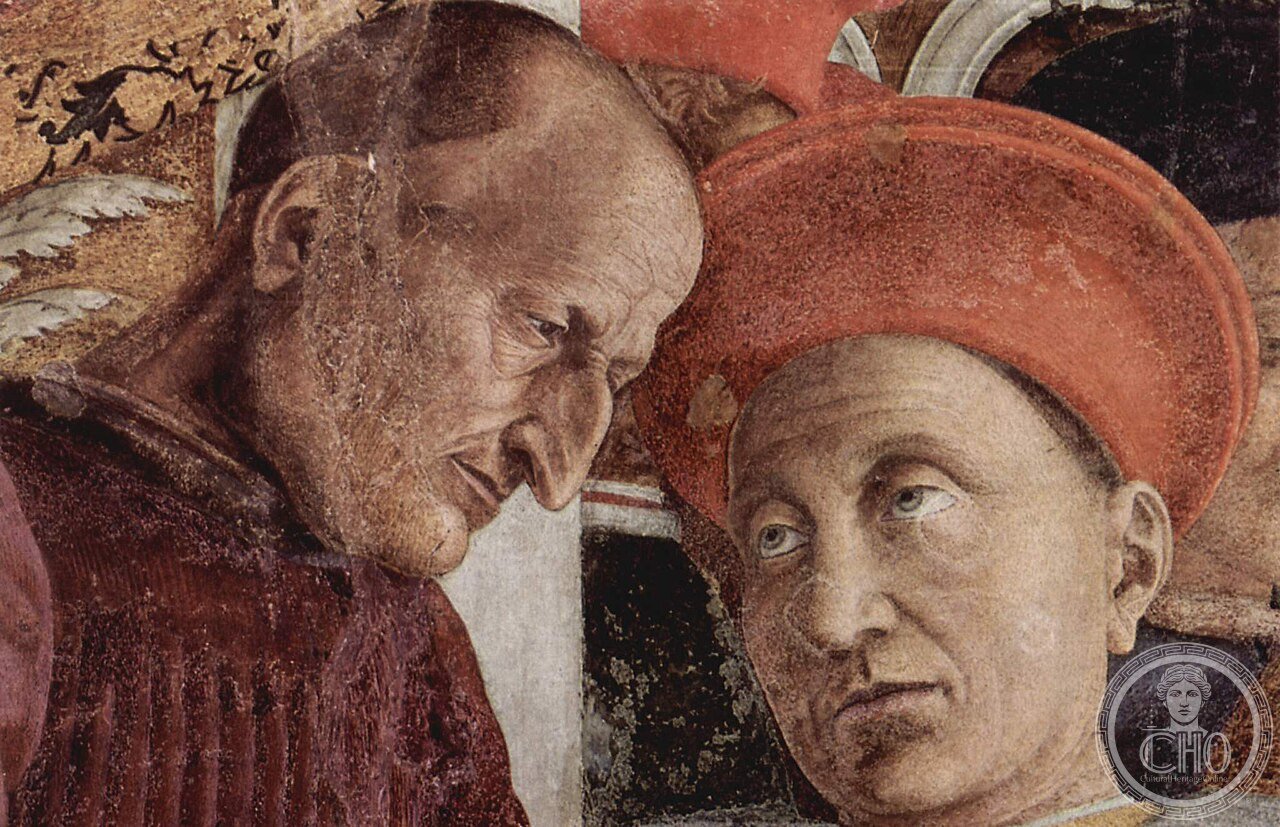
- The Camera degli Sposi (1474 CE) and why Mantegna’s oculus changed the history of ceiling painting: the Camera degli Sposi (the “Bridal Chamber” or “Room of the Married Couple”; the official name was the Camera Picta (the Painted Room); the room is in the Castello di San Giorgio (the tower-castle built 1395–1406 CE as a separate fortress attached to the Palazzo Ducale); the commission (Ludovico II Gonzaga commissioned Mantegna in 1465 CE to paint the room; work began in 1465–1466 CE but was interrupted by the plague of 1466 CE; the room was completed in 1474 CE — 9 years of work; the inscription on the room (above the entry arch): “OPVS HOC TENVIAE COMPARANDVM LVDOVICVS III MKI MARCHIO MANTVE ET BARBARA VXOR INCOMPARABILI SVI FECERVNT ANNO MCCCCLXXIIII” (This work, barely adequate for comparison, was done by Ludovico III, Marquis of Mantua, and his incomparable wife Barbara, in 1474)); the content of the frescoes (the south and west walls show the Gonzaga court: Ludovico II Gonzaga and Barbara of Brandenburg (seated on the south wall; the first portrait group in northern Italian art to depict real people (not allegories or sacred figures) in an architectural setting that pretends to be the actual room); the north wall: the Meeting scene (Ludovico Gonzaga meeting his son Francesco (who had just been appointed Cardinal by Pope Paul II in 1461 CE); the specific detail: the groom in the lower right corner of the meeting scene looks directly at the viewer — the first use of the “direct address” device in a secular Renaissance fresco)); the oculus (the ceiling roundel: a circle 2.7m in diameter painted to look like a hole in the vault above, through which the sky is visible; around the hole, 9 female figures in foreshortened poses lean over the balustrade and look down at the viewer; a Moorish attendant and a boy also look down; a tub of plants balances on the edge; the peacock visible through the balustrade columns is a Gonzaga heraldic symbol; the painted curtain that appears to be suspended from a wooden pole across the opening is the most virtuosic trompe-l’œil detail in 15th-century Italian art)
- GPS (Palazzo Ducale entrance): 45.1564° N, 10.7914° E
History
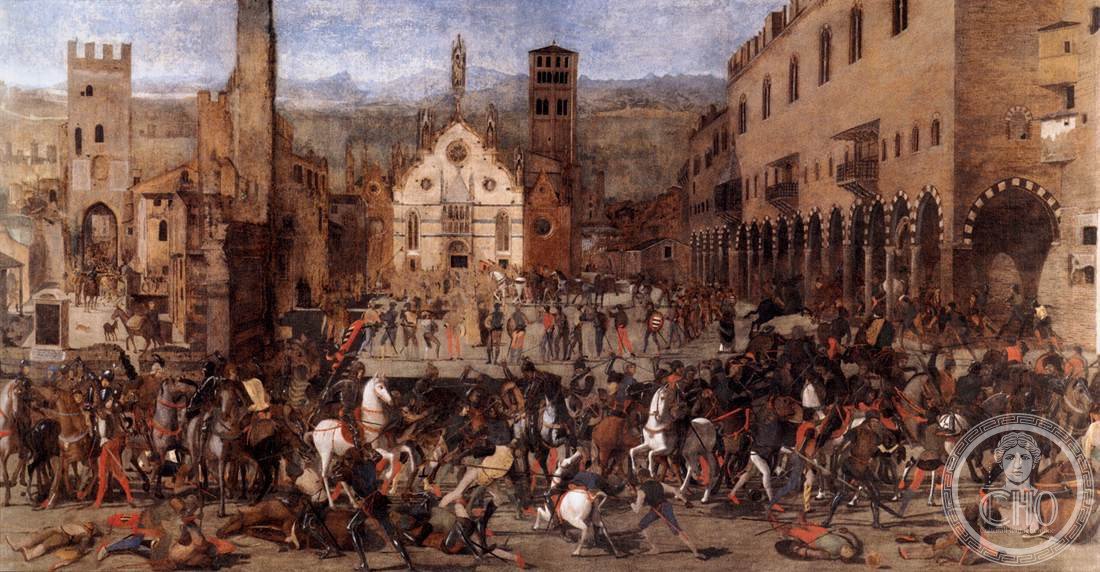
From the Bonacolsi lords to the Gonzaga to Austrian rule to 2008 UNESCO (the most precisely Mantova single Gonzaga history: the Gonzaga rise (Luigi I Gonzaga (d.1360 CE) overthrew the Bonacolsi lords of Mantua in 1328 CE; the specific event: a coup d’état on the night of August 16, 1328 CE; the Bonacolsi lords were killed or exiled; the Gonzaga controlled Mantua as capitani del popolo (leaders of the people) from 1328 CE; they received the formal title of Marchesi in 1433 CE (from Emperor Sigismund of Luxembourg) and Duchi in 1530 CE (from Emperor Charles V)); Virgil (the Roman poet Virgil (70 BCE–19 BCE) was born in Andes, a village near Mantua (identified with the modern Pietole, 4 km southeast of Mantua); the Mantovans have claimed Virgil as their civic patron since the medieval period; the statue of Virgil in the Piazza Virgiliana (19th century CE) is the largest statue in any Italian piazza dedicated to a Roman poet)); the Sack of Mantua (1630 CE: the most destructive event in Gonzaga history: the combined forces of the Holy Roman Empire captured Mantua (the War of the Mantuan Succession, 1628–1631 CE) and sacked the city in 1630 CE; the Habsburg troops stripped the Gonzaga palace of its art collection (the Gonzaga collection was the largest private art collection in Europe at the time: it included Raphael’s “Triumph of Galatea,” Mantegna’s “Triumphs of Caesar,” and approximately 2,000 paintings; most of the collection was sold to Charles I of England in 1627–1628 CE — before the Sack — for £15,000 (approximately £3 million in 2024 CE value); the Mantegna Triumphs are still in the Royal Collection at Hampton Court Palace)); 2008 CE UNESCO inscription reference 1370.
What you see
Palazzo Ducale, Camera degli Sposi, Palazzo Te, and the Alberti churches (the most precisely Mantova single visit (full day minimum; 2 days recommended)): 1) Palazzo Ducale (Piazza Sordello; open Tue–Sun 9 AM–7 PM; admission €15; the largest medieval-Renaissance palace complex in Italy by floor area (34,000 sq m; 450 rooms; 15 courtyards); the essential rooms: the Camera degli Sposi (Room 8 of the Castello di San Giorgio; visit requires a timed ticket supplement: the room is limited to 20 visitors at a time; 15-minute access; the most important single room in Italian Renaissance secular art); the Appartamento di Isabella d’Este (the rooms of the most powerful woman of the Italian Renaissance; Isabella d’Este (1474–1539 CE) collected antiquities and commissioned paintings from every major artist of the period (Mantegna, Perugino, Costa, Lorenzo da Pavia); her studiolo (study room) is the most complete surviving Renaissance woman’s apartment)); 2) Palazzo Te (Viale Te 13; open Tue–Sun 9 AM–6 PM; admission €15; the Gonzaga summer pleasure palace designed by Giulio Romano 1524–1534 CE; the Sala dei Giganti (the Room of the Giants: the full-room fresco of the Giants’ fall; the only room in Italian art where the floor, 4 walls, and ceiling are all part of a single continuous painted composition)); 3) Basilica di Sant’Andrea (Piazza Mantegna; Alberti’s masterpiece; free; the barrel vault is 18m wide — the widest vault built in Italy since the ancient Roman baths; the vault width is derived from Alberti’s measurements of the Pantheon).
Practical information
- Booking the Camera degli Sposi and visiting Sabbioneta in the same day: the Camera degli Sposi booking (the room requires a specific timed entry supplement to the Palazzo Ducale ticket (€3 supplement; 20 visitors maximum at one time; 15-minute groups); the supplement must be booked in advance online (palazzoduca.it or ticketone.it); peak season (April–October): book 2–4 weeks in advance; the specific visiting strategy (arrive at the Palazzo Ducale at opening time (9 AM Tue–Sun) to collect the Camera degli Sposi ticket with the earliest available slot; visit the non-Camera rooms while waiting for your slot; the Camera is best photographed in diffuse morning light (direct sun through the windows in the afternoon creates harsh shadows on the frescoes)); the Sabbioneta day trip (Sabbioneta: the ideal Renaissance city built by Vespasiano Gonzaga Colonna (1531–1591 CE) between 1556 and 1590 CE as a utopian city-state; 25 km west of Mantua; accessible by bus (Mantova→Sabbioneta: APAM bus 34 min, €3.20, every 1–2 hours) or bicycle (25 km flat cycle through the Po plain; the Mantova→Sabbioneta cycling route uses the Mincio+Po cycle paths (part of the EuroVelo 8 La Méditerranée cycling route)); the Sabbioneta circuit (2 hours; the Teatro all’Antica (the first freestanding purpose-built theater in Europe; designed 1588–1590 CE by Vincenzo Scamozzi who also designed the Teatro Olimpico in Vicenza; admission €8 for all Sabbioneta monuments via combined ticket))
Getting there
Trenitalia regional from Verona (45 min, €5) or Milan (1h30, €12). Palazzo Ducale: Piazza Sordello, open Tue-Sun 9-19, €15 (Camera degli Sposi supplement €3, book online). Palazzo Te: Viale Te, same hours, €15. GPS: 45.1564, 10.7914.
Nearby
- Verona — 45 km northeast (UNESCO WHS 2000; Arena opera festival; Castelvecchio Scarpa museum; Arche Scaligere Gothic tombs; Trenitalia 45 min)
- Cremona — 50 km northwest (the violin-making capital: Amati (founded 1564 CE), Stradivari (Antonio Stradivari 1644–1737 CE, died in Cremona; the Museo del Violino has 4 original Stradivari + Guarneri del Gesù violins); the Torrazzo (the tallest Romanesque bell tower in Italy: 112m)); not UNESCO but an excellent half-day from Mantova
Gallery
Sources
- Wikipedia, Mantua; Camera degli Sposi; Andrea Mantegna; Giulio Romano; Palazzo Te; Leon Battista Alberti, accessed June 2026
- UNESCO, Mantua and Sabbioneta, WHS reference 1370, inscribed 2008
- Chambers, David, and Jane Martineau, eds. Splendours of the Gonzaga. London: Victoria & Albert Museum, 1981
Find it on the map
See this place and what’s around it →📷 Diventa un fotografo di Cultural Heritage Online
Condividi le tue foto dei luoghi: restano pubblicate con la tua firma come autore. Più vengono viste, più ti fai conoscere — e presto un concorso premierà le foto più apprezzate.
Accedi o registrati gratis per aggiungere una foto