
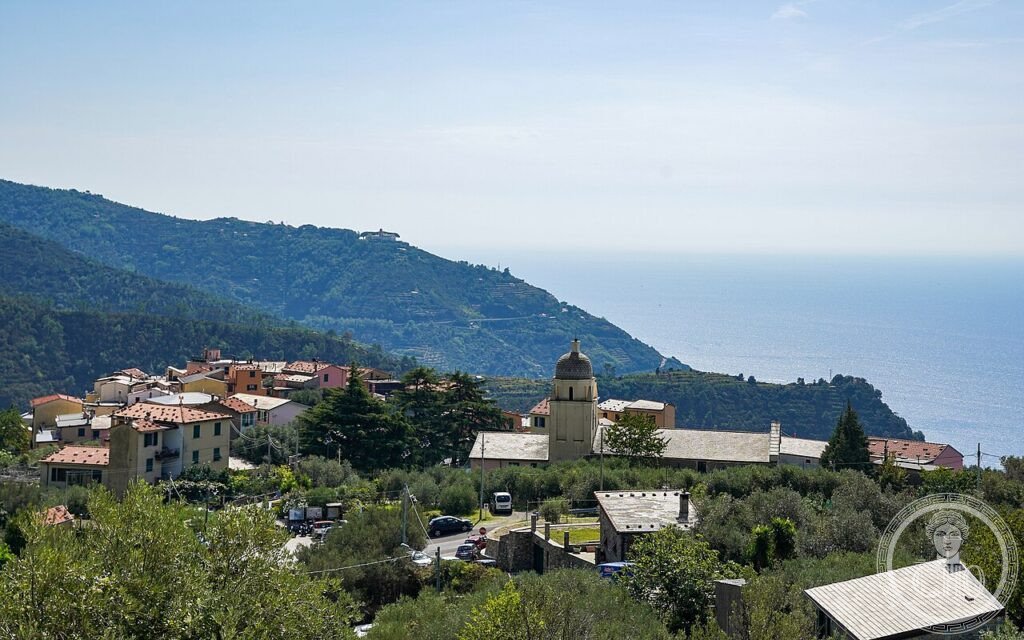
Five villages cling to a stretch of Ligurian cliff between La Spezia and Levanto, held up by dry-stone terraces built by hand over two thousand years to grow vines on slopes too steep for anything else. Inscribed by UNESCO in 1997 together with Porto Venere, the landscape survives only because those walls are still maintained.
At a glance
The Cinque Terre occupy roughly fifteen kilometres of coast between Levanto, which lies outside the protected zone, and Riomaggiore. The five villages are Monterosso al Mare, Vernazza, Corniglia, Manarola and Riomaggiore, each built directly onto the rock face or, in Corniglia’s case, set back on a cliff top above the sea. Monterosso is the largest and the only one with a sandy beach and road access; Corniglia is the only one not touching the water, reached from its station by a long flight of steps or a shuttle bus.
What ties the villages together is the terracing: dry-stone walls, known locally as ciàn, cut the hillsides into narrow strips wide enough to carry a row of vines. The UNESCO inscription of 1997, shared with the nearby town of Porto Venere, names this terraced landscape as the site’s principal value, not simply the picturesque villages themselves.
Key facts
- Location: Province of La Spezia, Liguria, between Levanto and Riomaggiore
- UNESCO status: World Heritage Site since 1997, reference 826, inscribed jointly with Porto Venere
- The five villages: Monterosso al Mare, Vernazza, Corniglia, Manarola, Riomaggiore
- Terraces: an estimated 6,700 km of dry-stone retaining walls, built and maintained without mortar over roughly two thousand years, each terrace typically one to three metres wide
- Wine: the terraces support the Cinque Terre and Sciacchetrà DOC vineyards, growing Bosco, Albarola and Vermentino grapes
- Management: the Cinque Terre National Park, established in 1999, two years after the UNESCO listing, to oversee terrace maintenance
History
The villages were built and fortified by the Republic of Genoa from the eleventh century, sited on inaccessible promontories to withstand the Saracen raids that troubled the Ligurian coast between the eighth and fifteenth centuries. The Doria family, the dominant Genoese noble house, held the villages as feudal lords, and their defensive towers still stand in Vernazza, Riomaggiore and Manarola.
The single most transformative event in the area’s modern history was the construction of the La Spezia–Levanto railway, completed in 1874. Cut through the cliffs with nine tunnels along the fifteen-kilometre line, it gave the villages their first land access other than by boat, tied them into the Ligurian economy and, from the 1920s, opened the way to tourism.
UNESCO inscribed the Cinque Terre and Porto Venere in 1997, identifying the terraced landscape as the core cultural value of the site. The Cinque Terre National Park followed in 1999 specifically to give the terraces, and their upkeep, a management structure.
What you see
Vernazza centres on the Piazza Marconi, its harbour square overlooked by a Genoese Doria tower from the eleventh century and by the Oratorio dei Disciplinanti, the village’s most significant medieval building. Manarola is the most photographed of the five, its ochre, terracotta and sage-green houses stacked in tiers directly above the sea, a colour scheme fishermen once used to pick out their own house on the way home. Corniglia, set back on its cliff, offers the longest views in the Cinque Terre, stretching on a clear day from the Lerici promontory to Portofino.
Two path systems link the villages: the high-level Sentiero Rosso, climbing to around 700 metres with views of all five settlements from its highest point near Vernazza, and the lower coastal Sentiero Azzurro, whose stretch between Manarola and Corniglia gives the closest sea views. The Via dell’Amore, the cliff path between Riomaggiore and Manarola, closed after a landslide in 2012 and has only partially reopened since 2024, a direct consequence of terraces above the path falling into disrepair.
The UNESCO zone extends to Porto Venere, at the tip of the peninsula closing the Gulf of La Spezia, valued as the most complete surviving example of Genoese medieval coastal fortification. Its Doria Castle dates from the twelfth century, the black-and-white marble Church of San Lorenzo from 1256, and the ruined Church of San Pietro, founded in the third century and rebuilt in the sixteenth, stands dramatically on the headland above the Arpaia cove.
Practical information
- Getting between villages: the regional train on the La Spezia–Levanto line is the standard way to move between the five villages; combined rail and path passes exist and are best checked and bought through the National Park or Trenitalia’s own channels
- Crowding: the villages are small, with a combined resident population far smaller than the numbers who pass through in high summer, so visiting outside July and August makes for an easier walk and fewer queues on the paths
- Paths: sections of the coastal and high-level paths close periodically after landslides, including parts of the Via dell’Amore, so it is worth checking the National Park’s current status before setting out
Getting there
The Cinque Terre are served by the La Spezia–Levanto railway, opened in 1874 and still the main artery of the area, with each of the five villages having its own station. La Spezia is the usual starting point for travellers arriving by mainline train.
Nearby
- Porto Venere — at the southern tip of the Gulf of La Spezia, included in the same UNESCO listing, with its Doria Castle and the Church of San Lorenzo
- Tellaro — across the gulf from Porto Venere, a small village on a rocky headland, less visited because it lies off the Trenitalia line
- Lerici — on the same shore as Tellaro, forming part of the wider gulf circuit opposite Porto Venere
Sources
- UNESCO
- Cinque Terre National Park
- Ferrovie dello Stato
Find it on the map
See this place and what’s around it →📷 Become a Cultural Heritage Online photographer
Share your photos of places: they stay published under your name as the author. The more they're seen, the more you get noticed — and soon a contest will reward the most appreciated photos.
Log in or sign up free to add a photo