
Memoriale Brion

Memoriale Brion Carlo Scarpa 1969-1978 Altivole Treviso Veneto FAI concrete water architecture family mausoleum
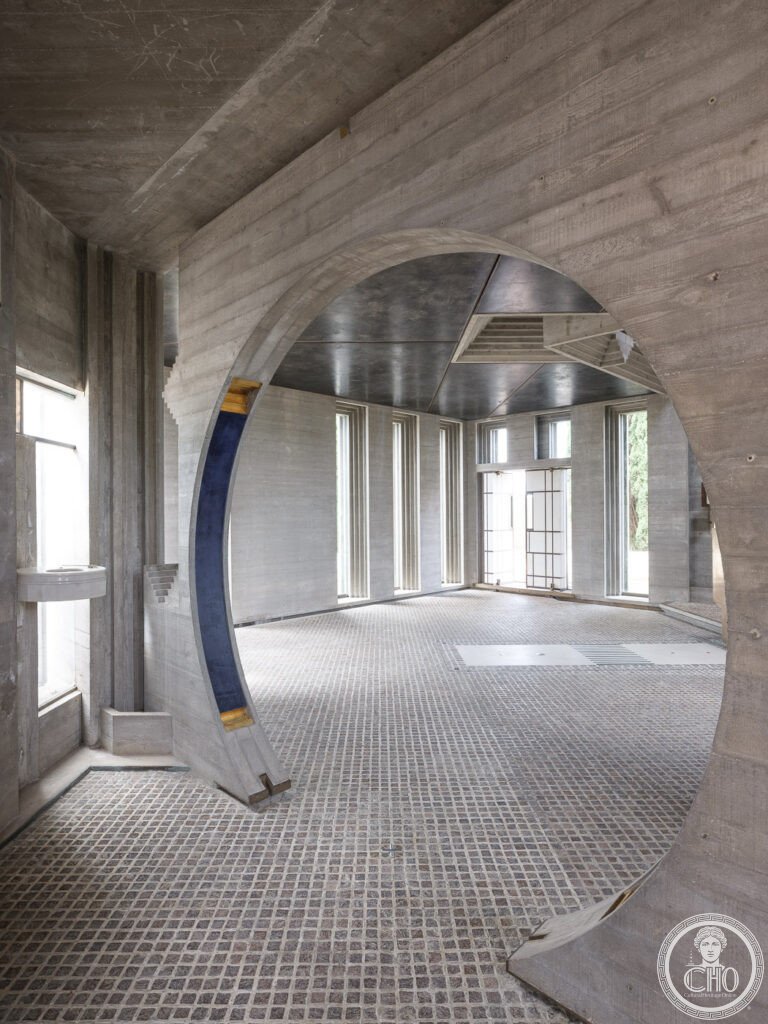
The Arcosolio pavilion at the Memoriale Brion (Carlo Scarpa, 1969–1978 CE; the Arcosolio is the two-arch structure that shelters the sarcophagi of Giuseppe and Onorina Brion; the two arches intersect at an angle — they are not parallel; the specific geometrical device: the arches are concrete interlocking tori (the same geometrical motif as the Brion family emblem, two rings leaning against each other); the arches frame a view of the watery garden and the grass field beyond; the sarcophagi of husband and wife are positioned so that they lean towards each other — the specific funerary message: ‘even in death we lean towards each other’; the moss covering the upper surfaces of the arch is not accidental — Scarpa designed the drainage of the concrete surface to encourage moss growth; it is in the professional literature as one of the earliest examples of deliberate biopatina design in 20th-century architecture), Altivole, Treviso, Veneto, Italy. Property FAI — Fondo Ambiente Italiano. Photo via Wikimedia Commons.
Altivole, Treviso, Veneto, Italy · Carlo Scarpa architect (1906–1978 CE); designed 1969 CE, built 1970–1978 CE; Scarpa died in Sendai Japan 1978 before completion; L-shaped cemetery garden 2,200 sq m; FAI property since 2023

Memoriale Brion

The Memoriale Brion at Altivole (Veneto) is the final major work of Carlo Scarpa (1906–1978) and, by wide critical consensus, the most important work of Italian architecture in the second half of the 20th century — a family mausoleum and meditation garden that took Scarpa nine years to design and build, and in which every surface, joint, and material transition was considered at the 1:1 scale that Scarpa called “seeing everything large.”

At a glance

Memoriale Brion (the most precisely MemorialeBrion single Altivole Treviso Veneto Italy 45.7578 N 11.9819 E FAI Fondo Ambiente Italiano since 2023; the commission: the Brion family — owners of Brionvega, the Italian electronics company whose designs (the TS522 portable radio; the Doney television) are canonical objects of Italian industrial design — commissioned Carlo Scarpa in 1969 CE to design a family burial site at the village cemetery of Altivole, Scarpa’s ancestral province; the context: the existing village cemetery of Altivole (a working cemetery that is still in use) is adjacent to the Memoriale but separated by a wall; the Memoriale occupies the L-shaped plot wrapping two sides of the existing cemetery; the scale: 2,200 sq m of garden, water, and concrete structures; the Memoriale is not a building in the conventional sense — it is a designed landscape with a series of pavilions, canals, and passages that are experienced as a walk through controlled compression and release of space); the critical position: the Memoriale Brion is the subject of the most-cited piece of architectural writing of the 20th century by an Italian architect: Scarpa’s own lecture “Come ho capito il Brion” (How I Understood the Brion) delivered at the Madrid School of Architecture in 1978 CE (the year of his death) is studied in architectural schools worldwide as a primary text on the relationship between design intent and material realization).

Key facts

  • Carlo Scarpa’s design method and why it made the Memoriale Brion unbuildable by normal construction processes: Carlo Scarpa (born Venice 1906 CE; died Sendai, Japan 1978 CE; professor at the IUAV University of Venice; never received his architecture degree — he practiced without a license for most of his career, a fact that led to a 1978 CE lawsuit against him that was resolved only after his death; an honorary doctorate was posthumously awarded) developed a design method based on continuous drawing revision — he would produce hundreds of drawings for a single construction detail, each one modifying the proportions and geometry of the previous version; the result: his drawings are now studied not as building documents but as artworks in their own right; the MAXXI museum in Rome holds the Scarpa archive; the Fondazione Querini Stampalia in Venice (another Scarpa project; 1963 CE) has the most complete collection of working drawings; the construction of the Memoriale Brion required craftsmen who could work from Scarpa’s drawings (which were non-standard, often shown at 1:1 or 1:2 scale) and who accepted that the design continued to change during construction; Scarpa worked on site throughout the build period, modifying details in situ; the most radical example: the water channels that run through the Memoriale were not in the original plan; they were designed and built after construction had started, requiring the demolition and rebuilding of sections of the garden wall to accommodate the new water routing; the cost implication of this method: the Memoriale Brion was massively over-budget; the Brion family accepted this because the quality of the result was immediately evident; the Brionvega connection: the same standards of craft that went into Brionvega product design (the radio case joints; the television set proportions) were applied to the building at architectural scale
  • GPS: 45.7578° N, 11.9819° E (Altivole village cemetery)

History

From Brionvega commission to architectural masterwork to FAI guardianship (the most precisely MemorialeBrion single 1906 CE Carlo Scarpa born in Venice; raised in Vicenza; trained as an architect at the IUAV Venice (without completing the graduation); early career: furniture design, exhibition design, Venini glass (he worked with Venini glassmakers at Murano throughout the 1930s–1940s; the techniques of glass casting he observed at Murano directly influenced his architectural use of material surface — the way light moves through translucent stone (the thin onyx panels of the Castelvecchio Museum stair landing) is analogous to light through glass); Castelvecchio Museum Verona (1958–1964 CE; the most important museum renovation of the 20th century; the installation of the Cangrande della Scala equestrian statue on the open-air concrete plinth at the museum entrance — visible from the museum interior through a glass panel — is the single most discussed moment in 20th century museum design); Fondazione Querini Stampalia Venice (1963 CE; the ground floor conversion of a Venetian palace to a contemporary exhibition space; the water flooding system that allows canal water to periodically flood the ground floor — an anti-flood adaptation transformed into a design feature — is one of the most discussed examples of site-responsive architecture in the period); 1969 CE the Brion commission: Giuseppe Brion died in 1969 CE; his widow Onorina Brion (née Tomasin) commissioned Scarpa to design the family burial site; Scarpa reportedly said “I want to make something that goes beyond the habitual, something that rises above the ordinary and the mediocre”; 1970–1978 CE construction: 9 years of continuous design revision; 1978 CE Scarpa died (he fell on a staircase in the garden of the Sendai Cultural Center, Japan, during a site visit; his death occurred during the construction of the Memoriale; the uncompleted elements were finished by his son Tobia Scarpa; Scarpa himself is buried in the Memoriale Brion, in a separate grave at the base of the Arcosolio pavilion); 2023 CE FAI (Fondo Ambiente Italiano) took over management and preservation; the FAI manages the property open to visitors from April to October).

What you see

The Arcosolio, the Pavilion of the Pool, the Chapel, and Carlo Scarpa’s own grave (the most precisely MemorialeBrion single visit sequence: enter from the village cemetery via the connecting passage; 1) the Garden entrance: the first view is the long wall of the L-shaped enclosure, broken by the inclined concrete I-beams that frame the sky; the I-beams are Scarpa’s signature detail — they appear in multiple forms throughout the Memoriale as a structural-decorative motif that references industrial section steel but is cast in béton-brut concrete; 2) the Arcosolio (the central pavilion; the two intersecting arch tori in concrete; the sarcophagi of Giuseppe and Onorina Brion beneath; the arches are 4.9m span; they intersect at an angle of approximately 80 degrees from parallel; the upper surface is mossy concrete; the lower face is smooth; the visual effect from inside: the arches frame the sky, the garden, and the water canal; the sarcophagi are not aligned perpendicular to the wall but at an angle — the husband and wife lean towards each other; the angle is Scarpa’s translation of the family emblem (two rings) into three-dimensional architecture; the ring motif appears at least 6 more times in the Memoriale in different materials and scales); 3) the Pavilion of the Pool (Padiglione della Peschiera; the meditation pavilion on the water; accessed via a sunken entrance passage (catacomb reference) and a boat-like door that rotates on a concealed pivot; the interior: a minimal room with a low ceiling and a window that shows only the waterline of the surrounding pool — the view is the water surface at eye level from a seated position; the specific architectural experience: you are enclosed by the water, with only the sky visible above the roof edge); 4) the Chapel (the private Brion family chapel; the interior is accessible; Scarpa reinterpreted the typological elements of a Catholic chapel (the apse, the altar, the choir) using only concrete and water, without religious imagery; the apse is replaced by a curved wall; the altar is a concrete table; the floor of the chapel is an asymmetric L-shape; the natural light enters from the top of the apse wall through a vertical slit); 5) Carlo Scarpa’s grave (at the base of the south exterior face of the Arcosolio wall; a simple horizontal slab with a bronze plaque; the location: the architect is buried at the base of his own most important work, in the same site as the clients who commissioned it).

Practical information

  • Getting to Altivole and the other Carlo Scarpa sites in Veneto (a 3-day Scarpa circuit): the Memoriale Brion (Altivole) is not accessible by public transport; rental car essential from Treviso or Venice; Altivole is 30 min from Treviso (SS 348 nord; 26 km); from Venice airport: 45 min; from Venice Mestre: 35 min; opening: April–October, Tuesday–Sunday 10 AM–5 PM; closed Monday and all November–March; admission €12 (reduced €8); FAI members: free (fai.it); advance booking recommended on weekends (fondoambiente.it); 3-day Veneto Scarpa circuit: Day 1 Memoriale Brion (3–4 hours; leave time for Asolo (10 km; the hilltop medieval village where Robert Browning and Eleonora Duse lived; the view of the Treviso plain from the Rocca) + Possagno (5 km from Asolo; the Gypsotheca e Museo Canova (Antonio Canova; the plaster cast museum expanded by Carlo Scarpa in 1956–1957 CE — the 1957 extension of the Gipsoteca is Scarpa’s first major architectural work and the most discussed early project in the Scarpa literature; the concrete barrel-vault roof brings indirect north light onto the plaster casts in a way that makes them appear to glow); Day 2 Verona: Castelvecchio Museum Scarpa renovation (1958–1964 CE; free with municipal museum combined ticket €12; the Cangrande statue; the walk route through the museum that Scarpa designed as a narrative sequence of views and reveals; the bridge over the internal courtyard); Day 3 Venice: Fondazione Querini Stampalia (1963 CE; Castello 5252; open Tue–Sun 10 AM–6 PM; €14; the ground floor renovation and garden; the exhibition space on the second floor with the Scarpa stair and the thin onyx panels); the Olivetti showroom (Procuratie Vecchie, Piazza San Marco; now managed by FAI — see Negozio Olivetti card))

Getting there

Rental car from Venice (45 min) or Treviso (30 min). Open April-October, Tue-Sun 10-17 (closed Mon + Nov-Mar). Admission €12 / FAI members free (fai.it). Book online weekends (fondoambiente.it). Combine with Gipsoteca Canova-Scarpa at Possagno (5 km) and Castelvecchio Verona. GPS: 45.7578, 11.9819.

Nearby

  • Gipsoteca e Museo Canova, Possagno — 5 km (Carlo Scarpa’s 1957 CE extension of the Canova plaster-cast museum; the first major Scarpa building; the concrete barrel vault brings north light onto Canova’s plaster models; open Tue–Sun 10–18; €12)
  • Asolo — 10 km (the hilltop medieval village above Treviso plain; Robert Browning and Eleonora Duse both died here; the Rocca fortress; the Museo Civico with Canova and local artworks; the view of the Piave plain and the Dolomites on clear days)

Sources

  • Wikipedia, Brion Cemetery; Carlo Scarpa; Brionvega, accessed June 2026
  • Scarpa, Carlo. “Come ho capito il Brion.” Lecture, Madrid School of Architecture, 1978
  • Dal Co, Francesco, and Giuseppe Mazzariol. Carlo Scarpa: The Complete Works. New York: Electa/Rizzoli, 1984

Hero image: Memoriale Brion, Altivole, Treviso, Veneto, Italy, Wikimedia Commons. Editorial text © Cultural Heritage Online, 2026.

📷 Diventa un fotografo di Cultural Heritage Online

Condividi le tue foto dei luoghi: restano pubblicate con la tua firma come autore. Più vengono viste, più ti fai conoscere — e presto un concorso premierà le foto più apprezzate.

Accedi o registrati gratis per aggiungere una foto
📋 Copy & share on social
Scroll to Top