
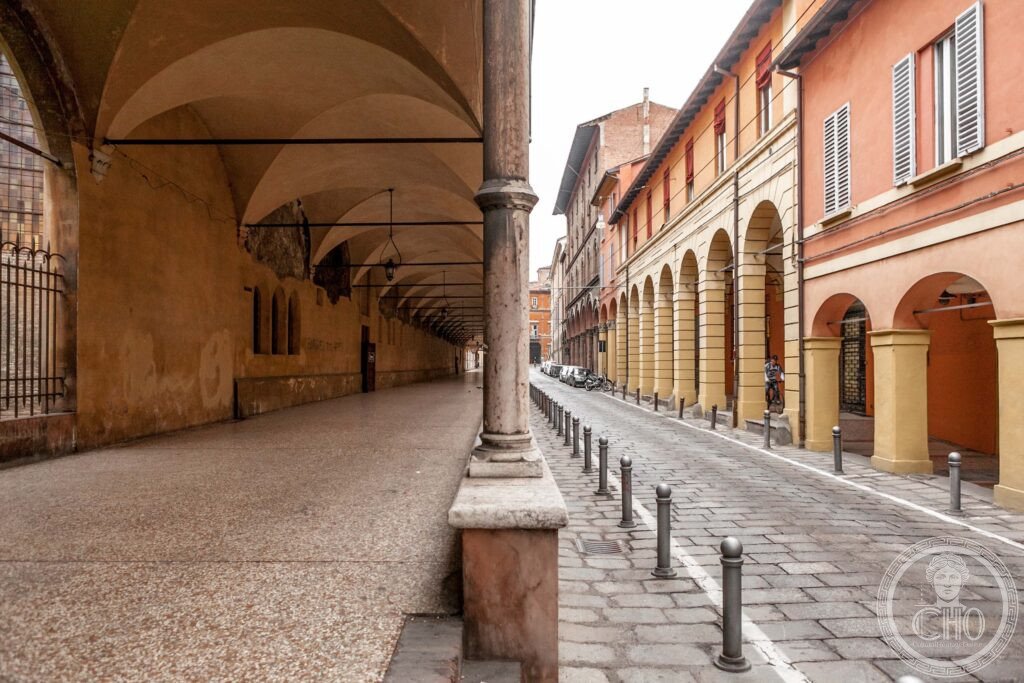
Nearly forty kilometres of vaulted arcades still shelter the streets of Bologna, a covered walking city built over nine centuries by private owners obeying a shared medieval rule. The porticoes let residents cross the centre in any weather, and the single Portico di San Luca climbs uninterrupted from the plain to its hilltop sanctuary.
At a glance
The porticoes of Bologna are a vernacular building type: from the eleventh century onwards, owners of timber-framed houses extended their upper floors over the public street to gain space, resting the addition on wooden posts along the pavement. Municipal law took over the practice from the twelfth century, fixing a minimum height and standard spacing so that, despite being built piecemeal by different private owners over nine centuries, the street reads as a single continuous vault. The portico strip remains private property in law, but owners are bound to keep it open to public passage, an obligation that has governed Bologna’s streets since the twelfth century and still applies to the surviving arcades today.
Of an original network reckoned at some sixty-two kilometres, about thirty-eight survive, concentrated in the historic centre. Twelve separate groups of portico, chosen to represent the different building types and social functions of the network, from the university quarter to the market streets to the pilgrimage route, were inscribed as a UNESCO World Heritage Site in 2021.
Key facts
- Type: continuous arcaded street porticoes, covered public walkways over private ground floors
- Location: historic centre of Bologna, Emilia-Romagna, along Via dell’Indipendenza and other streets
- Longest single portico: the Portico di San Luca, roughly 3.8 kilometres long with 666 arches, linking Porta Saragozza to the Sanctuary of the Madonna di San Luca
- Surviving length: around 38 kilometres, out of an estimated original 62 kilometres before nineteenth and twentieth-century demolitions
- Heritage status: twelve groups of Bologna porticoes inscribed on the UNESCO World Heritage List in 2021, reference 1650
History
The earliest Bolognese porticoes date from around the mid-eleventh century, when owners of timber-framed houses began extending their upper storeys over the street on wooden posts to gain floor space at minimal cost. The practice spread quickly, encouraged by the growth of the University of Bologna, founded in 1088, whose students needed housing above street-level shops. Bologna’s chronicles describe portico building as already established practice before 1100.
The city government began regulating the arcades in 1162, setting rules on height and public access, and issued a definitive statute in 1288 fixing a minimum clearance and standard column spacing across the city. Timber columns were gradually replaced with stone through the thirteenth century, a shift accelerated by a fire in 1272 that destroyed much timber construction. The Portico di San Luca, the longest single stretch, was built between 1674 and 1739, financed section by section by guilds, noble families and confraternities, each paying for the arches bearing their arms.
Bologna’s modernisation in the nineteenth and early twentieth centuries brought the demolition of a substantial part of the network, reducing the original extent by roughly two fifths. What survives, concentrated in the historic centre, was recognised by UNESCO in 2021, with twelve representative groups of portico placed on the World Heritage List.
What you see
Bologna’s porticoes come in several distinct forms. The rarest is the early wooden-column type, of which a handful of bays survive in Via Musei, their slender timber posts topped with Romanesque stone capitals carved with foliage and grotesque faces. Far more common is the stone-column portico of the twelfth and thirteenth centuries, seen along Via dell’Indipendenza and Strada Maggiore, with tall round columns in local sandstone or, on the grandest streets, imported red Verona marble. From the fourteenth century, heavier brick piers took over as upper floors were built in brick rather than timber, a type well preserved around Piazza di Porta Ravegnana beside the Two Towers. Piazza Maggiore shows a fourth variant, the colonnaded civic arcade, most notably around the Palazzo del Podestà, rebuilt in the late fifteenth century, whose portico runs on all four sides beneath unusually massive corner columns.
The Portico di San Luca is the longest of all, rising without a break from the Porta Saragozza gate to the hilltop Sanctuary of the Madonna di San Luca. Each of its 666 arches carries a small cartouche recording the guild, family or confraternity that paid for it, and the icon of the Madonna is carried down this route in an annual procession to Bologna Cathedral each spring, a tradition that has continued since 1433.
Practical information
- Access: the porticoes are open public space with no entry ticket, walkable at any hour
- Suggested route: from Piazza Maggiore, visitors can walk Via dell’Indipendenza’s stone-column arcades, the brick piers near the Two Towers, and the rare wooden columns of Via Musei in a single circuit
- Portico di San Luca: can be walked in full from Porta Saragozza to the Sanctuary, or sampled for its first arches; current access details are best checked with the local tourist office
- Guided information: archival records on the sponsors of the San Luca arches are held at the Archiginnasio library in Bologna
Getting there
The porticoes run through the historic centre of Bologna and are best reached on foot from Piazza Maggiore, the city’s main square. Porta Saragozza, the starting point for the Portico di San Luca, lies at the edge of the old walls and is likewise reachable on foot or by local public transport from the centre.
Nearby
- Piazza Maggiore — the civic heart of Bologna, ringed by its own colonnaded portico including the Palazzo del Podestà
- Due Torri (Piazza di Porta Ravegnana) — Bologna’s landmark medieval towers, beside the densest surviving brick-pier portico
- Via Musei — home to the rare surviving bays of the earliest wooden-column portico type
- Sanctuary of the Madonna di San Luca — the hilltop church at the end of the 3.8-kilometre Portico di San Luca
Sources
- UNESCO
- Archiginnasio library, Bologna
Find it on the map
See this place and what’s around it →📷 Become a Cultural Heritage Online photographer
Share your photos of places: they stay published under your name as the author. The more they're seen, the more you get noticed — and soon a contest will reward the most appreciated photos.
Log in or sign up free to add a photo