
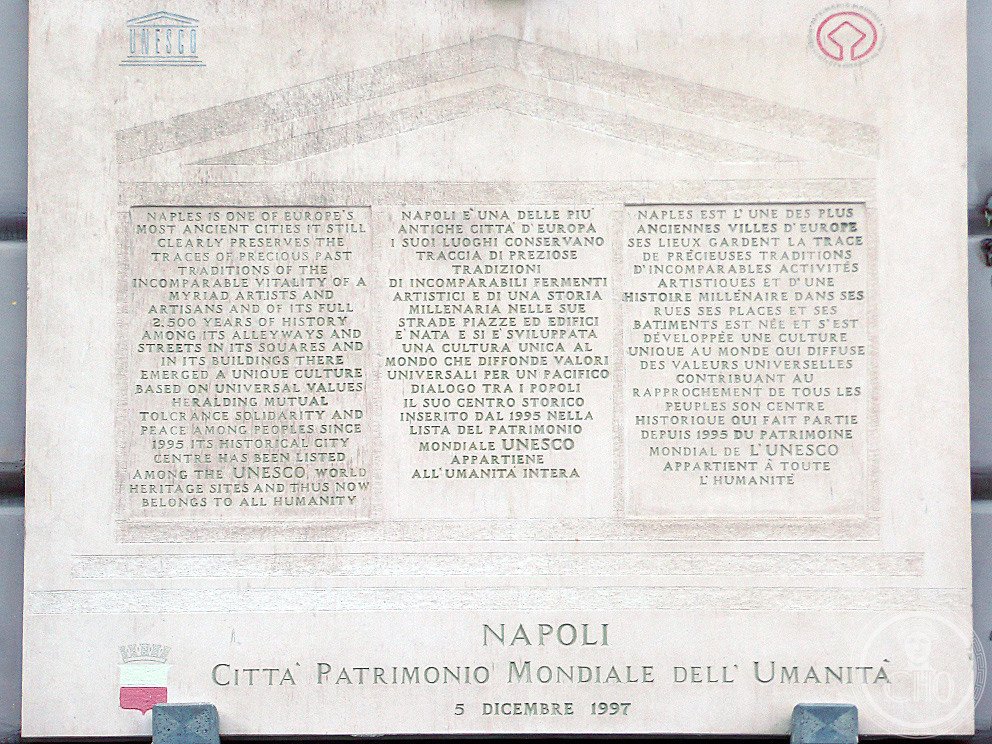
Centro Storico di Napoli
The most densely built, most continuously inhabited, and most architecturally layered urban UNESCO World Heritage Site in the world — Naples (UNESCO WHS 1995) has been inhabited for 2,500 years on the same street grid, accumulated 1,700 churches, buried two Graeco-Roman cities underground (Neapolis below the Decumani, Cumae at the edge of the plain), and produced the world’s most complex street-level vertical stratigraphy anywhere outside Rome.
At a glance
Naples Historic Centre (the most precisely NapoliCentroStorico single Naples city Campania Italy 40.8518 N 14.2681 E UNESCO WHS 1995 reference 726 historic centre of Naples 1700 churches densest concentration religious architecture any city Italy densest historic centre UNESCO WHS any European city by building floor area per hectare Greek Neapolis founded c.470 BCE by settlers from Cumae and Pithekoussa the colony name: Neapolis (New City) the grid: 3 decumani (east-west avenues — Tribunali Anticaglia Spaccanapoli) crossed by cardines (north-south streets) the grid footprint: still perfectly readable in satellite view after 2500 years current population UNESCO buffer zone approximately 1 million the underground: 2500 years of construction above 2500 years of buried city the specific depth: the current street level along Via dei Tribunali is approximately 6-8 metres ABOVE the original Greek street level of 470 BCE — Naples is Rome multiplied by 2000 years of additional layering).
Key facts
- The Spaccanapoli axis (why the straight line you see on the map is the most important street in Italian history): Spaccanapoli (literally “Naples-splitter”; formal name: Via Benedetto Croce + Via San Biagio dei Librai + Via Vicaria Vecchia; the southern Decumano Inferiore of ancient Neapolis) is the most historically significant single street in Italy that is not Via Appia — it was laid out by Greek colonists from Cumae in approximately 470 BCE as the southern main street of their new colony; the street has been continuously occupied since that moment; the current buildings above it range from 13th century CE to 20th century CE; walking Spaccanapoli from the Gesù Nuovo (1601 CE; Jesuit church with the diamante-faceted stone exterior) to the Basilica di Santa Chiara (1310 CE; Robert of Anjou; the largest church in Naples; the destroyed and rebuilt Gothic interior; the extraordinary 18th-century majolica cloister behind the church — the most colourful and completely tiled cloister garden in Italy, added 1739 CE by Domenico Antonio Vaccaro, each column and bench covered in pastoral Neapolitan scenes in tin-glazed earthenware) takes approximately 45 minutes and passes 2,500 years of Neapolitan civilization at street level
- GPS: 40.8518° N, 14.2681° E (Piazza del Gesù Nuovo, the western anchor of Spaccanapoli)
History
From Greek colony to UNESCO heritage via Norman, Hohenstaufen, Angevin, Aragonese, Bourbon, and Unified Italian rule (the most precisely NapoliCentroStorico single c.600 BCE Pithekoussa and Cumae Greek colonies Bay of Naples 470 BCE Neapolis founded by settlers from Cumae as new colony to replace older Cumae as commercial port hippodamic grid plan 3 decumani 10 cardines orthogonal streets 326 BCE Rome conquered Naples Roman-Neapolitan coexistence city kept Greek character through late antiquity 6th CE Byzantine Naples 763 CE independent Duchy of Naples 1139 CE Norman conquest Roger II Sicily Aragon 1139 CE capital Kingdom of Sicily Norman period: Castel dell Capuano 1165 CE Castel dell Ovo 1154 CE original Norman fortresses 1266 CE Charles of Anjou French Angevin dynasty conquered Naples capital of Kingdom of Naples most important medieval city Italy after Rome Angevin period: the greatest 13th 14th century building campaign in southern Italy Castel Nuovo 1279 CE the 3 Gothic chapels MUSA now: Palatine Chapel with Giotto frescoes surviving fragments; Santa Chiara 1310 CE Gothic basilica; Cathedral 1294 CE Gothic begun rebuilt multiple times 1442 CE Alfonso V Aragon Aragonese Naples 1442 1504 CE Aragonese period: the University of Naples Federico II (founded 1224 CE Frederick II — the first state university in the world, created by imperial decree, open to all subjects not just monks) academic tradition Spanish rule 1504 CE Charles I Spain (Charles V HRE) Spain 1700 CE 300 years direct or indirect Spanish rule the profound Spanish imprint on Neapolitan culture: language (dialect), architecture, religious confraternities, the Presepe (nativity crib — a Spanish devotional import that became Neapolitan high art: the Crib Workshop Street, San Gregorio Armeno, where artisans make nativity figures year-round, is the most photographed artisan street in southern Italy) 1734 CE Charles of Bourbon conquered Naples Kingdom of Naples (Sicily) 1738 CE Reggia di Portici 1738 1758 CE first excavations Herculaneum and Pompeii Bourbon patronage drove the discovery of the buried cities 1799 CE Neapolitan Republic briefly revolutionary 1799 1806 CE Napoleon installed Joseph Bonaparte 1815 CE Bourbon restoration 1861 CE Unification Italy Naples capital Kingdom Italy briefly 1865 CE Turin/Florence 1871 CE Rome capital 1995 CE UNESCO WHS).
What you see
The Decumani, the underground, Cappella Sansevero, and the San Gregorio Armeno artisans (the most precisely NapoliCentroStorico single Via Tribunali the most concentrated medieval architecture Naples 3 key buildings on the Tribunali axis: San Lorenzo Maggiore (1235 CE; the only Gothic church in Naples to preserve the original shape of the Greek agora and Roman macellum in its apse (accessed via the underground museum beneath the church; the excavated layers from Greek Neapolis street through Roman forum level to medieval church foundation are all visible and dated; the most stratigraphically clear single site in Naples); San Gregorio Armeno (the nuns embroidering street; the baroque church 1574 CE; but the street is famous for the presepe workshops that line it all year — the most famous nativity scene artisan street in the world; the shops sell traditional terracotta figures of shepherds, angels, and the Holy Family alongside satirical contemporary figures (politicians, footballers, celebrities added to traditional cribs — a tradition going back to 18th century CE when Neapolitan nobles commissioned cribs with miniature portraits of themselves and famous people)); Cappella Sansevero (1590 CE started; the chapel of the Sangro di Sansevero family; the collection of the most technically extreme marble sculptures in Italy: the Cristo Velato (Veiled Christ; 1753 CE; Giuseppe Sanmartino; the thin transparent veil over the face of Christ in reclining dead position the veil appears made of wet cloth not marble; the most visited single object in any Neapolitan museum); the Pudicizia (Modesty; 1752 CE; Antonio Corradini; the female figure with face covered by transparent marble veil); the Disillusion (Disinganno; 1754 CE; Francesco Queirolo; a figure extricating itself from a marble net — technically the most demanding marble carving in the Baroque period); admission timed; advance booking required at museosansevero.it; last entry 1 hour before close): Napoli Sotterranea (Naples underground; Via dei Tribunali 294; entrance in front of San Paolo Maggiore; the most comprehensive urban subterranean tour of ancient infrastructure in Italy; 2500 sq m of tunnels dating from Greek cisterns 470 BCE through Roman aqueduct system through WWII bomb shelter use 1940s CE; 40-metre descent into the Roman aqueduct; total tour 90 minutes; guided in Italian and English; advance booking recommended at napolisotterranea.org).
Practical information
- Getting there and navigating: from Rome: Frecciarossa 1h10m (very frequent; €20–50 base fare; the most traffic-heavy intercity rail connection in Italy after Milan-Rome); from Caserta: 40 min regional; Napoli Centrale (the main station; 2 min walk to piazza Garibaldi; 15 min walk to Via Tribunali via Piazza Dante; or metro Line 1 to Dante station — the metro station designed by Alberto Garutti (Dante 2002 CE) is the most art-filled metro station in Italy after Toledo); city navigation (the UNESCO centre is entirely walkable but the streets are narrow and motorcycles are constant; pickpocket risk above Italian average — one should keep a front pocket for phone; the Spaccanapoli / Tribunali / San Gregorio Armeno area is daytime safe and heavily visited; avoid the areas east of Piazza Garibaldi at night); best time (October–May; June–September: extremely hot and crowded; December: the San Gregorio Armeno nativity streets are at their most elaborate — many Neapolitans visit specifically in December for the presepe; the Cappella Sansevero is popular year-round but early-morning visits (before 10 AM) are significantly less crowded)); budget (Cappella Sansevero €10; Napoli Sotterranea €10; San Lorenzo Maggiore underground €9; free: all churches including the Santa Chiara cloister (separate entrance €6); the National Archaeological Museum (UNESCO-adjacent; Via Museo 19; the Secret Cabinet of Pompeii erotica; the Farnese Bull (3.7m height marble; the largest sculpture surviving from antiquity); €12; closed Tuesdays)); the Margherita pizza (the pizza was invented in Naples: specifically in 1889 CE by Raffaele Esposito of Pizzeria Brandi (Via Chiaia 1; the oldest continuously operating pizzeria in Naples) for Queen Margherita of Savoy’s visit; the tricolore: tomato (red), mozzarella (white), basil (green); Brandi makes it from 1889 CE original recipe; Spaccanapoli has 15+ Associazione Verace Pizza Napoletana certified pizzerias within 500m
Getting there
From Rome: Frecciarossa 1h10m. From Caserta: 40 min. Metro Line 1 to Dante (art metro). UNESCO centre walkable but narrow streets. Best October–May. December for nativity streets. Sansevero €10 (book museosansevero.it). Napoli Sotterranea €10. GPS: 40.8518, 14.2681.
Nearby
- Reggia di Caserta — 40 km north (UNESCO WHS 1997; the Bourbon royal palace 1752 CE Vanvitelli; 1200 rooms; 3 km park; Grande Cascata 68m; the Caserta Surrender of 29 April 1945 CE — the first German military surrender of WWII, signed in the Reggia; 40 min train from Naples Centrale)
- Pompeii e Ercolano — 25 km south-east (UNESCO WHS 1997; buried 79 CE; Pompeii 66 hectares excavated; Herculaneum better preserved; Circumvesuviana train from Napoli Centrale to Pompeii scavi (45 min) or Ercolano scavi (20 min); do both in one day with early start)
Gallery
Sources
- Wikipedia, Historic Centre of Naples; Spaccanapoli; Cappella Sansevero; Napoli Sotterranea; Pizza Margherita; University of Naples Federico II, accessed June 2026
- UNESCO, Historic Centre of Naples, WHS reference 726, inscribed 1995
Find it on the map
See this place and what’s around it →📷 Diventa un fotografo di Cultural Heritage Online
Condividi le tue foto dei luoghi: restano pubblicate con la tua firma come autore. Più vengono viste, più ti fai conoscere — e presto un concorso premierà le foto più apprezzate.
Accedi o registrati gratis per aggiungere una foto