
Centro Storico di Siena
The best-preserved large medieval city in the world and the place where the Italian school of painting made its most original contribution to Western art — Siena (UNESCO WHS 1995) reached its maximum power and cultural achievement in 1300 CE, was devastated by the Black Death in 1348 CE (losing two-thirds of its population), and as a result was never substantially rebuilt, preserving its Gothic urban fabric intact for 700 years.
At a glance
Siena (the most precisely SienaCentroStorico single Siena city Toscana Italy 43.3186 N 11.3310 E UNESCO WHS 1995 reference 717 largest intact medieval city Italy medieval population approximately 100,000 mid-14th century contemporary of Paris and Venice the 1348 CE Black Death effect: city lost 2/3 population reduced to 30,000 never recovered to medieval size never rebuilt in Renaissance or Baroque style city plan: 3 hills terzi (Terzo di Città Terzo di San Martino Terzo di Camollia) meeting at the central Campo 17 contrade (ward/borough divisions) with fierce local identity governing the 2 annual Palio horse races (July 2 and August 16) the Gothic building stock: 13th 14th century predominantly the Campo and Cathedral and major towers all Gothic 400 medieval towers originally 50-60 still standing medieval Siena economic base: banking the Monte dei Paschi di Siena founded 1472 CE still operating as the world’s oldest bank; the Sienese banking families funded 13th 14th century art commissions that produced the Italian School of painting).
Key facts
- Duccio di Buoninsegna and the Maestà (how the most celebrated single painting commission of the Middle Ages changed how Italian painters drew space): Duccio di Buoninsegna (c.1255–1319 CE; Sienese; the founder of the Sienese School) received the commission for the Maestà (Majesty; 1308–1311 CE; egg tempera on wood; 214cm × 412cm; central front panel; the Virgin in Majesty surrounded by saints and angels — the largest and most expensive single altarpiece commission in Italian painting history at that date) from the Siena Cathedral Opera del Duomo; the altarpiece was completed in 1311 CE and transported from Duccio’s workshop to the Cathedral in a formal procession involving the entire city — the most documented public celebration of a painting in medieval Italy; the Maestà is now in the Museo dell’Opera del Duomo (the building at the south end of the unfinished Facciatone — the unbuilt nave of the Cathedral that would have been the largest Gothic cathedral in Europe if completed before the 1348 plague); the key innovation: the gold-background Byzantine convention (flat, hieratic, no spatial recession) modified by Duccio to include the first consistent spatial depth in Italian painting — the throne of the Virgin has geometric recession, not flat gold; the figures have volume below the surface; the Sienese innovation (gold-ground depth without full perspectival space) is what distinguishes the Sienese from the Florentine approach: Giotto in Florence was doing volumetric figures in architectural space at the same time; Duccio was doing gold-ground figures with subtle spatial depth; neither approach has been fully understood as more revolutionary than the other — they solved different problems simultaneously in adjacent cities
- GPS: 43.3186° N, 11.3310° E (Piazza del Campo)
History
From Etruscan hill town to medieval banking capital to UNESCO heritage (the most precisely SienaCentroStorico single Etruscan settlement archaeological evidence on hills BCE 900 700 BCE Roman conquest Roman Saena Julia colony 1st century BCE medieval rebirth 11th 12th century CE independence from bishop communal self-governance 1000s CE Comune di Siena 1167 CE Republic of Siena independent 1260 CE Battle of Montaperti Siena vs Florence Sienese victory the most famous single battle of medieval Tuscan history: Sienese Ghibellines defeated Florentine Guelphs; the Arbia river ran red with blood (Dante Inferno 10.86) though the number is traditionally given as 10,000 Florentine dead 1287 CE Governo dei Nove (government of the nine) most stable Sienese government Campo commission: the 9 marble ribs dividing the Campo correspond to this period 1308 CE Duccio commission 1311 CE Maestà installed 1315 CE Simone Martini Maestà Sala del Mappamondo Palazzo Pubblico the secular equivalent 1337 CE Ambrogio Lorenzetti begins Effects of Good and Bad Government Palazzo Pubblico the first landscape fresco in European secular art and the most complete programme of civic propaganda in any medieval painting cycle: the Allegory of Good Government (the crowned allegory of the Commune of Siena; the personifications of Justice, Wisdom, Peace, and the theological virtues arranged around it) and the depiction of a prosperous Sienese city under good government (recognizable buildings; merchants; craftsmen; dancers; animals; the first panoramic cityscape in medieval art — you can identify specific buildings in the background that still exist in Siena today) 1348 CE Black Death Siena: autumn-winter 1348 CE approximately 65,000-80,000 dead out of 100,000 population the most devastating single city plague loss in Italy; city never recovered the Lorenzetti brothers both died 1348 CE; the building programme stopped; the Duomo nave project (Facciatone) abandoned; the economic dominance ended 1555 CE Florence Medici conquered Siena Republic ended 1995 CE UNESCO WHS).
What you see
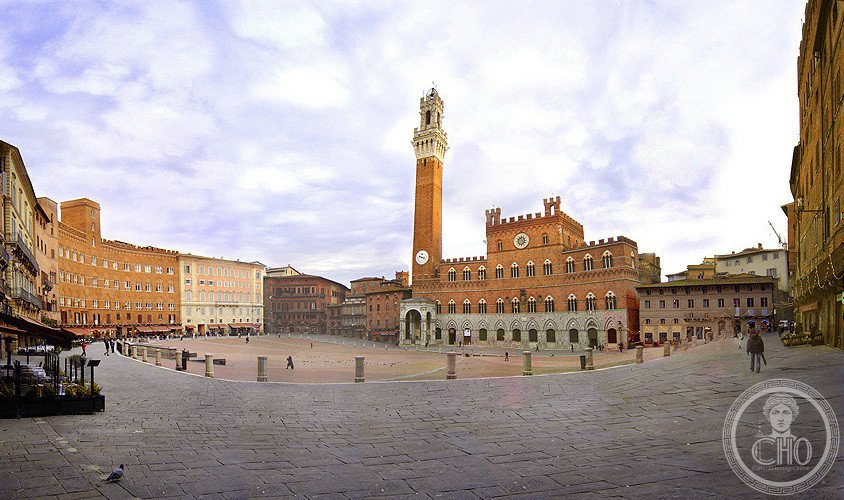
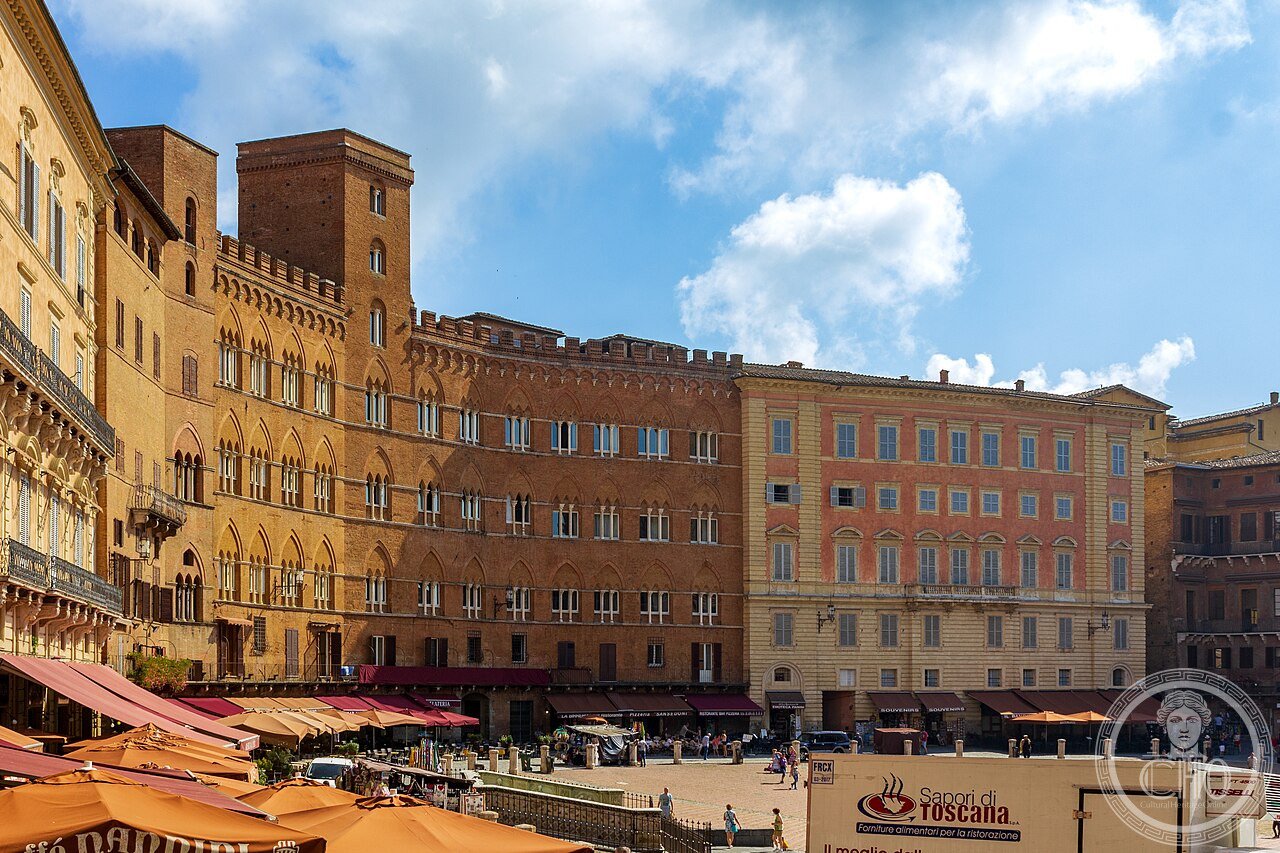
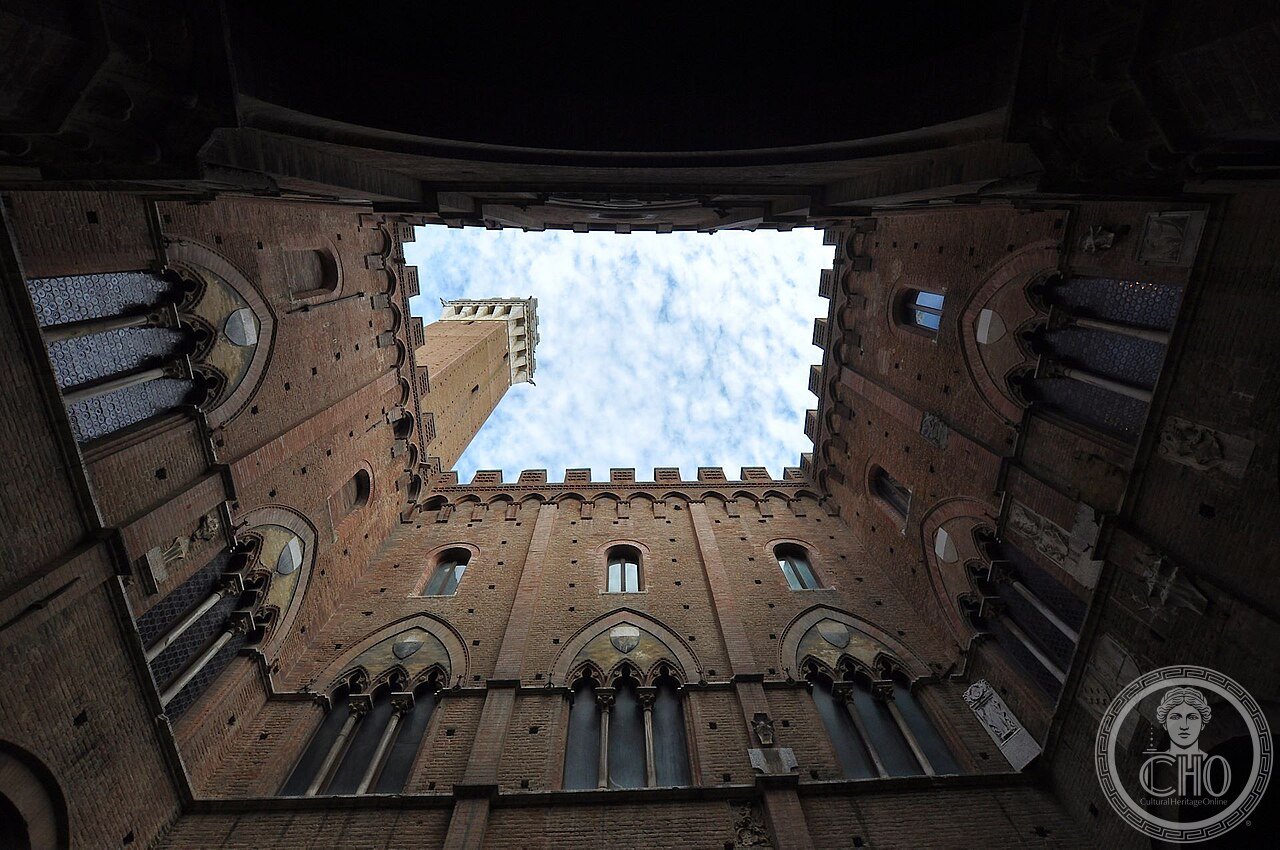
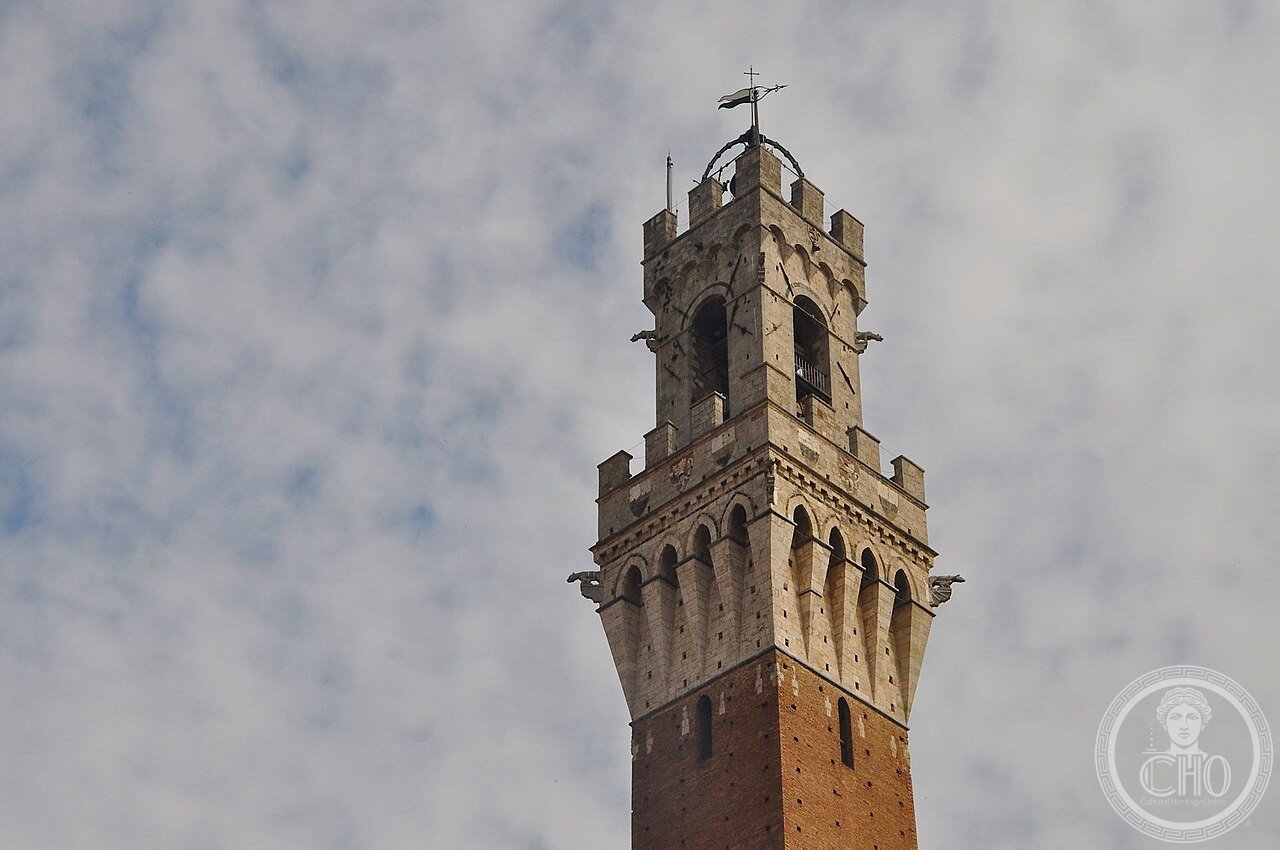
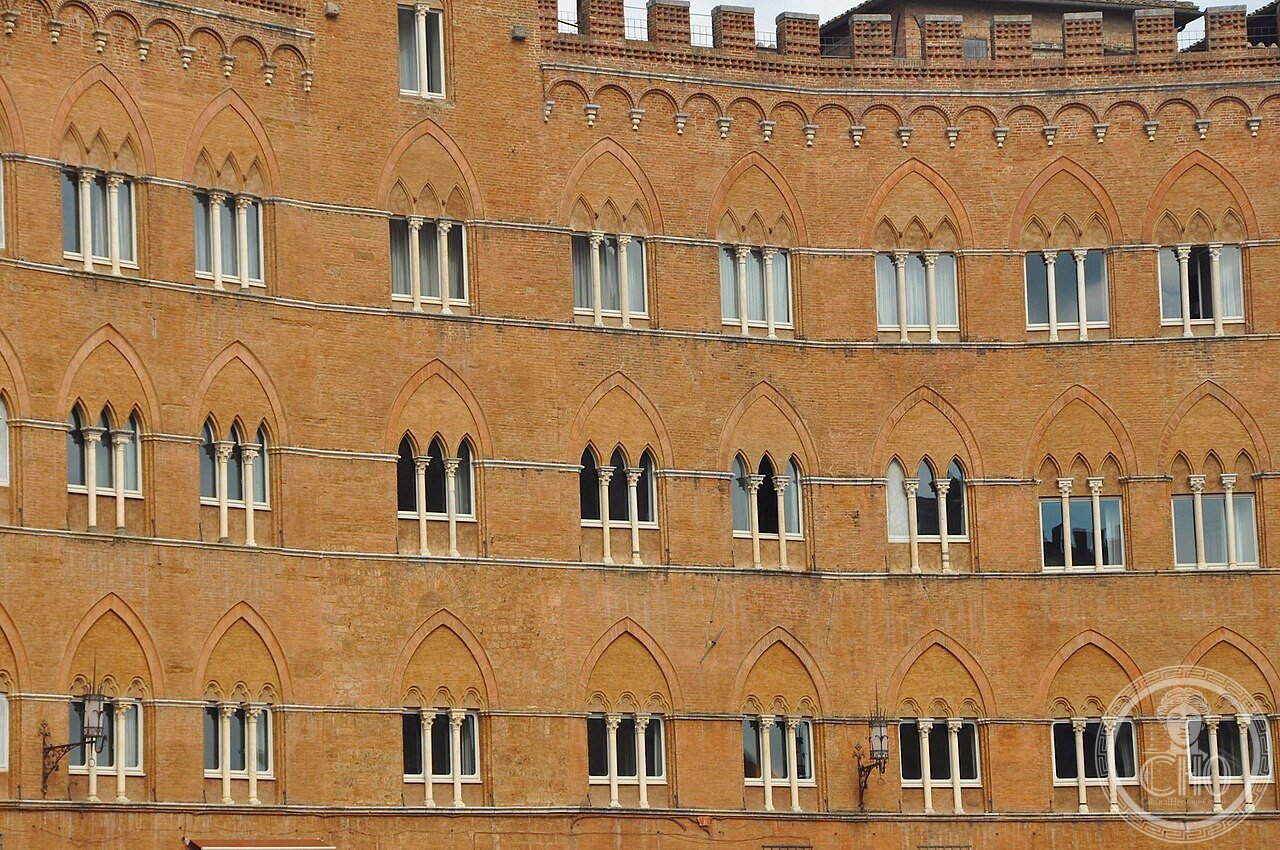
The Campo, the Duomo, the Palazzo Pubblico frescoes, and the contrade (the most precisely SienaCentroStorico single Piazza del Campo the physical slope toward the Palazzo Pubblico is 10-15 degrees real tilt; you feel it standing in the campo; 9 sectors of rust-coloured herringbone brick divided by 8 white marble ribs; the sector count references the Governo dei Nove the Campo programme: from October 1297 CE the opera decided to pave the Campo and control the facades all around it (the decision is documented in the Statuto of Siena 1309 CE — the oldest urban planning zoning regulation in Italy that specifies building appearance requirements: all facades facing the Campo must use the biforate (twin arched) window type used on the Palazzo Pubblico — every facing facade on the Campo has been following this single architectural specification since 1309 CE); the only exception: the Palazzo Chigi-Saracini (northeast corner; different window type; the only Campo building not compliant); Palazzo Pubblico 1297 1310 CE Gothic city hall; Sala del Mappamondo: Simone Martini Maestà 1315 CE (secular city hall Maestà — same subject as Duccio’s Cathedral altarpiece but for the civic seat of government; the political message: the Virgin and Child support the Commune, not just the Church); Sala della Pace: the Lorenzetti Good Government cycle 1337 1340 CE the most important surviving civic fresco cycle in Italy; Torre del Mangia 102m 1348 CE (construction began; the Black Death interrupted but did not stop the tower completion); entry to Palazzo Pubblico €12; Museo Civico with frescoes included; Duomo: 1215 CE begun Gothic nave 1359 CE completed; the Piccolomini Library (1492 CE; Bernardino Pinturicchio frescoes 1502 1508 CE; ten cycles of the life of Aeneas Silvius Piccolomini (Pope Pius II) the most complete fresco narrative of a historical figure’s life in 15th-century Italy); the Libreria floor tiles (52 inlaid marble narrative tiles 14th 17th century CE; the marble floor visible beneath protective boards is the most extensive marble intarsia floor in any Italian church — 56 scenes covering 3,000 square metres); Battistero di San Giovanni (the baptistery beneath the duomo apse; the Baptismal Font 1417 1431 CE gilded bronze Donatello Jacopo della Quercia Lorenzo Ghiberti contributed panels — the most important baptismal font commission of the early 15th century and the commission that pre-dates the Florence Baptistery doors competition where the same Ghiberti won); Museo dell’Opera del Duomo: the Maestà di Duccio 1311 CE (the front panel only — the back panels are dispersed across European and American museums) and the original Pisano statues from the Cathedral facade (the originals inside; copies outside; the Giovanni Pisano 1284 1296 CE prophets and sibyls — the most emotionally charged Gothic sculptural programme in Italy)).
Practical information
- Getting there and navigating: from Florence: bus (Sena/Tiemme; 1h15m; most efficient; from Santa Maria Novella bus station; departs frequently); train from Florence (1h45m; change at Empoli; less convenient than bus); car parking (Parcheggio il Campo; outside the ZTL; the historic centre is completely pedestrian and in many parts has steep grades — walking Siena requires reasonable fitness); the Palio (July 2 and August 16 CE; the horse race around the Campo perimeter; 10 of the 17 contrade race; riders in contrade colours; the race lasts approximately 90 seconds; preparation includes the assigning of horses by lot several days before (the ceremony of the tratta); for free standing in the Campo: arrive by 2 PM for the July 2 race and claim a position at the Campo perimeter; there is no exit until the race ends — approximately 3-4 hours standing; for grandstand seats: €300-600 per seat on the façade of the palazzi surrounding the Campo — book through the specific palazzo owners 6-12 months in advance; the contrade dinner (cena della prova generale; on the eve of the race, each contrada holds a banquet for its members in the streets of its quarter — many hundreds of tables; Sienese of all ages; outsiders can join by walking into the quarter during the evening — this is the most authentic Sienese social experience and requires no ticket)); the Osteria Grassa rule (the best food in Siena is in the enoteca and osteria in the streets of the Terzo di Città around the campo — not in the touristy restaurants on the Campo itself; duck liver crostini and Cinta Senese pork are the Sienese food markers)
Getting there
From Florence: bus 1h15m (most efficient; Santa Maria Novella bus station). Train 1h45m change at Empoli. Car parking outside ZTL. Entirely pedestrian, steep grades. Palio: July 2 + Aug 16 (Campo free 2 PM, stands €300-600). Book advance at osterie in Terzo di Città not Campo restaurants. GPS: 43.3186, 11.3310.
Nearby
- San Gimignano — 45 km north-west (UNESCO WHS 1990; the medieval tower city; 14 towers surviving of 72 original; the Collegiate church frescoes (Bartolo di Fredi; Barna da Siena; 14th century CE); the Museum of Torture in a medieval tower (the most visited single attraction in San Gimignano — not the art, but the torture devices; Florentine and San Gimignano scholars disagree strongly on whether this is an appropriate use of a medieval tower); the Vernaccia di San Gimignano DOCG (the first Italian wine to receive DOC designation in 1966 CE; the white wine made from Vernaccia grape unique to this microclimate; the best producers: Panizzi, Terruzi, Montenidoli))
- Val d’Orcia — 50 km south (UNESCO WHS 2004; the Renaissance agricultural landscape designed by the Piccolomini in the 15th century CE; Pienza (the ideal Renaissance city; 1459 CE commission by Pope Pius II Piccolomini); Montalcino and the Brunello di Montalcino DOCG (the most age-worthy Italian red wine; minimum 10 years to peak; the Biondi-Santi family created the style in 1870 CE from the Sangiovese Grosso (Brunello) grape cultivar they isolated on the Greppo estate))
Gallery
Sources
- Wikipedia, Siena; Piazza del Campo; Duccio di Buoninsegna; Ambrogio Lorenzetti; Siena Cathedral; Palio di Siena, accessed June 2026
- UNESCO, Historic Centre of Siena, WHS reference 717, inscribed 1995
Find it on the map
See this place and what’s around it →📷 Diventa un fotografo di Cultural Heritage Online
Condividi le tue foto dei luoghi: restano pubblicate con la tua firma come autore. Più vengono viste, più ti fai conoscere — e presto un concorso premierà le foto più apprezzate.
Accedi o registrati gratis per aggiungere una foto