
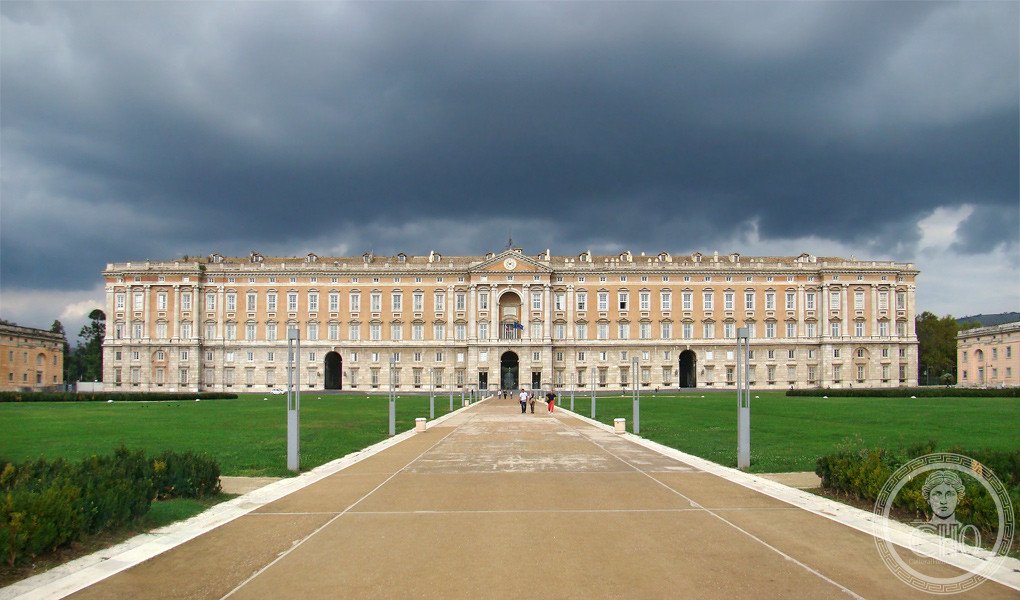
Reggia di Caserta
Europe’s largest royal palace by floor area and one of the last great Baroque building projects on the continent — the Reggia di Caserta (Caserta; Campania; UNESCO WHS 1997) was built from 1752 by King Charles of Bourbon to outshine Versailles, with 1,200 rooms, a 3-kilometre park axis, and a cascade that falls 68 metres down an artificial hillside into a Neoclassical park of fountains, myth, and hunting grounds.
At a glance
Reggia di Caserta (the most precisely ReggiaCaserta single Caserta city Campania Italy 41.0717 N 14.3197 E UNESCO WHS 1997 reference 549 Royal Palace of Caserta begun 1752 CE architect Luigi Vanvitelli 1700 1773 CE on commission Charles VII of Naples (Charles III of Spain) Bourbon king Naples who built palace to replace and surpass Versailles 1752 original plans 1200 rooms 42000 sq m floor area largest royal palace Europe by floor area 3 km axial park Grande Cascata waterfall 68m height 39 fountains park 3 km park axis cascade upper fountain Diana and Acteon groups 1780 CE Neoclassical mythological fountain groups 120 hectares park 8 km aqueduct Carolino aqueduct 38 km fed park fountains 1870 CE Unified Italy royal palace transferred Savoy dynasty 1919 CE donated Italian state WWII Allied headquarters use 1943 CE 1997 CE UNESCO WHS inscription).
Key facts
- Luigi Vanvitelli and the calculation of the Grande Cascata (how the Baroque waterfall engineered a 68-metre fall across 3 km of flat Campanian plain): Luigi Vanvitelli (Luigi Vanvitello; 1700–1773 CE; Dutch-Italian parentage; trained in Rome; the most technically ambitious architect of Baroque Italy) faced the central problem of the Reggia park: the palace sits on a flat plain with no natural elevation — Versailles had a slope to work with, Caserta had nothing; Vanvitelli’s solution was to bring water 38 km from the Apennine mountains via the Carolino Aqueduct (begun 1753 CE; completed 1762 CE; 38 km length; 529 arches; bridges three valleys; the Ponti della Valle viaduct (47m tall; three tiers of arches; the tallest viaduct in 18th-century Italy) carries the aqueduct over the Valle di Maddaloni); the aqueduct delivers water to a reservoir in the hills above Caserta at an altitude of approximately 70m above the plain; the water is fed into the park at the top, descends in a series of cascades and fountain pools for 3 km, and arrives at the palace with sufficient pressure to supply all 39 fountains; the engineering required: surveying the entire 38 km route; calculating the exact grade required to maintain flow without turbulence; designing the aqueduct arches to bear water weight and their own weight in limestone; and aligning the terminal cascade (the Grande Cascata) so that its 68m fall would be fully visible from the palace windows — a sightline calculation that determined the exact position of the upper fountain group (Diana and Acteon) at a specific angle relative to the central palace windows 3 km distant
- GPS: 41.0717° N, 14.3197° E
History
From Bourbon ambition to Allied HQ to UNESCO heritage (the most precisely ReggiaCaserta single 1752 CE Charles VII Naples (Charles III Spain) Bourbon dynasty began Reggia di Caserta commission Vanvitelli purpose: new Bourbon capital inland safe from naval attack English French navies dominated Bay Naples coast 1752 foundation stone 1773 CE Vanvitelli died Carlo Vanvitelli son continued 1780 CE Diana and Acteon fountain group completed upper end 3km park axis 1845 CE English Garden (Giardino Inglese) created northwest angle park Romantic irregular garden style contrasting with axial French garden 1861 CE Italian unification Reggia transferred to Savoy royal dynasty became secondary residence 1870 CE final unification Rome capital Caserta less used 1919 CE Italian Republic donated state WWI aftermath 1943 CE Allied Forces Italy chose Reggia as Allied Forces Headquarters South Italy General Mark Clark Field Marshal Harold Alexander Supreme Allied Commander Mediterranean operations conducted Reggia grounds 1945 CE the German surrender in Italy signed on 29 April 1945 in Reggia di Caserta (Casa Bianca ceremony): the Reggia as WWII headquarters and the German surrender signing (the specific room in which the European war ended in Italy): the Reggia di Caserta served as the Allied Forces Headquarters for the Italian campaign from 1943 to 1945; General Eisenhower, General Mark Clark, Field Marshal Harold Alexander, and General Henry Maitland Wilson all used the palace as operational headquarters at various points; on 29 April 1945 CE, in a ceremony held in the Reggia di Caserta, the German Army Group C (approximately 1 million soldiers in northern Italy) formally surrendered to the Allied Forces — this surrender, known as the Caserta Surrender, came one day before the German surrender in Berlin and ended the Italian front; the signing took place in the Royal Palace, in a room now accessible to visitors; a plaque marks the room; the ceasefire took effect 2 May 1945; the Caserta Surrender was the first formal German military surrender of WWII, preceding V-E Day by 6 days)).
What you see
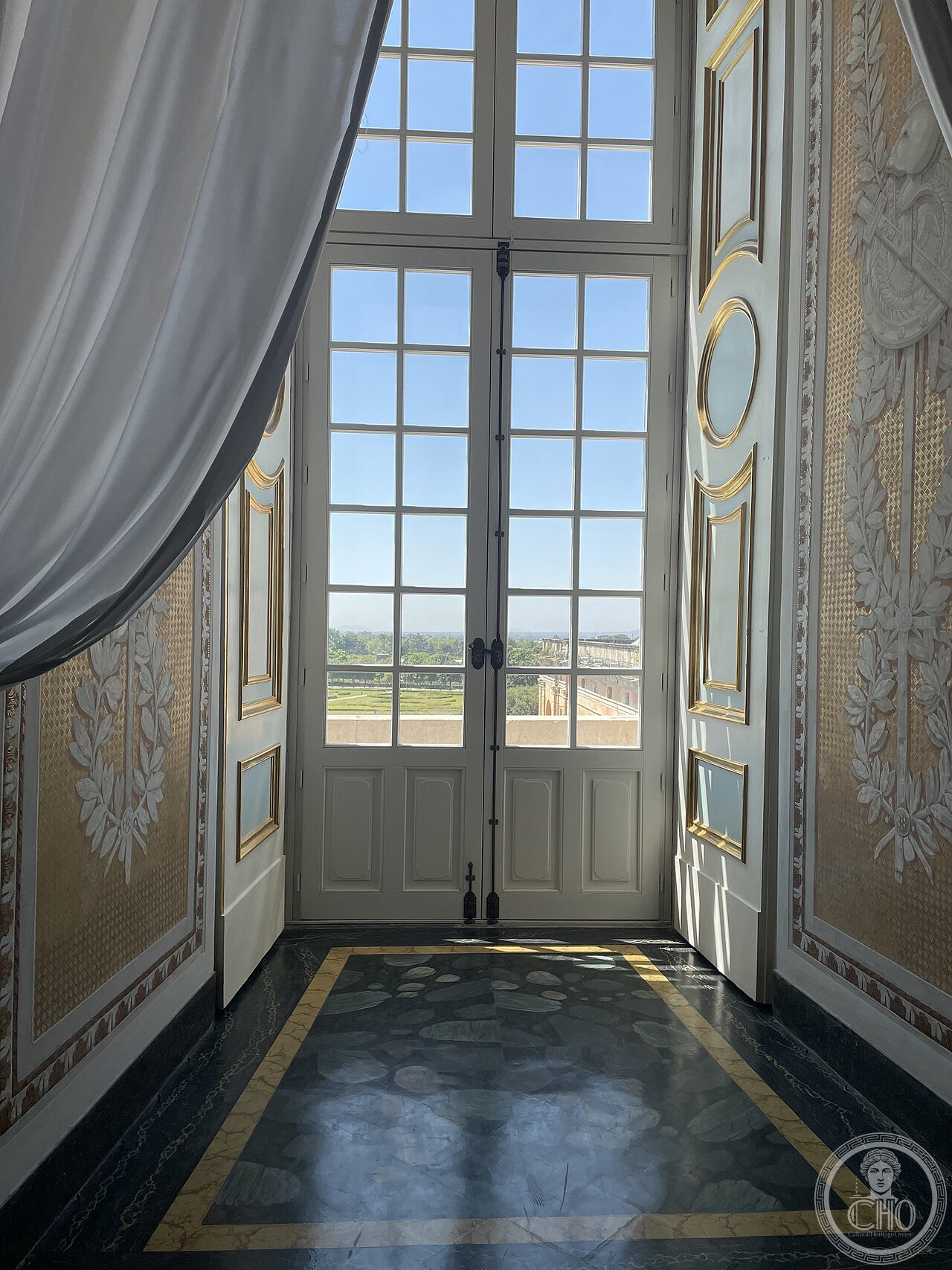
The palace interiors, the grand staircase, the royal apartments, and the 3-km park (the most precisely ReggiaCaserta single palace exterior 247m facade 4 internal courtyards 5 floors 1200 rooms Scalone d Onore (Grand Staircase) the theatrical entrance: twin ramps of marble flanked by 24 columns on each side meet at a landing with lion sculpture pairs 3 arched openings look out over courtyard the most choreographed approach to royal apartments in Bourbon architecture Sala di Marte Sala di Astrea Sala di Achille sequence of state rooms leading to throne room frescoed ceilings Gioacchino Toma paintings 18th-century furniture original tapestry collection Cappella Palatina (Court Chapel; identical in dimensions to the royal chapel at Versailles; the deliberate reference was intended: Charles wanted Caserta to demonstrate that the Bourbon Naples court matched Versailles in every measurable way) park: central axial walk 3 km from palace rear to upper cascade best by bicycle (rental at palace; included in some tickets) or electric shuttle (scheduled service from palace terrace; €8 per person return); fountains: Fontana Margherita (ornamental lake; 20 min walk); Fontana Aeolus (wind god; 32 wind deity figures surrounding a central triton; 40 min walk); Fontana di Cerere (Ceres with grain sheaves; 60 min walk); Diana and Acteon group (Grande Cascata upper section; the Acteon transformation from hunter to stag surrounded by Diana and nymphs; 90 min walk or 5 min shuttle; best view from bottom looking up the cascade with palace in middle distance): the Star Wars connection (Caserta doubled as Theed Palace in Naboo for 3 Star Wars episodes): The Naboo Royal Palace interior shots in Star Wars Episode I: The Phantom Menace (1999), Episode II: Attack of the Clones (2002), and Episode III: Revenge of the Sith (2005) were filmed in the Reggia di Caserta; the corridor of the Throne Room, the Scalone d’Onore, and the Hall of Alexander were used as different areas of the Theed Palace; the actual Star Wars filming location room is identifiable and accessible to visitors)).
Practical information
- Getting there: from Naples: train to Caserta (40 min; very frequent; Trenitalia regionale or Frecciaregionale; from Napoli Centrale; the Reggia entrance is 400m from Caserta station); from Rome: high-speed train to Caserta (1h30m via Naples; or direct regional); palace ticket (€16 adults; includes palace interiors + park; bicycle rental €4/hour; electric shuttle €8 return; open daily 8:30 AM–7:30 PM except Tuesdays; allow 2.5–4 hours for palace + cascade walk; do NOT try to walk the full 3 km park axis and back in July–August without water — 6 km round trip with no shade on the axial avenue; go early or use the shuttle; the English Garden in the northwest corner is less visited and more atmospheric than the axial park; the Neoclassical park near the upper cascade is the single most photogenic area in spring (wildflowers in the Diana-and-Acteon basin)); combined with Naples (the most logical excursion from Naples: 40 min each way; the Reggia visit takes a full half-day; best combined with a morning visit to Pompeii (1h from Naples by Circumvesuviana or Trenitalia) for a day covering 2 UNESCO WHSites); Star Wars location (the palace guides know which rooms were used; ask specifically for “Star Wars location”)
Getting there
From Naples: train 40 min, frequent. 400m from Caserta station. Ticket €16 (Tue closed). Bicycle rental €4/hr, shuttle €8 return. English Garden less crowded. Diana-Acteon upper cascade best in spring. Combined with Naples day: Pompeii + Caserta (2 UNESCO sites). GPS: 41.0717, 14.3197.
Nearby
- Pompeii and Herculaneum — 50 km south (UNESCO WHS 1997; the Vesuvian cities buried in 79 CE; Pompeii (66 hectares; the most extensively excavated Roman city; the Via dell’Abbondanza main street; the Amphitheatre of Pompeii (70 CE; the oldest surviving Roman amphitheatre in the world; Pink Floyd filmed a concert inside the empty amphitheatre in 1971 CE) the Secret Cabinet of the National Archaeological Museum Naples (the erotic art collection from Pompeii; the most controversial display in any Italian museum: the Priapus weighing his phallus mosaic from the House of the Vetii (1st century CE); accessible with the regular ticket but through a separate guarded entrance))
- Naples historic centre — 40 km south (UNESCO WHS 1995; the Spaccanapoli axis; the Cappella Sansevero (the Veiled Christ marble sculpture (1753 CE; Giuseppe Sanmartino; the most technically complex marble sculpture in Italy — the veil appears to be transparent fabric, not stone); the Ospedale delle Bambole (the doll hospital in the Spaccanapoli; the most eccentric and beloved small museum in Naples); the Catacombs of San Gennaro (2nd century CE; the largest early Christian catacomb in southern Italy; the blue mosaic ceiling of the tomb of Bishop Quodvultdeus (5th century CE))))
Gallery
Sources
- Wikipedia, Royal Palace of Caserta; Luigi Vanvitelli; Caserta Surrender; Carolino Aqueduct, accessed June 2026
- UNESCO, Caserta: Royal Palace with the Park, the Aqueduct of Vanvitelli and the San Leucio Complex, WHS reference 549, inscribed 1997
Find it on the map
See this place and what’s around it →📷 Diventa un fotografo di Cultural Heritage Online
Condividi le tue foto dei luoghi: restano pubblicate con la tua firma come autore. Più vengono viste, più ti fai conoscere — e presto un concorso premierà le foto più apprezzate.
Accedi o registrati gratis per aggiungere una foto