
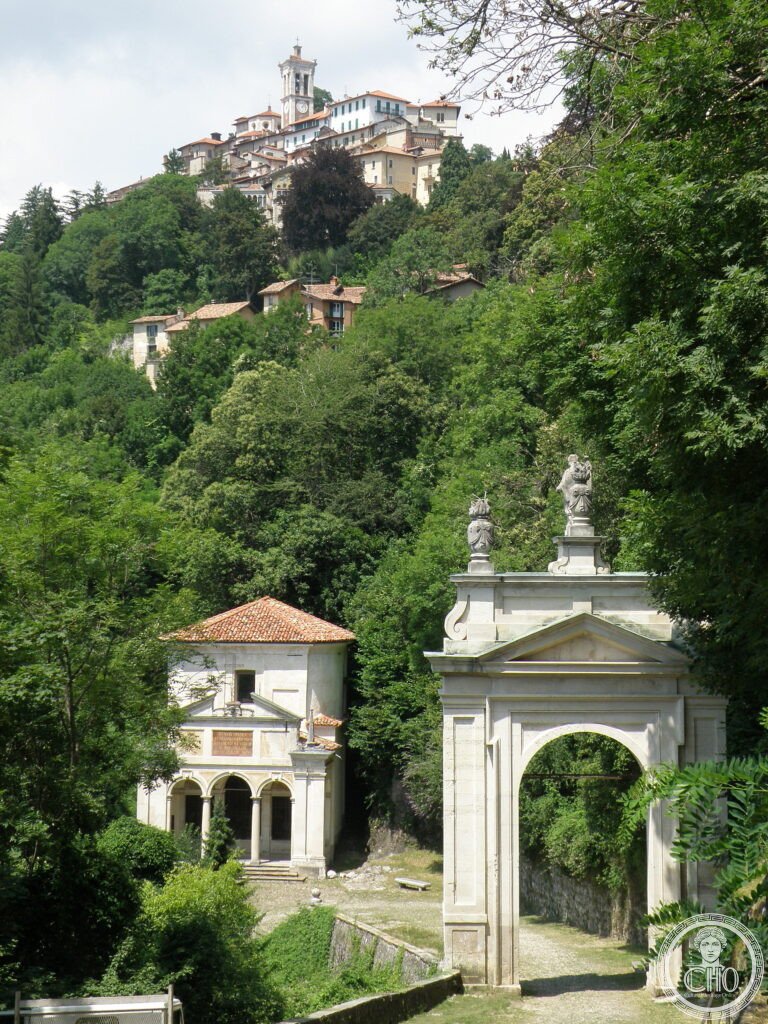
Nine hilltop pilgrimage routes across Piedmont and Lombardy translate the life of Christ, the mysteries of the Rosary and the lives of saints into chapels crowded with life-size terracotta figures and painted backdrops. Conceived as a substitute Jerusalem for pilgrims who could never reach the Holy Land, they remain one of the most unusual devotional landscapes in Italy.
At a glance
The Sacri Monti are a group of nine sacred mountains built between the late fifteenth and the seventeenth century in Piedmont and Lombardy. Each is a hillside route punctuated by chapels containing life-size terracotta figures set against fresco backgrounds, together forming a continuous devotional narrative. The idea began with the Franciscan friar Bernardino Caimi, who had served as guardian of the Christian holy places in Jerusalem and proposed recreating the topography of the Holy Land within the Alpine landscape.
The nine sites are Varallo in Valsesia, the oldest and largest; Oropa near Biella; Belmonte at Valperga; Montrigone at Crevola; Crea at Serralunga di Crea; Orta San Giulio on Lake Orta; Arona on Lake Maggiore; the Sacro Monte above Varese; and Ghiffa near Verbania on Lake Maggiore. Collectively the nine sites hold hundreds of chapels, statues and frescoes. UNESCO inscribed the group as a single serial World Heritage property in 2003, citing their significance as a Counter-Reformation devotional landscape and as an exceptional ensemble of sacred architecture.
Key facts
- Number of sites: nine, spread across Piedmont and Lombardy
- Founder of the concept: Bernardino Caimi, a Franciscan friar who had been guardian of the Holy Land
- Oldest site: Varallo in Valsesia, consecrated in 1491
- Key artist: Gaudenzio Ferrari, who painted the first major frescoes at Varallo between 1506 and 1528 and set the template followed at every site
- UNESCO status: inscribed in 2003 as a serial World Heritage property under criteria concerning Counter-Reformation devotional culture and sacred architecture
- Scale: the nine sites together contain several hundred chapels, statues and frescoes
History
The Sacri Monti originated with Bernardino Caimi, who returned to Italy in 1481 after the Ottoman conquests made continued Christian access to Jerusalem uncertain. He proposed building three-dimensional reproductions of the holy places within the Alpine hills, and Varallo was chosen for its resemblance to the Valley of Josaphat and for the rock outcrop at its summit that recalled Calvary. The site was consecrated in 1491, and between 1506 and 1528 Gaudenzio Ferrari painted the frescoes that combined with terracotta figures to create the format later repeated across the whole system.
The Council of Trent, which concluded in the 1560s, and the Counter-Reformation that followed gave the Sacri Monti a new theological purpose: they demonstrated the validity of saints’ veneration and of pilgrimage at a time when both were contested by Protestant reformers and when travel to Palestine was increasingly difficult. Under the patronage of Cardinal Federico Borromeo and the architect Pellegrino Tibaldi, Varallo was expanded from the 1580s with a more systematic narrative programme, and Carlo Borromeo visited the site in 1591 as part of a formal canonical inspection.
New Sacri Monti followed through the seventeenth century: Varese was founded in 1604 under the architect Giuseppe Bernascone, with fourteen chapels leading to the existing sanctuary of the Madonna del Monte; Orta was founded in 1617 around the life of Francis of Assisi; and Oropa was established in 1618 around its Black Madonna icon. Most of the remaining sites were completed during the seventeenth and eighteenth centuries. Varese was declared a national monument in 1821, and in 2003 UNESCO inscribed all nine Sacri Monti together as a single serial World Heritage property.
What you see
At Varese, the Via Sacra begins at the Piazza del Mosé in Santa Maria del Monte and climbs a cobbled path through woodland to the sanctuary above. Fourteen chapels punctuate the ascent, culminating in a chapel dedicated to the Coronation of the Virgin and a terrace at the summit with views over Lake Varese, Lake Maggiore and, on clear days, the Alps.
At Varallo, chapels can be reached on foot or by cable car and include the Piazza of the New Jerusalem, considered the most complex spatial arrangement in the whole system. Its Chapel of the Massacre of the Innocents is densely populated with terracotta children, soldiers and grieving mothers, arranged as a single dramatic tableau. At Oropa, the devotional focus is a dark twelfth-century icon of the Black Madonna, housed within a white Baroque basilica built in the nineteenth century. Orta’s twenty chapels follow the life of Francis of Assisi and are considered to retain more of their original painted surfaces than any other site in the group. Crea, set among the vineyards of Monferrato, has twenty-three chapels dedicated to the mysteries of the Virgin, while Ghiffa, with only three chapels, is the smallest and most intimate of the nine.
Throughout the system, figures were made from fired clay, painted in flesh tones with glue-based pigments, given painted or glass eyes, and dressed in real or carved fabric. Visitors traditionally view each scene from outside through a barred window, a device that heightens the sense of looking into a frozen moment rather than at a static sculpture group.
Practical information
- Access: the Via Sacra at Varese is walked on foot along a cobbled path; at Varallo a cable car is available as an alternative to walking.
- Viewing the chapels: most interiors are seen from outside through a barred window rather than entered directly.
- Opening times and any charges: these vary by site and season, so it is best to check directly with the relevant Sacro Monte or diocesan authority before visiting.
Getting there
The Sacri Monti lie across a wide area of Piedmont and Lombardy, from Varallo in Valsesia and Oropa near Biella to Orta San Giulio, Arona and Ghiffa around Lake Maggiore, and the Sacro Monte above Varese, close to the border with Lombardy. The Sacro Monte di Varese sits above the town of Varese itself, reached by the Via Sacra footpath from Santa Maria del Monte.
Nearby
- Sacro Monte di Varallo — in Valsesia, Piedmont; the oldest and most extensively developed of the nine sites.
- Sacro Monte di Oropa — near Biella, Piedmont; home to the Black Madonna and a large Baroque basilica.
- Sacro Monte di Orta — on Lake Orta, Novara; dedicated to the life of Francis of Assisi.
- Sacro Monte di Ghiffa — near Verbania on Lake Maggiore; the smallest of the nine sites.
Sources
- UNESCO
Find it on the map
See this place and what’s around it →📷 Become a Cultural Heritage Online photographer
Share your photos of places: they stay published under your name as the author. The more they're seen, the more you get noticed — and soon a contest will reward the most appreciated photos.
Log in or sign up free to add a photo