
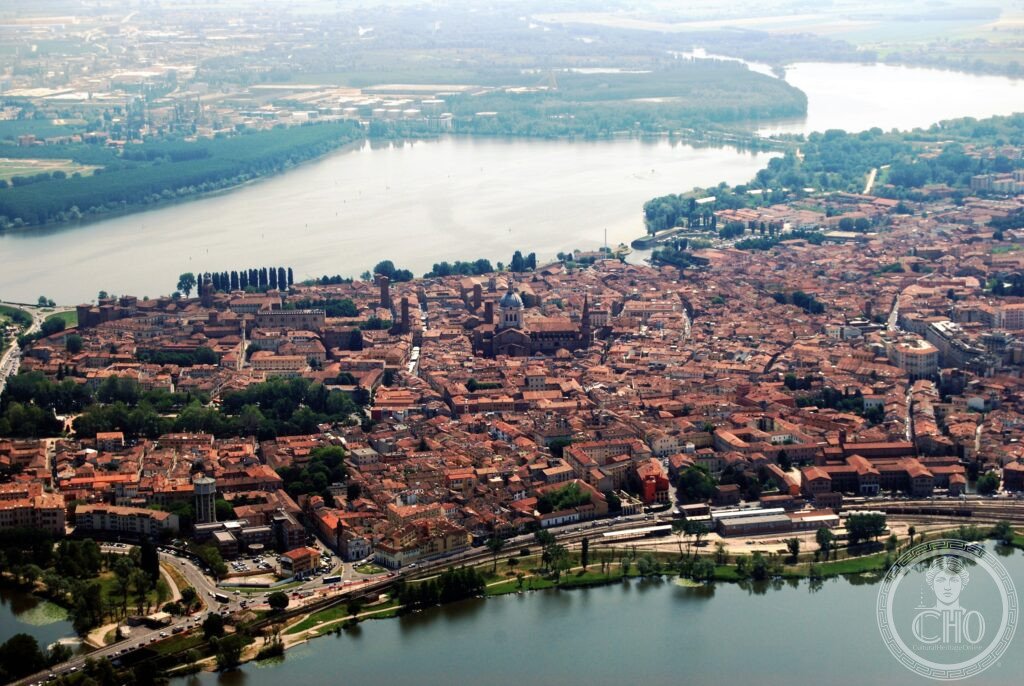
Mantua (Mantova)
The city that gave the world Virgil, the world’s largest ducal palace complex, and the most revolutionary perspective painting of the Italian Renaissance — Mantua (Mantova; Lombardia, Italy; UNESCO WHS 2008) was the capital of the Gonzaga dynasty for 380 years (1328-1708 CE), contains Europe’s largest palace complex (500 rooms; 34,000 m²), and inside the Palazzo Ducale houses the Camera degli Sposi where Andrea Mantegna (1431-1506 CE) created the first ceiling fresco painted with illusionistic perspective, opening the eye of the Renaissance into a fictional sky.
At a glance
Mantua (the most precisely MantuaItaly single Mantova Lombardia Italy Mincio River Po Valley southern Lombardia near Verona 40 km Cremona 55 km Brescia 60 km artificial lake island medieval dam Mincio River made Mantua near-island military position three artificial lakes surround historic centre Gonzaga dynasty 1328 1708 CE 38 Gonzaga rulers Gonzaga patrons arts Mantegna court painter 1460 1506 CE Raphael teacher Perugino connection Giulio Romano Palazzo Ducale 500 rooms 34000 sqm 15 courtyards Europe’s largest palace complex continuous 380 years construction expansion Virgil birthplace 70 BCE Publius Vergilius Maro Virgil born near Mantua Andes village Pietole modern name Roman poet Aeneid Georgics Eclogues UNESCO WHS 2008 includes also nearby Sabbioneta ideal Renaissance city also UNESCO heritage in any UNESCO world heritage site)).
Key facts
- Andrea Mantegna’s Camera degli Sposi (the room that changed how Europeans looked at ceilings): the Camera degli Sposi (Chamber of the Bride and Groom; now called Camera Picta, the Painted Room; 1465-1474 CE; Andrea Mantegna (1431-1506 CE); a room approximately 8m × 8m in the Torre di San Giorgio of the Palazzo Ducale) was painted for Ludovico III Gonzaga, Marquis of Mantua and his wife Barbara of Brandenburg; the ceiling fresco (the Oculus: a circular opening in the painted architectural sky painted at the exact centre of the ceiling vault; cherubs and women in court dress lean over a painted stone balustrade to look down at the viewer below; one of the cherubs precariously balances a large object on the balustrade — an early example of trompe-l’œil and the first illusionistic ceiling fresco in Western painting) created the entire programme of illusionistic ceiling painting that followed (the Sistine Chapel ceiling (Michelangelo, 1508-1512), the Palazzo Farnese ceiling (Carracci, 1597-1602 CE), the ceiling of the Palazzo Reale in Genoa (van Dyck, 1620s), and ultimately every Baroque ceiling fresco in Europe); Mantegna was the court painter in Mantua from 1460-1506 CE (46 years — the longest continuous employment of a major artist at a single court in Italian Renaissance history)
- GPS: 45.1564° N, 10.7914° E
History
From Etruscan city to Roman Virgil to Gonzaga duchy to Habsburg rule to united Italy (the most precisely MantuaItaly single Etruscan settlement 7th century BCE Mincio river confluence Po Mantua earliest traces 70 BCE Publius Vergilius Maro Virgil born Andes village near Mantua Virgil greatest Roman poet Aeneid national epic Rome Georgics pastoral Eclogues nature country living Virgil educated Rome Cremona Milan 42 BCE civil war confiscation farms rural crisis Virgil father farm confiscated civil war veterans Eclogues written about this crisis 19 BCE Virgil died unfinished Aeneid 1115 CE Countess Matilda of Tuscany major donor Pope against Emperor territories 1274 CE Gonzaga family arrive Mantua 1328 CE Luigi I Gonzaga captain of the people overthrew commune established dynasty 1328 CE Gonzaga period begins 38 Gonzaga rulers 380 years 1432 CE Gianfrancesco Gonzaga Marquis first Gonzaga Marquis 1460 CE Mantegna court painter appointed 1460 1506 CE Mantegna 46 years court 1474 CE Camera degli Sposi completed Mantegna masterpiece 1530 CE Federico II Gonzaga becomes Duke first Gonzaga Duke 1524 CE Giulio Romano arrives Mantua 1524 CE from Rome Palazzo Te construction begins 1525 CE Giulio Romano Palazzo Te pleasure palace 1540 CE Mannerism supreme at Mantua Giulio Romano career apex 1627 CE Vincenzo II Gonzaga sold entire art collection to Charles I England sale art 55 paintings Raphael Titian Caravaggio 1627 CE financial crisis art sale 1630 CE Mantua Sacked Imperial troops war of Mantuan succession one of worst sacks in Lombardy worse than Rome 1527 1627 CE 1708 CE last Gonzaga died no heir Austria Habsburgs took Mantua Austrian Habsburg period 1708 1866 CE 1866 CE Italian unification Kingdom Italy took Mantua Third Italian War of Independence 2008 CE UNESCO heritage: the Palazzo Te and the Room of the Giants (the most violent painted room in Italian art): Giulio Romano (1499-1546 CE; the principal assistant of Raphael who completed the Vatican Stanze after Raphael’s death in 1520 CE) designed the Palazzo Te (1525-1535 CE) as a leisure palace outside the city walls for Federico II Gonzaga; the Room of the Giants (Sala dei Giganti; 1532-1534 CE) covers every surface — walls, ceiling, floor — with painted scenes of Zeus destroying the Titans in a collapsing architectural landscape: the painted columns appear to fall inward onto the visitor; the giants writhe in painted agony around the walls; the painted thunder crumbles the painted architecture; the visitor stands in the painted rubble; when contemporary visitors entered the Sala dei Giganti in 1534 CE, they reportedly staggered — it was the first total immersive painted environment in Western art, preceding 20th-century installation art by 400 years)) — the most precisely MantuaItaly single 70 BCE Virgil born Andes near Mantua 1328 CE Luigi I Gonzaga dynasty 380 years 38 rulers 1460 1506 CE Mantegna 46 years 1474 CE Camera degli Sposi Oculus first illusionistic ceiling Western painting all later Baroque derived 1524 CE Giulio Romano arrives Palazzo Te 1525 CE Sala dei Giganti 1532 1534 CE first total immersive painted environment 1627 CE art sold Charles I England 55 paintings Raphael Titian 1627 CE worst sack since Rome 1527 2008 CE UNESCO heritage in any UNESCO world heritage site)).
What you see
Palazzo Ducale, the Camera degli Sposi, Palazzo Te, and the Gonzaga city (the most precisely MantuaItaly single Palazzo Ducale 500 rooms 34000 sqm 15 courtyards largest palace complex Europe continuous 380 year construction 1328 1708 CE Camera degli Sposi Torre di San Giorgio 8 × 8m room Oculus ceiling 1465 1474 CE Mantegna cherubs leaning over painted balustrade 1 cherub balancing object trompe l oeil first illusionistic ceiling Western painting wall frescoes Gonzaga court members portraits 1474 CE most naturalistic court group portraits Italian Renaissance Gonzaga portraits Mantegna two walls painted court scene Ludovico III Gonzaga Barbara Brandenburg court members horses dogs attendants all identified by inscriptions 15th century CE portrait naturalism Palazzo Te pleasure palace 1525 1535 CE Giulio Romano outside city walls 1 km southwest historic centre 4 major halls Room of Psyche erotic scenes from Apuleius myth painted for Federico II private rooms Room Giants 1532 1534 CE total immersive painted environment collapsing columns giants walls ceiling floor every surface entire visitor surrounded painted destruction Room Horses Giulio Romano most loved horses paintings best equine portraits Renaissance period Room of the Wind Sala dei Venti astrological ceiling Basilica Sant Andrea 1472 CE Leon Battista Alberti design first time classical Roman temple facade applied to a Christian church Alberti architectural treatise De re Aedificatoria 1452 CE published 1485 CE design revolutionary Alberto barrel vault interior widest nave in Tuscany 30m wide Church of San Sebastiano 1460 CE Alberti first Renaissance church with free-standing columns on exterior Rotonda San Lorenzo 1083 CE Romanesque UNESCO heritage: Leon Battista Alberti at Mantua (how a single humanist architect changed the direction of Western church architecture): Leon Battista Alberti (1404-1472 CE; Florentine humanist, architect, athlete, philosopher, mathematician, and the author of the first modern architectural treatise) designed two churches in Mantua at the invitation of Ludovico III Gonzaga: San Sebastiano (1460 CE) and Sant’Andrea (1472 CE); the Sant’Andrea facade applies the classical Roman triumphal arch (the Arch of Constantine in Rome, and the Roman arch tradition) directly to a Christian church facade — the first time this had been done (the Alberti formula: the church facade = triumphal arch + classical temple pediment + adapted Roman vocabulary); this Alberti formula became the template for the entire Italian Renaissance and Baroque church facade: Bramante adopted it in Rome; Michelangelo used it for St Peter’s Basilica; every Renaissance church facade you see in Italy derives from Alberti’s invention at Mantua’s Sant’Andrea)) — the most precisely MantuaItaly single Palazzo Ducale 500 rooms 34000 sqm Camera degli Sposi 8×8m Oculus cherubs balancing 1474 CE first illusionistic ceiling wall portraits Gonzaga court 1474 naturalistic Palazzo Te 1525 1535 CE Giulio Romano Room Giants 1532 1534 total immersive collapsing columns Room Horses equine Renaissance Psyche erotic Sant Andrea 1472 CE Alberti triumphal arch church facade template all later Italian Renaissance Baroque church facades San Sebastiano 1460 free-standing columns first 2008 CE UNESCO heritage in any UNESCO world heritage site)).
Practical information
- Getting there: from Milan: direct train (45-55 min; €8-18; Frecciarossa or regional; from Milano Centrale to Mantova; frequent departures); from Verona: regional train (35-45 min; €5; frequent); from Bologna: train via Verona (2h; €15-25); the Palazzo Ducale (€15; open Tue-Sun 8:15 AM-7:15 PM; booking strongly recommended; the camera degli Sposi requires advance booking by time slot — limited to 20 visitors/time slot; the Oculus ceiling fresco viewing: stand directly below the centre of the ceiling and look up — the cherubs lean over the balustrade directly above you; the effect is immediate and disorienting); the Palazzo Te (€12; open Mon 1-6 PM, Tue-Sun 9 AM-6 PM; the Room of the Giants: enter slowly, let the eyes adjust, look up, then slowly around; the total-immersion effect requires about 60 seconds to register fully); Basilica Sant’Andrea (free; open 8 AM-noon and 3-7 PM; the interior proportions — the widest barrel vault in Tuscany — are best appreciated by standing in the centre of the nave and looking the full length); best time (spring and autumn; Mantua sits in the Po Valley fog zone (November-February dense fog; July-August humid heat 35°C+; September and October mild and clear))
Getting there
From Milan: direct train 45-55 min (€8-18). From Verona: 35-45 min (€5). Palazzo Ducale €15 (Camera degli Sposi: advance booking, 20 visitors/slot). Palazzo Te €12. Sant’Andrea free. Best: spring, October. Avoid November-February (fog) and July-August (heat). GPS: 45.1564, 10.7914.
Nearby
- Sabbioneta — 35 km south-west (UNESCO WHS 2008 jointly with Mantua; the ideal Renaissance city built by Vespasiano Gonzaga (1531-1591 CE; nephew of Federico II) from scratch between 1556 and 1591 CE as his personal utopian Renaissance capital; the most completely realized example of the 16th century CE ideal-city theory in a built form; the hexagonal street plan; the Galleria degli Antichi (the first purpose-built gallery building in the world (1584 CE) — the direct ancestor of all later art galleries and museums); the Teatro Olimpico (1588 CE; Vincenzo Scamozzi; the only Renaissance theatre outside Vicenza; a near-complete original Renaissance theatre interior with painted perspective scenery still in place); accessed by bus from Mantua)
- Verona — 40 km east (UNESCO WHS 2000; the Roman Arena (1st century CE; the world’s third-largest Roman amphitheatre; still in use for the Verona Opera (Arena di Verona Festival; July-August; summer opera performances watched by 14,000 spectators seated in the original Roman tiers)); Juliet’s House (Casa di Giulietta; the fictional setting of Shakespeare’s “Romeo and Juliet”; 13th century CE medieval building; the bronze Juliet statue in the courtyard (1972 CE) is the most-touched public sculpture in Italy — the right breast polished to a shine by millions of hands))
Sources
- Wikipedia, Mantua; Gonzaga; Andrea Mantegna; Camera degli Sposi; Palazzo Te; Leon Battista Alberti, accessed June 2026
- UNESCO, Mantua and Sabbioneta, WHS reference 1089, inscribed 2008
Find it on the map
See this place and what’s around it →📷 Diventa un fotografo di Cultural Heritage Online
Condividi le tue foto dei luoghi: restano pubblicate con la tua firma come autore. Più vengono viste, più ti fai conoscere — e presto un concorso premierà le foto più apprezzate.
Accedi o registrati gratis per aggiungere una foto