
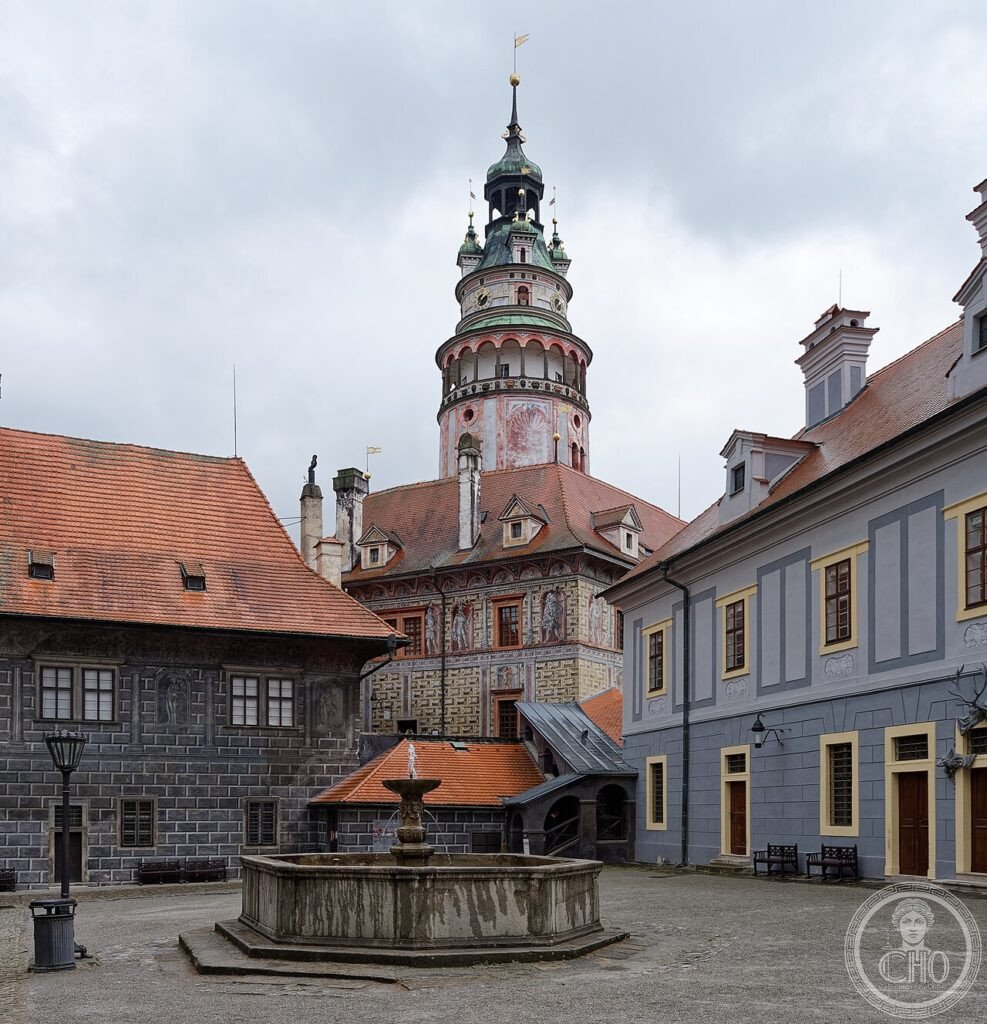
A castle town wound tight inside a loop of the Vltava, Český Krumlov kept its Baroque theatre locked and untouched for nearly two centuries. The result is a stage still fitted with its original scenery, machinery and costumes, set above a medieval town that slipped from Gothic to Renaissance to Baroque without ever being rebuilt.
At a glance
Český Krumlov’s castle complex, some forty buildings on a rocky spur ringed almost entirely by the Vltava, is said to be the second largest in the Czech Republic after Prague Castle. Three noble families shaped it in turn: the Rosenbergs from 1302, the Eggenbergs from 1622, and the Schwarzenbergs from 1719. Below the walls, a moat still houses bears, a tradition kept up since the sixteenth century. The whole town and castle were inscribed as a UNESCO World Heritage Site in 1992.
Key facts
- Founded: 13th century, on a rocky spur encircled by a meander of the Vltava
- Builders: Rosenberg dynasty (1302–1602), followed by the Eggenberg (1622–1717) and Schwarzenberg (1719–1947) families
- Castle theatre: built in 1682 under the Eggenbergs, enlarged by the Schwarzenbergs to seat around 400 in 1766
- Round Tower: the oldest surviving part of the castle, its Renaissance arcades painted as illusion rather than built
- Heritage status: inscribed as a UNESCO World Heritage Site in 1992
History
The Rosenberg family, whose emblem was a five-petalled red rose, held Krumlov for three centuries from 1302. Vilém z Rožmberka ran one of the most sophisticated Renaissance courts north of the Alps, and it was under Rosenberg patronage that the Round Tower gained its painted Renaissance arcades and much of the town below took its present grid of streets and burgher houses. Financial difficulties forced Petr Vok, the last Rosenberg, to sell the estate to Emperor Rudolf II in 1602, ending the dynasty’s tenure.
In 1622 the castle passed to Johann Ulrich von Eggenberg, a reward from Emperor Ferdinand II for Catholic support after the Battle of White Mountain. It was the Eggenbergs who built the Baroque castle theatre in 1682, the most significant single addition to the complex. The family died out in 1717, and the estate passed to the Schwarzenbergs two years later; Joseph Adam Schwarzenberg enlarged the theatre in 1766, but it fell out of fashion the following year and was simply locked up rather than modernised, which is why its machinery survives intact.
The twentieth century brought annexation during the Sudeten crisis, wartime occupation, the expulsion of the Sudeten German population and confiscation of the Schwarzenberg estate under the Beneš decrees, and finally nationalisation after the Communist coup of 1948, when the castle became state property and a museum. UNESCO recognition followed in 1992.
What you see
The visit runs through a sequence of courtyards from the entrance gate to the Round Tower, the oldest part of the castle, whose Renaissance arcade is not built stonework at all but a painted Mannerist illusion of masonry, window frames and pilasters designed to look like an open loggia from a distance. Further courtyards lead past the clock tower to the Baroque theatre and on to the Eggenberg wing and the formal Baroque garden below, later reworked as an English-style park with a cascade and a Belvedere viewpoint.
The castle theatre, visited only with a guide, still holds its original thirteen rail-mounted wing sets, its rope-and-pulley flying machinery, its trap doors and around four hundred period costumes. The scene-change mechanism can transform the set in under half a minute. Rare performances are staged there using historically appropriate lighting, candles and oil lamps rather than electric light.
In the town below, the Lazebnický bridge crosses to Náměstí Svornosti, the main square lined with Gothic and Renaissance façades, and the Hotel Růže, a former Jesuit college. The Egon Schiele Art Centrum, housed in a converted Baroque brewery, holds works by the Austrian Expressionist painter, who lived in the town in 1911 through his mother’s family connection and painted numerous views of it. Below the castle gate, three brown bears still live in the moat, a living heraldic tradition documented since the late sixteenth century and maintained today by the South Bohemian Museum.
Practical information
- Castle courtyards: open to the public without charge; the interior, the theatre and guided routes require advance booking through the castle’s official site
- Baroque theatre visits: strictly limited and best booked well ahead through the official castle website
- Bears at the moat: visible from the bridge above without any ticket
- Best time to visit: late spring or early autumn, ahead of the summer peak; the Baroque Music Festival takes place in the castle in early July
Getting there
Český Krumlov is reached from Prague by direct coach services departing Florenc bus station, or by car on the motorway followed by regional roads. From Vienna it is a popular day trip by bus or car. Current timetables and journey details are best checked with the coach operators or the town’s own tourist information channels.
Nearby
- Prague — the Czech capital, with Prague Castle the only larger castle complex in the country, reachable by direct coach
- Vienna — across the border in Austria, commonly visited as a day trip in either direction
Sources
- South Bohemian Museum
- Zámek Český Krumlov (official castle administration)
- Egon Schiele Art Centrum
Find it on the map
See this place and what’s around it →
📷 Become a Cultural Heritage Online photographer
Share your photos of places: they stay published under your name as the author. The more they're seen, the more you get noticed — and soon a contest will reward the most appreciated photos.
Log in or sign up free to add a photo