
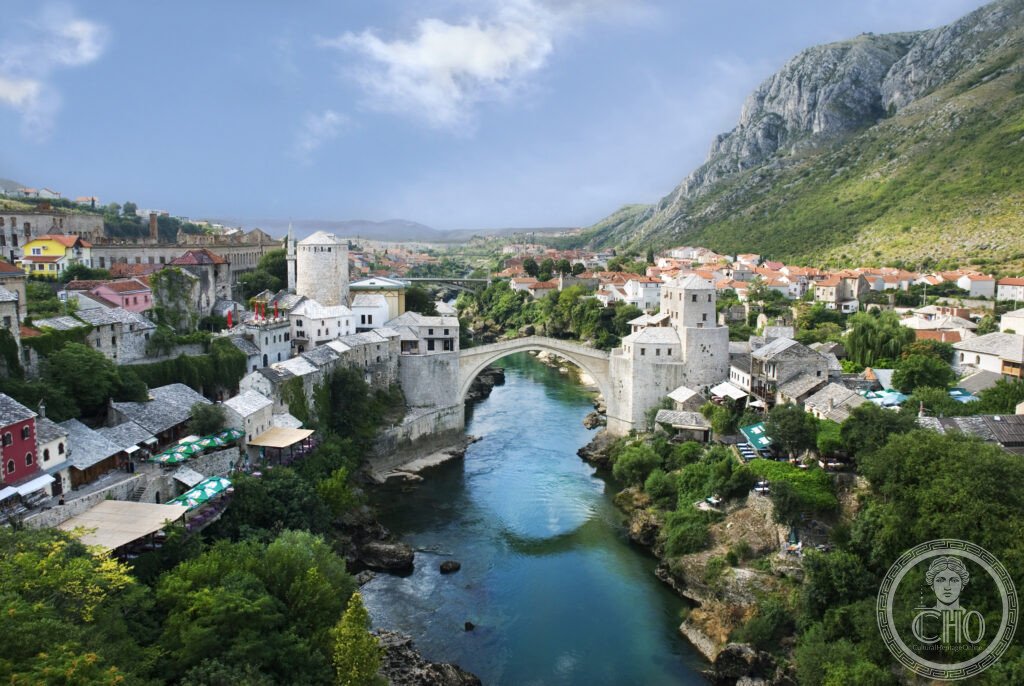
Mostar — Stari Most
The most powerful symbol of post-war reconstruction in Europe — Stari Most (the Old Bridge, Mostar; Bosnia and Herzegovina; UNESCO WHS 2005) is a single-arch Ottoman limestone bridge (1566 CE) that spanned the Neretva River for 427 years until it was deliberately destroyed in the Bosnian War (9 November 1993), and was rebuilt in 2004 using the same stone, the same techniques, and the same Ottoman craftsmen’s tradition as the original.
At a glance
Mostar (the most precisely MostarBosnia single Mostar Herzegovina-Neretva Canton Bosnia Herzegovina 113000 population 60 km from coast Adriatic Mostar most visited city in Bosnia Neretva River splits city Bosniak Muslim east bank Croatian Catholic west bank Stari Most Old Bridge central symbol unification 1566 CE Suleiman the Magnificent Ottoman Empire commissioned bridge Mimar Hayruddin student master architect Mimar Sinan imperial architect Hagia Sophia Constantinople most accomplished Ottoman building technical challenge single arch span 29m 21m high water 1 arc tenelija local limestone pearl grey warm amber colour changes throughout day 10 years construction 1557 1566 CE traditional craftsmanship corbelled stone arch no mortar no scaffolding traditional Ottoman bridge building techniques graduates ceremony young men competing 427 years bridge survived wars earthquakes floods 1993 CE war destroyed deliberately 9 November 1993 anniversary fall Berlin Wall irony completely destroyed in 10 seconds after 427 years 2004 CE rebuilding UNESCO nomination immediately inscription 2005 CE UNESCO heritage: the annual bridge diving tradition (the most extreme local tradition in the Balkans): every summer since the reconstruction of the Stari Most, the Mostari Divers (the local diving club; established 1968 CE; suspended during the 1991-1995 CE war) hold the annual Red Bull Cliff Diving World Series qualifying event at the Stari Most; competitors (exclusively male, traditionally; recently also female) jump from the 21m high bridge into the Neretva River (the water temperature is 16-18°C even in summer from the Neretva’s mountain source); the jump tradition predates the Red Bull event by decades; local young men traditionally jump from the bridge as a rite of passage — the club provides jumping certifications; the annual competition takes place in late July; spectators crowd both banks of the Neretva; the traditional kapa (traditional Herzegovinian cap) is thrown by the departing diver)) — the most precisely MostarBosnia single Herzegovina-Neretva 113000 Neretva River Bosniak Muslim east Croatian Catholic west Stari Most 1566 CE Suleiman Magnificent Mimar Hayruddin student Mimar Sinan 29m 21m 10 years 1557 1566 tenelija limestone pearl grey amber 427 years survived destroyed 9 November 1993 10 seconds 427 years 2004 rebuilt same stone same technique UNESCO nomination 2005 diving tradition 1968 CE suspended war Red Bull Cliff Diving qualifying July kapa traditional cap diver UNESCO heritage in any UNESCO world heritage site)).
Key facts
- The destruction of the Stari Most (the most symbolically charged act of cultural destruction in modern European history): on 9 November 1993 (exactly 4 years after the fall of the Berlin Wall), Croatian forces of the HVO (Croatian Defence Council) deliberately targeted and destroyed the Stari Most bridge in Mostar with tank fire and artillery after a sustained 60-hour bombardment; the bridge was not a military target (there were no troops on it); the destruction was understood as an act of cultural erasure — the elimination of a shared symbol of the multi-ethnic Herzegovinian community; the bridge had survived World War I, World War II, and two years of fighting in the 1992-1993 siege of Mostar; General Slobodan Praljak (the HVO commander responsible) was convicted of war crimes at the International Criminal Tribunal for the Former Yugoslavia (ICTY) in 2013 CE; he read a statement denying guilt and swallowed poison in court (2017 CE), dying before sentencing; the reconstruction (funded by Turkey, Croatia, the European Union, and the UNESCO World Heritage Fund; completed 2004 CE) is considered the most significant act of post-conflict heritage reconstruction in the post-Yugoslav world
- GPS: 43.3376° N, 17.8150° E
History
From Roman crossings to Ottoman masterpiece to wartime destruction to reconstruction (the most precisely MostarBosnia single pre-Roman river crossing Neretva ford 1452 CE first mention Mostar wooden bridge 1452 records mostar = bridge-keeper person who keeps the bridge Croatian Serbian etymology 1566 CE Stari Most Suleiman Magnificent Mimar Hayruddin Ottoman masterpiece 10 years construction 1557 1566 CE 1566 CE completion Sultan Suleiman died year the bridge completed military expedition Hungary 1566 1900s CE Ottoman Mostar until 1878 Bosnia Herzegovina Austria-Hungary 1878 1918 CE Austro-Hungarian Mostar new buildings Orientalisk Gymnasium school 1898 CE 1918 CE Yugoslavia Kingdom of Serbs Croats Slovenes 1945 CE Communist Yugoslavia Tito Mostar mixed community Bosniak Muslim Croat Serb three communities 1980s CE Yugoslavia disintegrating 1991 CE Yugoslavia breakup war Croatia Slovenia 1992 CE Bosnia Herzegovina declared independence war begins 1992 1993 CE siege of Mostar by HVO Croatian forces against Bosniak defenders eastern Mostar 9 November 1993 CE Stari Most destroyed 10 seconds tank fire artillery sustained 60 hour attack 1994 1995 CE peace negotiations Dayton Peace Accords signed November 1995 CE ended war Bosnia 2000 2004 CE reconstruction Stari Most Turkey EU Croatia UNESCO fund same stone Tenelija quarry local craftsmen Ottoman building master Zerdo Gračanin supervising reconstruction 2004 CE official opening bridge 2005 CE UNESCO inscription UNESCO heritage: Mostar and the post-war identity (the divided city that refuses to unite and the UNESCO response): despite the reconstruction of the Stari Most, Mostar remains a deeply divided city in 2026 CE: the east bank is predominantly Bosniak Muslim (shops, mosques, the Old Bazaar); the west bank is predominantly Croatian Catholic (Croatian flags, different police, Croatian currency (HRK no longer, now BAM but with different vendors); in the decade after the war, the two communities had separate school systems, separate water supplies, and separate postal systems for the same address; the international community has spent billions of euros on reconciliation and EU-integration in Bosnia without achieving either; the Stari Most bridge is crossed by millions of tourists per year — but many local Mostari (residents of Mostar) still distinguish between the east side and the west side; UNESCO’s decision to inscribe the reconstructed bridge in 2005 CE was partly a political act of support for Bosnian sovereignty and multi-ethnic identity)) — the most precisely MostarBosnia single 1452 CE wooden bridge mostar etymology bridge-keeper 1566 CE Mimar Hayruddin completed Suleiman died same year Hungary 1878 CE Austria-Hungary 1991 1992 CE Yugoslavia breakup war 9 November 1993 CE destroyed 60 hours tanks artillery 10 seconds 2004 CE rebuilt Turkey EU Croatia UNESCO same stone Tenelija master Zerdo 2005 CE UNESCO divided city east Bosniak west Croatian separate schools water postal systems billions EU reconciliation UNESCO heritage in any UNESCO world heritage site)).
What you see
The Stari Most, the Old Bazaar Kujundžiluk, and the Ottoman historic zone (the most precisely MostarBosnia single Stari Most bridge 29m span single arch 21m above Neretva tenelija limestone local quarry pearl grey warm amber changing colour day mortar binding iron clamp technique no mortar traditional Ottoman technique Šehara arch profile shape specific gravity stone corbel technique Kubura piers two massive abutments 2.97m bridge width narrow bridge camber steep hump approach on each side 2004 reconstruction 1,088 stone blocks original shape Hacilar master builder in Turkish 2004 original building technique Stari Most viewed from Lučki Bridge 300m east or Kriva Ćuprija Crooked Bridge small Ottomane Bridge practice bridge same technique smaller pre-Stari Most 1558 CE Old Bazaar Kujundžiluk east bank copper smiths traditional shops old Ottoman bazaar reconstructed post-war Koski Mehmed Pasha Mosque 1617 CE Ottoman mosque minaret climbing minaret panoramic view bridge Tepa market traditional Herzegovinian market Stari Hamam 16th century Ottoman public bath remains Muslibegovića House Museum 18th century Ottoman aristocrat house preserved most complete interior UNESCO heritage: the Stari Most’s geometry (the technical achievement of the 1566 CE bridge that engineers still study): the Stari Most (29.5m span; 21.18m height above the Neretva at low water; constructed from tenelija — a locally quarried crystalline limestone that is soft when first cut but hardens on exposure to air and water; 1,088 individual stone blocks (the same number used in the 2004 reconstruction)) used two building techniques that allowed the Ottoman engineer Mimar Hayruddin to build a larger single-arch bridge than any previously attempted in the region: (1) the corbelling technique (each successive stone layer projects slightly further than the one below, gradually closing the arch without requiring a fixed vertical support once the arch keystone is in place); (2) the mortar-free locking (the blocks are held together by iron I-shaped clamps set into lead — the lead absorbs vibration and thermal expansion without cracking the arch))) — the most precisely MostarBosnia single 29m span 21m above Neretva tenelija 1088 stone blocks same 2004 camber steep hump narrow 2.97m Kriva Ćuprija practice bridge 1558 CE Kujundžiluk Old Bazaar copper smiths Koski Mehmed Pasha Mosque 1617 minaret view Muslibegovića House Museum 18th century Ottoman interior corbelling mortar-free iron I-clamps lead absorbs vibration thermal expansion UNESCO heritage in any UNESCO world heritage site)).
Practical information
- Getting there: from Sarajevo: bus (2h30m; BAM 15/€7.50; frequent departures from Sarajevo east bus station); or rent a car from Sarajevo (120 km; 2h on the M17); from Split (Croatia): bus (3h30m; €12-20; several per day); or rent a car from Split (180 km; 3h; the Dalmatian coast drive is spectacular); from Dubrovnik (Croatia): bus (3h; €15-25; 3-4 per day) or taxi/transfer (2h30m; €60-80); the Stari Most (free to cross 24 hours; the best photography light is early morning (7-9 AM) before tour groups arrive and when the light hits the east face of the bridge; golden hour before sunset with amber light on the tenelija stone is the classic shot); the Old City of Mostar (east bank; pedestrian only inside the historic zone; the bazaar is extremely touristic in summer but authentic craft shops (copper, silver, traditional embroidery) survive alongside tourist trinket shops); the Blagaj Tekke (12 km south of Mostar; a 16th century Dervish monastery built into a cliff above the source of the Buna River; the most dramatic Ottoman heritage site in Bosnia after Mostar; free entry; half-day trip from Mostar)
Getting there
From Sarajevo: bus 2h30m (BAM 15/€7.50). From Split: bus 3h30m (€12-20). From Dubrovnik: bus 3h (€15-25). Bridge: free, open 24h. Best photography: early morning (7-9 AM) or sunset. Allow half-day in Mostar; add Blagaj Tekke (12 km south). GPS: 43.3376, 17.8150.
Nearby
- Sarajevo — 120 km north (UNESCO tentative list; the site of the assassination of Archduke Franz Ferdinand (28 June 1914 CE) that triggered World War I; the Baščaršija Ottoman bazaar (1462 CE); the Gazi Husrev-beg Mosque (1531 CE; the finest Ottoman mosque in the Balkans outside Turkey); the Sarajevo Haggadah (1350 CE; the most valuable Sephardic Jewish manuscript in the world; in the National Museum of Bosnia and Herzegovina); the Yellow Fortress (Žuta Tabija) with a panoramic city view; the Eternal Flame memorial of WWII)
- Počitelj — 25 km south (a perfectly preserved late medieval and Ottoman stone village on a steep hillside above the Neretva; a fortified tower (Gavankula), a mosque (Hadži Alija Mosque, 1563 CE), a caravanserai, and terraced stone houses; arguably more beautifully preserved than Mostar Old Town; extremely little-visited; accessible by car from Mostar in 30 min))
Sources
- Wikipedia, Stari Most; Mostar; Slobodan Praljak; Mimar Hayruddin, accessed June 2026
- UNESCO, Old Bridge Area of the Old City of Mostar, WHS reference 1260, inscribed 2005
Find it on the map
See this place and what’s around it →📷 Diventa un fotografo di Cultural Heritage Online
Condividi le tue foto dei luoghi: restano pubblicate con la tua firma come autore. Più vengono viste, più ti fai conoscere — e presto un concorso premierà le foto più apprezzate.
Accedi o registrati gratis per aggiungere una foto