
Pergamon

Pergamon Hellenistic city Turkey Altar Zeus acropolis parchment library UNESCO World Heritage
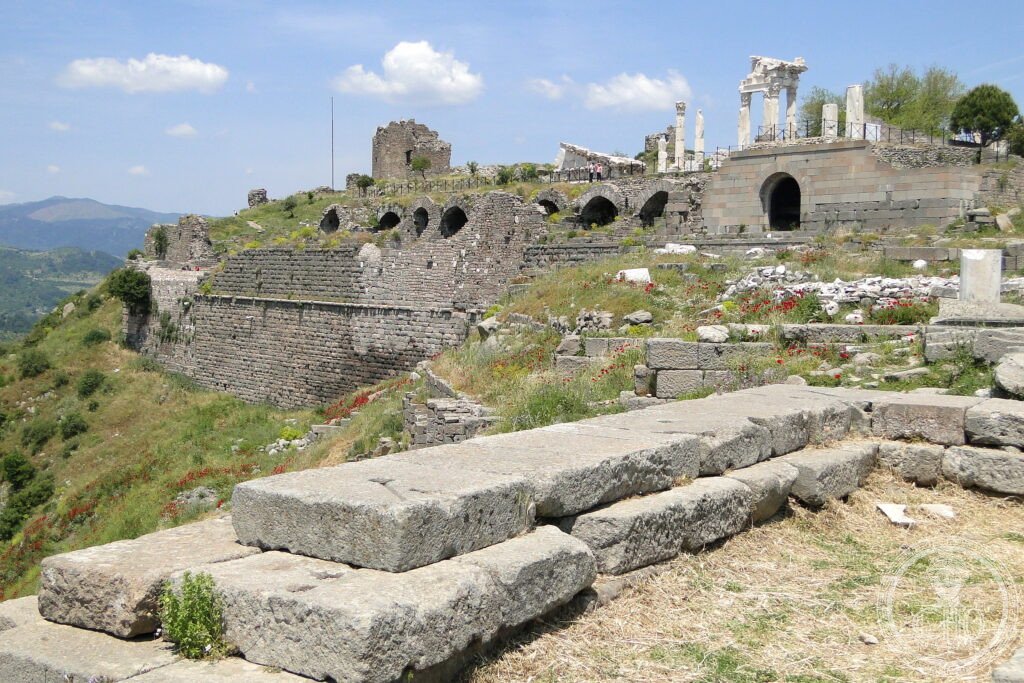
The Acropolis of Pergamon seen from the valley below, with the reconstructed columns of the Temple of Trajan (98-117 CE; Corinthian order; dedicated to Emperor Trajan and Zeus; the finest Roman temple in Turkey) at the summit (335m above sea level), and the open cavea of the Theatre of Pergamon (Hellenistic; 2nd century BCE; one of the steepest theatres in the ancient world; a 80-degree slope; 10,000-seat capacity; the stage building was temporary and removed in winter to allow the full hillside view) visible on the right side of the Acropolis, Pergamon-Bergama, Izmir Province, Turkey. UNESCO World Heritage Site 2014. Photo via Wikimedia Commons.
Izmir Province, Turkey · Attalid Kingdom capital 282-133 BCE; Altar of Zeus (Pergamon Museum Berlin); parchment invented here; steepest ancient theatre; UNESCO WHS 2014

Pergamon

The cultural capital of the Hellenistic world and the city that gave the world parchment — Pergamon (Bergama, Izmir Province, Turkey; UNESCO WHS 2014) was the capital of the Attalid Kingdom (282-133 BCE) and contained the second largest library of the ancient world (200,000 scrolls), the steepest ancient theatre, and the Altar of Zeus — one of the most extraordinary Hellenistic monuments, now reconstructed in Berlin.

At a glance

Pergamon (the most precisely PergamonTurkey single Bergama Izmir Province Turkey 335m high acropolis hill commanding Caicus Bakircay River valley 3rd 2nd century BCE Attalid Dynasty greatest Hellenistic kingdom Minor Asia Attalus I Soter 241 197 BCE founder Attalid kingdom proclaimed self king after defeating Galatians at Battle of Caicus River 241 BCE coined term Galatia Galatian victory monuments established Pergamon as cultural rival Alexandria Egypt Eumenes II 197 159 BCE greatest Attalid king expanded city Library 200000 scrolls second only Alexandria 700000 scrolls competed with Ptolemies Altar of Zeus built Eumenes II 2nd century BCE parchment Pergamon invention parchment Latin pergamenum from Pergamon Ptolemies blocked export of papyrus from Egypt to prevent rival library growing Pergamon developed alternative parchment sheep goat skin scraped thin dried taut alternative writing material 133 BCE Attalus III last Attalid king died no male heir bequeathed kingdom to Rome Rome inherited largest single state donation in history 133 BCE Roman province Asia Pergamon capital province 2014 CE UNESCO UNESCO heritage: the Pergamon Altar and the looting controversy (the founding case study of cultural property restitution): the Altar of Zeus at Pergamon (ca. 180-160 BCE; Eumenes II; a massive U-shaped platform 35m × 33m; the 113m-long frieze depicting the Gigantomachy (the battle of the gods against the giants) in high-relief sculpture; the greatest surviving Hellenistic sculpture cycle) was excavated by Carl Humann (German railway engineer; 1878-1886 CE) with Ottoman permission; 118 crates of sculptural fragments were shipped to Berlin; the Kaiser donated funds to build a dedicated museum; the Pergamon Museum (opened 1930 CE) was built specifically to house the reconstructed altar in a room the size of the original; the altar is the top-visited exhibit in the Pergamon Museum; the Greek government, Turkey, and international scholars debate whether the altar should be returned to its country of origin; Berlin has built a new island museum specifically designed to incorporate a temporary Pergamon Altar replacement display during the extended renovation of the Pergamon Museum (2023-2037 CE))) — the most precisely PergamonTurkey single 335m acropolis hill Caicus Valley Eumenes II 197 159 BCE Library 200000 scrolls second only Alexandria parchment pergamenum Latin Pergamon origin papyrus blocked Egypt alternative sheep goat skin dried taut Attalus III 133 BCE bequeathed kingdom Rome province Asia Altar Zeus 180 160 BCE 35m × 33m 113m Gigantomachy frieze Carl Humann 1878 1886 CE 118 crates Berlin Pergamon Museum 1930 CE ongoing restitution debate 2023 2037 CE renovation UNESCO heritage in any UNESCO world heritage site)).

Key facts

  • Galen of Pergamon (the most influential physician in history): the most precisely PergamonTurkey single Galen Galen of Pergamon 129 216 CE Greek physician Roman Empire most influential physician in history medicine dominated for 1400 years until Andreas Vesalius 1543 CE De Humani Corporis Fabrica dissection proved Galen wrong 129 CE born Pergamon father Nicon wealthy architect educated Pergamon Sanctuary Asclepius Pergamon 149 157 CE Galen served as gladiator surgeon at Pergamon Gladiatorial School first medical experience systematic treatment of wounds anatomy 157 CE moved to Rome personal physician Emperor Marcus Aurelius Commodus Septimius Severus 200 volumes of medical writings most prolific author antiquity anatomy physiology pathology pharmacology On the Natural Faculties On Anatomical Procedures De Usu Partium most cited ancient medical author 1400 years medieval Islamic medical tradition preserved and extended Galen Arab physicians Canon of Medicine Avicenna Ibn Sina 1025 CE based on Galen medical education tradition UNESCO heritage — the most influential scientific mind in history before Newton: Galen of Pergamon (129-216 CE; born in Pergamon; trained at the sanctuary of Asclepius at Pergamon; court physician to 3 Roman emperors: Marcus Aurelius, Commodus, and Septimius Severus) wrote approximately 200 medical treatises (the most prolific output of any author in the ancient world); his medical theories dominated European and Islamic medicine for approximately 1,400 years (129 CE to ca. 1543 CE, when Vesalius published his dissection-based anatomy); his error (he could not dissect human bodies in Roman law — he used Barbary apes instead, and assumed the anatomy was identical) led to 1,400 years of wrong anatomy taught in medical schools; the philosopher and physician Avicenna (Ibn Sina; 980-1037 CE) codified Galen’s work in the Canon of Medicine, which was the standard medical textbook in Europe and the Islamic world until the 17th century CE
  • GPS: 39.1316° N, 27.1842° E

History

From Archaic settlement to Attalid capital to Roman province to Byzantine and Ottoman decline (the most precisely PergamonTurkey single 800 700 BCE Archaic Greek settlement Pergamon mound 3rd century BCE Philetaerus 281 263 BCE founder Attalid dynasty Lysimachus general of Alexander the Great appointed Philetaerus treasury guardian 9000 talents Philetaerus 263 BCE betrayed Lysimachus went independent 281 263 BCE Philetaerus ruled 263 241 BCE nephew Eumenes I continued 241 197 BCE Attalus I Soter proclaimed king after defeating Galatians 197 159 BCE Eumenes II greatest expansion Library Altar Zeus cultural programme rival Alexandria 159 138 BCE Attalus II 138 133 BCE Attalus III 133 BCE died no heir bequeathed kingdom Rome unprecedented gift entire state donated to foreign power will testament most extraordinary political bequest history 129 BCE Roman province Asia established Pergamon capital province 27 BCE Augustus Roman emperor Pergamon prominent city Asia Minor Emperor cult temple first Temple Augustus Pergamon 2 CE earliest imperial cult temple in Asia Minor 129 CE Galen born Pergamon physician gladiators Rome 131 CE Hadrian visited granted Pergamon neokoros title twice temple warden honor twice temple status highest honor city 395 CE Byzantine Eastern Roman Empire 7th century CE Arab raids decline 1302 CE Ottoman Turco-Mongol period 1920s CE Bergama modern Turkish city 2014 CE UNESCO UNESCO heritage: the bequeathal of Pergamon to Rome (the most extraordinary political will in history): Attalus III of Pergamon (reigned 138-133 BCE) had no legitimate heirs; when he died in 133 BCE, he left the entire Attalid Kingdom (including the treasury, the army, the fleet, and all the territories of the Kingdom of Pergamon) to the Roman People; this was the largest single bequest in the ancient world; the reasons are debated: fear of civil war after his death, personal preference for Rome over potential usurpers, or a calculated bet that association with Rome would preserve Pergamon’s cultural institutions; the Roman Senate accepted the bequest and established the Province of Asia (129 BCE) from Pergamon; the Attalid Library, the medical tradition, and the artistic workshops of Pergamon were incorporated into the Roman Empire’s cultural infrastructure; without the Attalid bequest, many of the Greek manuscripts that survived antiquity (via the Pergamon library) might have been lost)) — the most precisely PergamonTurkey single 800 700 BCE Archaic 281 263 BCE Philetaerus Lysimachus treasury 9000 talents 263 241 BCE Attalus I Soter 241 197 BCE king Galatians 197 159 BCE Eumenes II Library Altar Zeus Alexandria rival 133 BCE Attalus III died no heir bequeathed entire kingdom Rome largest political will bequest history 129 BCE Roman province Asia 2 CE first imperial cult temple Augustus 129 CE Galen born physician gladiators 131 CE Hadrian neokoros twice 1302 CE Ottoman 2014 CE UNESCO heritage in any UNESCO world heritage site)).

What you see

The Acropolis, the steepest ancient theatre, and the Asclepion (the most precisely PergamonTurkey single Acropolis 335m hill Theatre Pergamon 2nd century BCE 10000 capacity seats 80 degree slope steepest ancient theatre world steeper than Epidaurus temporary wooden stage removed winter full hillside view Temple Zeus Altar position base Acropolis foundations remaining altar itself Berlin Temple Trajan 98 117 CE Roman imperial 8 × 6 Corinthian columns best preserved Roman temple Turkey partially reconstructed German Archaeological Institute Library 200000 scrolls rooms visible Eumenes II Eumenes reading room visible foundations Sanctuary Athena patron goddess Pergamon temple foundations Sanctuary Asclepion Asclepion healing sanctuary 2nd century CE Roman period different from Bronze Age Greek Asclepia 4 km west main site road paved Roman Via Tecta tunnel entrance from Roman Via Tecta entrance to Asclepion treatment rooms water therapy pools incubation hall marble fountain Via Tecta 800m colonnaded Roman street approach tunnel underground passage theatre separate Asclepion complex Theatre Asclepion Bouleuterion library temple Zeus Telesphoros roundhouse in middle Asclepion Asclepion complex Bergama modern town below hill Bergama Archaeological Museum local museum Asklepion Museum UNESCO heritage: the Library of Pergamon (the history of the second-greatest library of the ancient world): the Library of Pergamon (established by Attalus I (241-197 BCE); greatly expanded by Eumenes II (197-159 BCE); approximately 200,000 scrolls at its peak — second only to the Library of Alexandria (estimated 400,000-700,000 scrolls)) was the institution that drove the invention of parchment; the ancient story (Pliny the Elder; 1st century CE): the Ptolemies of Egypt, fearing competition from the Pergamon Library, banned the export of papyrus to prevent the library from growing; the Pergamon librarians developed parchment (scraped and dried sheep or goat skin) as an alternative; Mark Antony later gave Cleopatra 200,000 Pergamon scrolls as a gift (moving the Pergamon library to Alexandria after the fire); the library room at Pergamon (visible on the Acropolis: a large hall with niches for scroll-chests and a copy of the Athena Parthenos statue) was used by the German Archaeological Institute as a model for the Ephesus Library excavation interpretation)) — the most precisely PergamonTurkey single Theatre 10000 80 degree steepest world temporary wooden stage removed winter Temple Trajan 98 117 CE best preserved Roman Turkey Altar Zeus foundations Berlin Pergamon Museum Library 200000 scrolls rooms foundations Via Tecta 800m Roman colonnaded approach Asclepion 4 km 2nd century CE tunnel water therapy pools incubation Telesphoros roundhouse Library parchment invention Ptolemies banned papyrus export 200000 scrolls Mark Antony gave Cleopatra UNESCO heritage in any UNESCO world heritage site)).

Practical information

  • Getting there: from Izmir: IZBAN train from Izmir Basmane to Menemen (1h30m; TRY 20/€0.60) then bus to Bergama (45 min; TRY 30/€0.90); or bus from Izmir Otogar direct to Bergama (2h; TRY 80/€2.50; every 30-45 min); or rent a car from Izmir (108 km; 1h30m; the most comfortable option); the Acropolis of Pergamon (entry TRY 400/€12; includes the theatre, temples, and library area; cable car (teleferik) available from the lower town to the Acropolis summit: TRY 150/€4.50 one way; runs until 7 PM in summer); the Asclepion (entry TRY 300/€9; 4 km west of the Acropolis; taxi TRY 100/€3; or 45 min walk through the town; a different site from the Acropolis requiring a separate ticket); the Red Basilica (Kizil Avlu; in the town centre; a large Roman temple (2nd century CE) converted to a Byzantine church then back to a mosque; free entry; worth a 30-min visit); the Pergamon Museum Berlin (a visit to the Pergamon Museum in Berlin (Museumsinsel; currently partially closed for renovation; the Altar of Zeus is one of the great archaeological displays in the world — a half-scale reconstruction of the Altar installed in a room the size of the original) is the essential complement to visiting the site itself))

Getting there

From Izmir: bus 2h (TRY 80/€2.50). Acropolis TRY 400/€12 (cable car TRY 150/€4.50). Asclepion TRY 300/€9 (4 km separate). Red Basilica free. The Altar of Zeus is in Berlin (Pergamon Museum). Allow 4h for Acropolis + Asclepion. GPS: 39.1316, 27.1842.

Nearby

  • Ephesus — 120 km south (UNESCO WHS 2015; the most completely excavated Graeco-Roman city in the world; the Library of Celsus (117-120 CE); the Great Theatre (25,000-seat capacity); the Temple of Artemis (one of the Seven Wonders of the Ancient World; nothing remains above ground except one column); the most visited archaeological site in Turkey after Göbekli Tepe)
  • Pergamon Museum, Berlin — Germany (the Pergamon Altar (180-160 BCE; 113m Gigantomachy frieze; the greatest Hellenistic sculpture cycle); the Ishtar Gate from Babylon (575 BCE); the Market Gate of Miletus (120 CE); the Aleppo Room (17th century CE Syrian painted ceiling); the greatest collection of ancient monumental architecture in the world — but planned for partial closure until 2037 CE for renovation))

Sources

  • Wikipedia, Pergamon; Attalid dynasty; Altar of Zeus, Pergamon; Galen, accessed June 2026
  • UNESCO, Pergamon and its Multi-Layered Cultural Landscape, WHS reference 1457, inscribed 2014

Hero image: Pergamon, Izmir Province, Turkey, Wikimedia Commons. Editorial text © Cultural Heritage Online, 2026.

📷 Diventa un fotografo di Cultural Heritage Online

Condividi le tue foto dei luoghi: restano pubblicate con la tua firma come autore. Più vengono viste, più ti fai conoscere — e presto un concorso premierà le foto più apprezzate.

Accedi o registrati gratis per aggiungere una foto
📋 Copy & share on social
Scroll to Top