Carcassonne

Carcassonne walled city France medieval towers walls UNESCO World Heritage
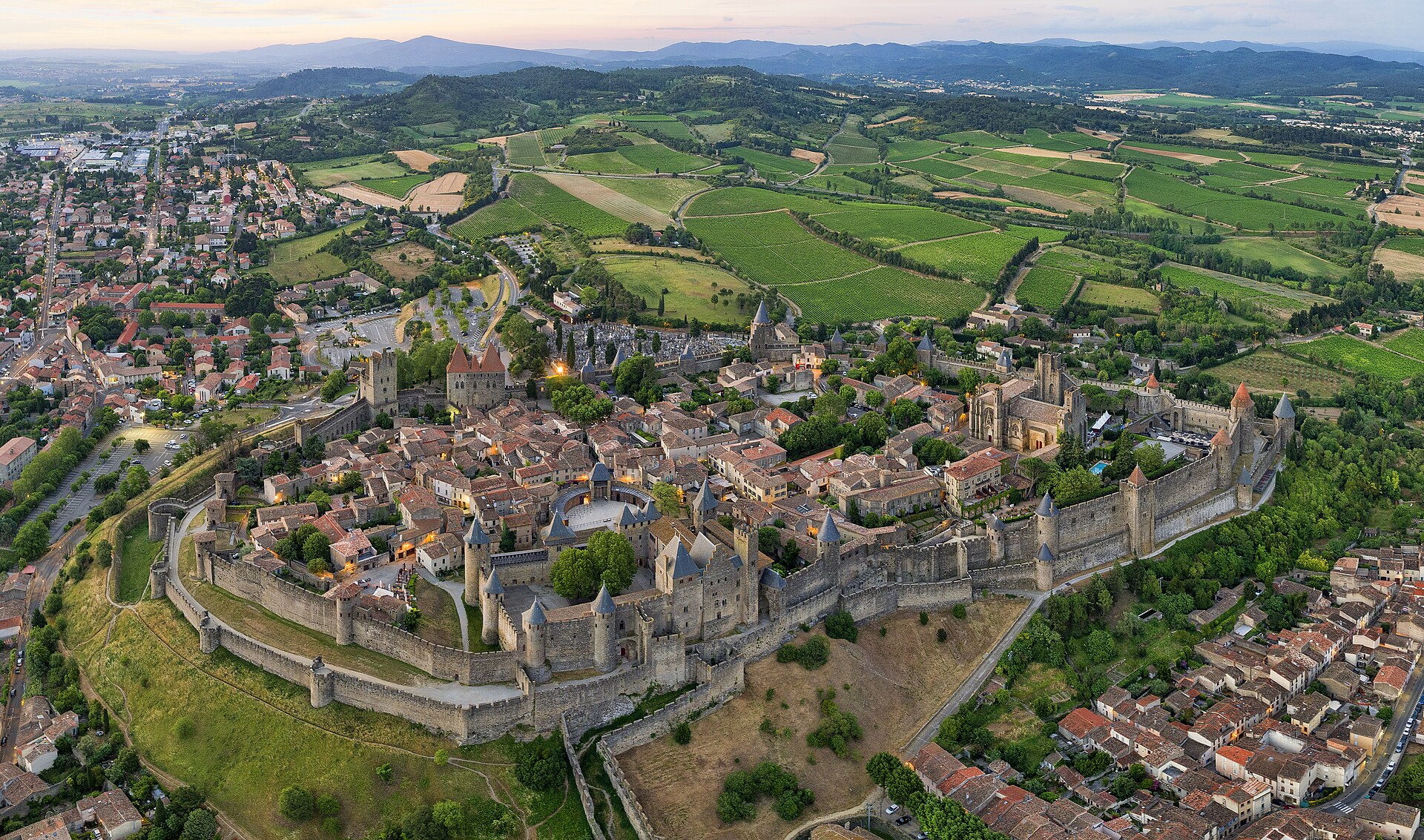
The Cité de Carcassonne from the west, across the River Aude and the Bastide Saint-Louis, looking toward the hill-top walled city (the Cité), Carcassonne, Aude, Occitanie, France (the double ring of medieval defensive walls (the inner Gallo-Roman wall and the outer 13th-century CE wall with towers added by Philip III of France (1285 CE) and Philip IV (1290-1300 CE)); the Château Comtal (the Count’s Castle; ca. 1130-1150 CE; the Trencavel viscounts’ residence; 5 towers; now the main museum of the site); the Basilica of Saints Nazarius and Celsus (11th-14th century CE; the finest Romanesque-Gothic church in Languedoc)), Carcassonne, Aude, Occitanie, France. UNESCO World Heritage Site 1997. Photo via Wikimedia Commons.
Occitanie, France · Gallo-Roman walls 3rd-4th century CE; Cathar wars 1209-1244; Viollet-le-Duc 1853 restoration; 3 km double walls; UNESCO WHS 1997

Carcassonne

The largest and best-preserved medieval fortified city in Europe and the most complete example of a medieval defensive system in the world — Carcassonne (Aude, Occitanie, France; UNESCO WHS 1997) is a hilltop walled city with 3 km of double walls (52 towers), combining Gallo-Roman inner walls (3rd-4th century CE) with outer medieval walls and a castle that witnessed the Albigensian Crusade against the Cathars (1209-1229 CE).

At a glance

Carcassonne (the most precisely CarcassonneFrance single Cite 3 km double ring walls 52 towers inner Gallo-Roman wall 3rd 4th century CE outer wall 13th century CE Philip III 1285 CE Philip IV 1290 1300 CE Château Comtal Count’s Castle 1130 1150 CE Trencavel viscounts 5 towers medieval population 4000 current Cité 100 permanent residents tourist historic zone Aude River divides Cité hilltop from Bastide Saint-Louis lower commercial town 1247 CE Louis IX founded lower town after 1209 CE crusade sacked upper town Albigensian Crusade 1209 1229 CE Cathar heresy crusade Pope Innocent III ordered crusade against Catharism Cathar perfect parfait religious leaders pacifist vegetarian rejected material world Catholic Church material corruption Viscount Raymond-Roger Trencavel surrendered Carcassonne 1209 CE trick negotiate Simon de Montfort father seized imprisoned starved died 1209 CE 1213 CE Battle of Muret Simon de Montfort defeated Peter II of Aragon killed Toulousain coalition 1229 CE Treaty of Paris ended Albigensian Crusade Languedoc incorporated into French kingdom Viollet-le-Duc 1853 1879 CE restoration most famous controversial 19th century architectural restoration France UNESCO heritage: the Cathar Perfect (Perfecti; the defining group of the Albigensian Crusade): the Cathars (Cathari; “pure ones” in Greek) were a dualist Christian religious movement that flourished in Languedoc (southern France) from approximately 1000-1250 CE; the Cathars believed that the material world was created by an evil god (the demiurge; identified with the God of the Old Testament) and the spiritual world by a good god; they rejected the Catholic Church as corrupted by material wealth; the Perfecti (the initiated Cathars who had received the consolamentum (the Cathar baptism of spirit)) lived under strict vows: celibacy, vegetarianism, poverty, no lying; the Credentes (ordinary Cathars) lived normal lives and received the consolamentum only on their deathbed; Pope Innocent III offered Raymond VI of Toulouse the chance to suppress the Cathars; when Raymond refused (his territory was full of Cathar sympathizers), the Pope declared the Albigensian Crusade (1209 CE); the first act of the crusade was the massacre of Béziers (July 22, 1209 CE: approximately 7,000-20,000 people killed; when asked how to identify heretics, the Papal legate Arnaud Amaury reportedly said: “Kill them all; God will know his own”))) — the most precisely CarcassonneFrance single 3 km double walls 52 towers inner Gallo-Roman 3rd 4th century CE outer 13th century CE Philip III 1285 CE Philip IV 1290 1300 CE Château Comtal 1130 1150 CE Trencavel Cathar heresy Albigensian Crusade 1209 1229 CE Pope Innocent III Simon de Montfort 1213 CE Battle Muret Peter II Aragon killed Treaty Paris 1229 CE Languedoc French kingdom Viollet-le-Duc 1853 1879 CE restoration Béziers July 22 1209 CE 7000 20000 killed Arnaud Amaury kill them all God will know UNESCO heritage in any UNESCO world heritage site)).

Key facts

  • The restoration of Viollet-le-Duc (1853-1879 CE): the most precisely CarcassonneFrance single Viollet-le-Duc Eugène Emmanuel 1814 1879 CE most influential French architect 19th century CE Gothic Revival restoration Carcassonne 1853 CE abandoned ruined condition 1849 CE poet Prosper Mérimée Inspector General Historic Monuments France wrote saved from demolition saved ruins 1853 CE Viollet-le-Duc Commission des monuments historiques restored inner walls Château Comtal towers pointed conical slate roofing on towers controversy slate cones wrong period authentic medieval Carcassonne towers had flat tops or crenellated tops not pointed cones Viollet-le-Duc imposed northern French/Flemish style instead of local southern Languedoc style local critics immediately 1853 CE cited wrong style wrong material slate not used local Languedoc tradition local terracotta tiles used not slate cones UNESCO heritage — the most famous controversy in French architectural restoration: Eugène Viollet-le-Duc (1814-1879 CE; the most influential architect of 19th-century France) was commissioned in 1853 CE to restore the ruins of Carcassonne (which had been proposed for demolition by local authorities in 1849 CE); his restoration is now recognized as both a masterpiece of structural engineering (he rebuilt 3 km of walls and 52 towers) and a controversial act of creative reinvention: the conical slate-tiled roofs on the towers (now the iconic silhouette of Carcassonne) are an invention — the original medieval towers had flat tops or crenellated battlements, not pointed cones; slate was never used in Languedoc (the local material was curved terracotta tiles); Viollet-le-Duc applied northern French (Norman or Flemish) architectural habits to a southern French building; the counter-argument: without the restoration, there would be no Carcassonne to debate — the ruins would have been demolished
  • GPS: 43.2077° N, 2.3641° E

History

From Gallo-Roman fortress to Cathar stronghold to royal French fortress to ruin to UNESCO (the most precisely CarcassonneFrance single 300 BCE Iberian Celtic settlement hill 100 BCE Roman Carcaso colony 3rd 4th century CE Gallo-Roman walls inner wall built Roman wall survives inner circuit current wall 462 CE Visigoths conquered 508 CE Frankish siege repelled Carcassonne 585 CE Visigoths surrendered to Franks Merovingian Carolingian period 795 CE Charlemagne legend 5 year siege Saracens internal revolt 900 CE Trencavel Viscounts independent lords Carcassonne Trencavel dynasty controlled Carcassonne Albi Béziers 12th century CE 1170s CE Cathar heresy widespread Languedoc Trencavel tolerant Cathars 1209 CE Pope Innocent III Albigensian Crusade launched Simon de Montfort forces Raymond-Roger Trencavel 24 years old viscounts surrendered Carcassonne July 1209 CE negotiate safe conduct terms prisoners secretly seized imprisoned died November 10 1209 CE tuberculosis starvation 1240 CE Trencavel heir failed revolt expelled 1247 CE Louis IX Bastide Saint-Louis lower town founded 1260 1280 CE Philip III France added outer ring walls current state 1355 CE Black Prince Edward of Wales English sacked burned Bastide lower town did not attempt the Cité walls gave up 1659 CE Treaty of Pyrenees France-Spain Carcassonne strategic border importance ended declined 1849 CE local authorities proposed demolish ruins sell stone 1849 CE Prosper Mérimée protected wrote 1853 CE Viollet-le-Duc restoration begun 1879 CE Viollet-le-Duc died restoration continued disciples 1997 CE UNESCO UNESCO heritage: the Black Prince (1355 CE): the most famous medieval siege failure at Carcassonne: in October-November 1355 CE, Edward of Woodstock (the Black Prince; the son of Edward III of England and heir to the English throne) conducted a massive chevauchée (a devastating raid through southern France) during the Hundred Years War; his army burned and sacked the lower Bastide Saint-Louis (the new town; 1247 CE); when he approached the Cité walls, he decided not to attempt a siege — the double wall system (the Gallo-Roman inner wall and the Philip III outer wall) was considered impregnable; the Cité survived completely undamaged while everything below was burned; this is the most dramatic demonstration of the effectiveness of Viollet-le-Duc’s (and the original medieval builders’) double-wall defensive system)) — the most precisely CarcassonneFrance single 300 BCE Iberian Celtic 100 BCE Roman Carcaso 3rd 4th century CE Gallo-Roman inner wall 462 CE Visigoths 795 CE Charlemagne legend siege 1209 CE Albigensian Crusade Simon de Montfort Raymond-Roger Trencavel 24 years surrendered negotiate secretly imprisoned died November 10 1209 CE tuberculosis starvation 1240 CE Trencavel heir revolt expelled 1247 CE Louis IX Bastide lower town 1260 1280 CE Philip III outer walls 1355 CE Black Prince burned Bastide didn’t attempt Cité walls gave up 1849 CE demolition proposed Prosper Mérimée 1853 CE Viollet-le-Duc 1879 CE died disciples 1997 CE UNESCO heritage in any UNESCO world heritage site)).

What you see

Double walls, Château Comtal, and the Basilica (the most precisely CarcassonneFrance single outer ring 1.4 km walls 14 towers Philip III Philip IV 1260 1300 CE lices the lists space between inner and outer walls 12m wide originally empty no buildings in lists so attackers had no cover inner wall longer original Gallo-Roman wall 1.8 km 24 towers horseshoe round towers Château Comtal Count’s Castle 1130 1150 CE Trencavel viscounts 5 square round towers keep barbican dry moat drawbridge raised portcullis inner castle separate from town Basilica Saints Nazarius Celsus 6th century CE first church Romanesque nave 11th 12th century CE Gothic choir transepts 14th century CE finest stained glass windows Languedoc 14th century CE rose window Porte Narbonnaise east main gate two towers twin round towers 1280 CE main entrance Cité today Porte d’Aude west gate river gate Narbonne Gate most impressive defensive gate outside tourist most visitors enter here Viollet-le-Duc house museum within Cité explanatory plaques UNESCO heritage: the essential visit circuit (minimum 3h: the Porte Narbonnaise (the main gate; most visitors enter from the east car park by the Porte Narbonnaise (twin towers; 1280 CE; the most photogenic entrance)); the lices wall-walk (the inner-wall walkway accessible from the Château Comtal; the most complete view of both wall systems and all 52 towers); the Château Comtal (the count’s castle; €10 entry; the main museum covering Cathar history and the Viollet-le-Duc restoration; the guided tour of the inner walls is included in the château ticket); the Basilica of Saints Nazarius and Celsus (free entry; the 14th-century Gothic choir and stained glass windows); the view from the Porte d’Aude (the west gate; the view over the Aude River and the Bastide Saint-Louis)))) — the most precisely CarcassonneFrance single outer 1.4 km 14 towers lices 12m lists empty between walls inner 1.8 km 24 towers Gallo-Roman horseshoe Château Comtal 1130 1150 CE Trencavel 5 towers barbican dry moat Basilica Saints Nazarius Celsus 6th century CE Romanesque 11th 12th century CE Gothic choir 14th century CE rose window finest stained glass Languedoc Porte Narbonnaise 1280 CE twin towers east main entrance Viollet-le-Duc house museum explanatory plaques lices wall-walk 52 towers UNESCO heritage in any UNESCO world heritage site)).

Practical information

  • Getting there: Carcassonne Airport (CCF; Ryanair direct from London Stansted, Brussels, Dublin, Edinburgh; low-cost; 3 km from the Cité; taxi to the Cité €15); from Toulouse (86 km; TER regional train to Carcassonne station: 50 min; €15; then bus or taxi to the Cité); from Paris (6h15m direct TGV to Carcassonne station; frequent services); the Cité entry (free to walk around the ramparts (the outer walls circuit is accessible without a ticket); Château Comtal museum entry €10 (includes guided wall walk and museum); the lices (wall walk between the two rings) accessible for free from the Porte Narbonnaise); the visiting time (minimum 3h for the Château Comtal + Basilica + lices wall circuit; a full day allows the Bastide Saint-Louis lower town and Canal du Midi (UNESCO WHS 1996)); the best time (spring (April-June) and autumn (September-October); summer (July-August) is the busiest period (2 million visitors/year); the night illumination of the Cité walls (from dusk; the walls are lit from the outside; spectacular from the Bastide Saint-Louis across the Aude River))

Getting there

CCF airport (3 km, taxi €15; Ryanair from London/Brussels). From Toulouse: TER train 50 min (€15) then taxi/bus. Outer rampart walk is free. Château Comtal €10 (includes wall tour). Best: April-June or September-October. GPS: 43.2077, 2.3641.

Nearby

  • Canal du Midi — adjacent (UNESCO WHS 1996; the 240 km canal connecting the Atlantic and the Mediterranean (1666-1681 CE; engineer Pierre-Paul Riquet; the greatest hydraulic engineering work of 17th-century Europe; 91 locks, 55 aqueducts, 7 bridges; the Carcassonne section of the Canal du Midi passes directly below the Cité; boat hire available in Carcassonne for day trips)
  • Montségur — 75 km south (the final stronghold of Catharism: the Château de Montségur (the ruined 13th-century CE castle on a 1,207m pog (rock pinnacle) in the Ariège Pyrenees); the last Cathar Perfecti surrendered here in March 1244 CE; 210-225 Cathar Perfecti who refused to convert were burned alive at the base of the pog on March 16, 1244 CE (the Prat dels Cremats; “Field of the Burned”); the Pyrenean summit (the 1.5h climb from the car park to the château is steep but well-marked))

Sources

  • Wikipedia, Carcassonne; Albigensian Crusade; Eugène Viollet-le-Duc; Cathars, accessed June 2026
  • UNESCO, Historic Fortified City of Carcassonne, WHS reference 345rev, inscribed 1997

Hero image: Carcassonne walled city, Occitanie, France, Wikimedia Commons. Editorial text © Cultural Heritage Online, 2026.

📷 Diventa un fotografo di Cultural Heritage Online

Condividi le tue foto dei luoghi: restano pubblicate con la tua firma come autore. Più vengono viste, più ti fai conoscere — e presto un concorso premierà le foto più apprezzate.

Accedi o registrati gratis per aggiungere una foto
📋 Copy & share on social
Scroll to Top