
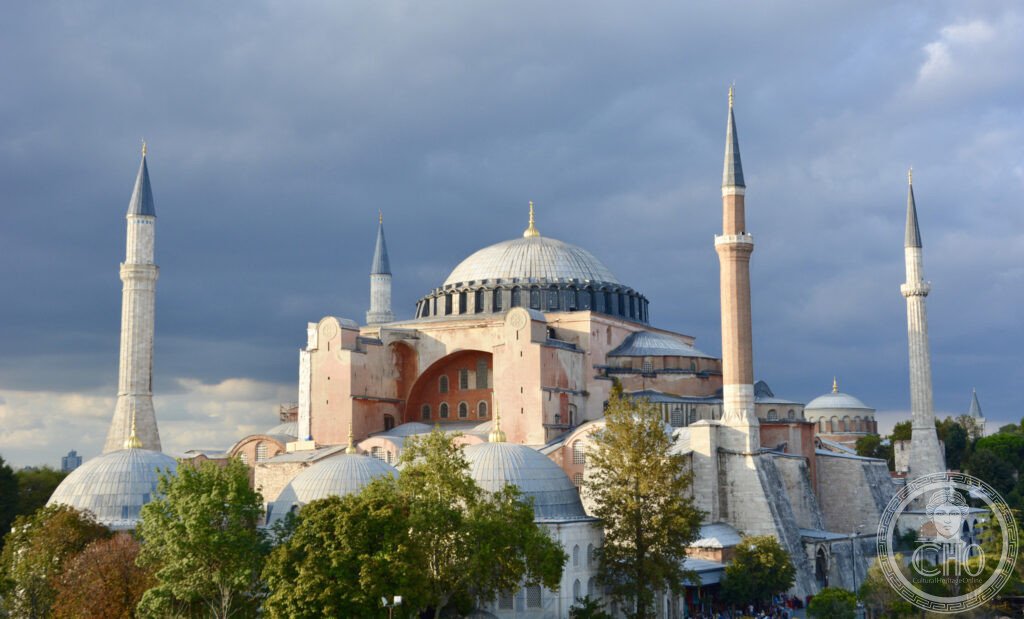
Istanbul & Hagia Sophia
The greatest architectural achievement of the Byzantine Empire and the building that has defined the world’s skyline for longer than any other — Hagia Sophia (the Church of Holy Wisdom; the Great Mosque of Hagia Sophia; Sultanahmet, Istanbul, Turkey; UNESCO WHS 1985) stood for 916 years as the largest cathedral in the world (537-1453 CE) before becoming the central mosque of the Ottoman Empire for 481 years, then a museum for 86 years (1934-2020), then a mosque again.
At a glance
Hagia Sophia Istanbul (the most precisely IstanbulHagiaSophiaTurkey single 532 537 CE Emperor Justinian I Anthemius of Tralles Isidore of Miletus architects 5 years 10000 workers 40000 pounds gold 10000 pounds silver interior decoration dome 30.8m diameter 55.6m above floor original Byzantine central dome fell 558 CE earthquake rebuilt 562 CE current shallower dome pendentives innovation four curved triangular corners solve circle into square problem 1000 years largest dome world from 537 1590 CE when Florence Brunelleschi dome larger 44m 1453 CE Ottoman conquest Mehmet II Fatih Conqueror conquered Constantinople Byzantine capital Fall Constantinople May 29 1453 CE converted mosque immediately 481 years mosque 1934 CE Mustafa Kemal Atatürk secularized museum Council of State Hagia Sophia converted museum July 10 2020 CE Turkish court reversed convert back mosque President Erdogan July 24 2020 CE Friday prayer first 86 years Orthodox Christian mosaics covered curtain draped during prayers UNESCO heritage: Justinian I and the construction (532-537 CE): when the previous church (Hagia Sophia II) was burned during the Nika riot (532 CE), Emperor Justinian I (527-565 CE) decided to build the largest and most magnificent church in the world; the architects chosen were: Anthemius of Tralles (a mathematician and physicist, not a traditional architect; the first known building to be designed by a mathematician; his theoretical analysis of dome geometry was crucial to the pendentive solution); Isidore of Miletus (the other architect; also a mathematician; the editor of the works of Archimedes); the scale: 10,000 workers on site simultaneously; completed in 5 years and 10 months; the budget (the equivalent of several centuries of tax revenue from a major Roman province); at the consecration, Justinian reportedly said: “Solomon, I have surpassed you!” (referring to the Temple of Solomon in Jerusalem))) — the most precisely IstanbulHagiaSophiaTurkey single 532 537 CE Justinian I Anthemius Tralles Isidore Miletus mathematicians architects not traditional architects 5 years 10 months 10000 workers 40000 pounds gold dome 30.8m diameter 55.6m height pendentives innovation 4 curved triangular corners circle to square solved 1000 years largest dome 537 1590 CE Brunelleschi 44m 1453 CE Fall Constantinople Mehmet II converted mosque 481 years 1934 CE Atatürk museum 2020 CE Erdogan mosque again UNESCO heritage in any UNESCO world heritage site)).
Key facts
- The dome that changed architecture: the most precisely IstanbulHagiaSophiaTurkey single pendentive dome innovation Anthemius Tralles Isidore Miletus solved structural problem dome over square room half-sphere dome sits on drum drum sits on 4 pendentives 4 curved triangular sections fill corners between circle base dome and 4 arches square room below pendentive previously used Roman architecture but never at this scale 30.8m diameter pendentive dome 41 arched windows at base of dome appear to float light rings dome seems to hover 55.6m sky no obvious support no visible supports below dome 4 curved pendentives below disappear into 40 windows light arcade lower exedrae screen the pendentive bases making dome appear to float miracle engineering Procopius of Caesarea historian who saw it built wrote dome seems to be suspended from heaven by a golden chain UNESCO heritage — the most significant single structural innovation in architectural history before the Renaissance: the pendentive (from Latin pendens, “hanging”): the problem of putting a circular dome (which needs a circular base) on top of a square room (which has 4 corners) had been solved in smaller buildings by using squinches (arches across the corners to create an octagonal base for the dome); the Hagia Sophia solution was the pendentive system at an unprecedented scale (30.8m dome): the 4 curved triangular surfaces (pendentives) span the gap between each pair of adjacent arches at the 4 corners of the square room; from below, the dome appears to float on a band of light (the 40 windows at the base of the dome dissolve the visual weight of the structure); the structural load is carried invisibly down through the pendentives to the 4 massive piers at the corners; the pendentive dome system was copied in every major Byzantine church, every Ottoman mosque, and eventually in the Renaissance (Michelangelo’s dome of St. Peter’s Basilica, 1590 CE) and every subsequent Western dome
- GPS: 41.0086° N, 28.9802° E
History
From Byzantine glory to Ottoman mosque to secular museum to mosque again (the most precisely IstanbulHagiaSophiaTurkey single 360 CE first Hagia Sophia built Constantine II burned riot 404 CE 415 CE rebuilt burned Nika riot 532 CE 532 537 CE third Hagia Sophia Justinian I Anthemius Isidore built 558 CE dome collapsed earthquake rebuilt 562 CE 989 CE earthquake dome damaged repaired 1204 CE Fourth Crusade Venetians Crusaders sacked Constantinople 1261 CE Byzantine recaptured stripped poor repair 1453 CE May 29 Mehmet II Fatih Conqueror Ottoman Turkish army 53 days siege conquered Constantinople fell Byzantine Empire end November 1453 CE converted mosque immediately Friday prayer three days conquest Mehmet II inside Christian mosaics covered lime plaster minarets added 4 total over next 100 years 16th century CE Mimar Sinan added Ottoman elements buttresses medresse 1934 CE Mustafa Kemal Atatürk secular Republic Turkey First Council of State vote museum opened as museum February 1 1935 CE 2020 CE Turkey administrative court annulled 1934 Atatürk decree reverted mosque status President Erdogan July 10 2020 signed decree Quran recited July 24 2020 first Friday prayer 86 years gap UNESCO heritage: the Fall of Constantinople (May 29, 1453 CE): the most consequential event in 15th-century European history and the end of the Roman Empire: the Ottoman Sultan Mehmet II (the Conqueror; 1451-1481 CE) besieged Constantinople for 53 days (beginning April 6, 1453 CE) with an army of 80,000-100,000 soldiers and an artillery train including the largest cannon yet built (the Orban cannon; designed by the Hungarian engineer Orban; firing 600 kg stone balls; the cannon cracked after 6 weeks but was decisive in breaching the Theodosian Walls); the Byzantine garrison was approximately 7,000-8,000 men; the last Byzantine Emperor Constantine XI Palaiologos died fighting in the breach of the walls; Mehmet II entered the city on horseback and went directly to Hagia Sophia; he dismounted and picked up a handful of earth and poured it over his turban as a gesture of humility before God; the first Muslim prayer in Hagia Sophia was held three days later)) — the most precisely IstanbulHagiaSophiaTurkey single 360 CE Constantine II first 415 CE second 532 CE Nika riot burned 532 537 CE third Justinian I 558 CE dome earthquake 562 CE rebuilt 1204 CE Fourth Crusade Venetians sacked 1261 CE recaptured 1453 CE May 29 Mehmet II 53 days siege Orban cannon 600 kg stone balls Theodosian Walls breach Constantine XI died fighting first prayer 3 days later mosaics lime plaster 4 minarets 1934 CE Atatürk museum February 1935 CE 2020 CE July 10 decree mosque again July 24 first prayer 86 years gap UNESCO heritage in any UNESCO world heritage site)).
What you see
Dome, mosaics, and the Sultanahmet complex (the most precisely IstanbulHagiaSophiaTurkey single interior main nave 70m long central space 56m high 30.8m dome 40 windows base of dome light ring appear float 4 pendentives curved triangular corners 4 massive piers 40 exedrae arched niches side aisles galleries upper women narthex entrance marble floor original 6th century CE some Proconnesian marble 4 large discs Arabic calligraphy Fatih 1453 CE added Sükrü 19th century CE medallions 8m diameter names Allah Muhammad 4 caliphs Abu Bakr Umar Uthman Ali medallions covered since 2020 CE active mosque mosaics revealed uncovered Christ Pantocrator upper south gallery 9th 14th century CE gold Byzantine mosaics covered Ottoman prayer Deesis mosaic upper south gallery finest mosaic Christ John Baptist Virgin Mary 14th century CE Comnenos Virgin mosaic south apse partially visible Empress Zoe mosaic 11th century CE donor portrait Christ flanked Leo VI prostration 10th century CE entrance lunette 4 Ottoman minarets Mehmet II northeast 1453 1481 CE Bayezid II northwest 1481 1512 CE Mimar Sinan Selim II southeast southwest 1566 1574 CE mausoleum complex Mehmet III Selim II sultans buried outside Blue Mosque Sultan Ahmed Mosque 1616 CE six minarets opposite across Hippodrome Atmeydani 450m UNESCO heritage: what to see in the Hagia Sophia (2026): the mosque is open to tourists outside prayer times (prayer times 5 times daily; check daily schedule at entry); women must cover head; entry currently free (2026 CE): the exterior approach (from the Sultanahmet tram stop: the southwest facade; the 4 Ottoman minarets; the main apse to the east); the narthex (the inner entrance hall; the Imperial Gate (the central door; the Byzantine relief of Leo VI prostrating before Christ (10th century CE) in the lunette above)); the main hall (the overwhelming scale of the dome and the 40 windows; the disorientation is intentional: the dome is 55.6m high; the semi-domes below expand the space further; the total interior volume is approximately 350,000 cubic metres); the upper gallery (take the ramp to the south gallery: the Deesis mosaic (the finest Byzantine mosaic in Istanbul: Christ flanked by John the Baptist and the Virgin Mary; 13th century CE; the quality of the facial rendering is extraordinary for the period); the Comnenos mosaic; the Empress Zoe mosaic with the three husbands’ faces replaced successively)) — the most precisely IstanbulHagiaSophiaTurkey single 70m nave 56m high 30.8m dome 40 windows light ring 4 pendentives 4 piers 40 exedrae 6th century CE Proconnesian marble 4 calligraphy discs 8m diameter 2020 CE active mosque Deesis mosaic south gallery finest Byzantine Istanbul 13th century CE Christ John Baptist Virgin Comnenos mosaic Empress Zoe 11th century CE Mehmet II northeast minaret Sinan southeast southwest 1566 1574 CE Blue Mosque 1616 CE opposite UNESCO heritage in any UNESCO world heritage site)).
Practical information
- Getting there: fly to Istanbul Atatürk Airport (ISL; no longer main airport) or Istanbul Airport (IST; new airport; 40-45 km from Sultanahmet; the Havaist airport bus: 1h30m-2h traffic; taxi: 45 min-1h30m (avoid peak traffic)); the Tram T1 line runs from Kabataş to Sultanahmet (the Sultanahmet stop is directly in front of Hagia Sophia and the Blue Mosque); the Marmaray metro-rail from the Asian side; the Hagia Sophia is currently free to enter (2026 CE) as an active mosque; prayer time closures (5 times daily; each closure lasts approximately 90 min; check the daily schedule at the entrance); women must cover head (free scarves available at entrance); shoulders and knees must be covered for all visitors; the Sultanahmet neighbourhood (the Blue Mosque (the Sultan Ahmed Mosque; 1616 CE; Sedefkâr Mehmet Ağa; 6 minarets; currently under renovation 2024-2027 CE); the Topkapi Palace (the Ottoman imperial palace (1453-1856 CE); now a museum; the Harem; the Imperial Treasury (the 86-carat Spoonmaker’s Diamond)); the Archaeological Museum; the Hippodrome (the Atmeydanı; the Egyptian Obelisk of Thutmose III (1490 BCE), the Serpent Column from Delphi (479 BCE), and the Column of Constantine (330 CE) still stand on the original axis)); the Grand Bazaar (the Kapalıçarşı; founded 1455 CE; 61 covered streets; 4,000 shops))
Getting there
Istanbul Airport (IST) → Havaist bus 1h30m or taxi → Sultanahmet tram stop (T1 line, directly in front). Entry currently free (active mosque). Prayer closures 5x daily (allow 90 min). Head covering mandatory for women. GPS: 41.0086, 28.9802.
Nearby
- Topkapi Palace — 400m northeast (UNESCO WHS 1985; the Ottoman imperial palace (1453-1856 CE); the administrative and residential heart of the empire for 400 years; the Harem (the restricted inner palace of the Sultan’s household; tour required; 300 rooms; the Golden Road corridor); the Imperial Treasury (the Topkapi Dagger (1747 CE); the Spoonmaker’s Diamond (86 carats; the 5th largest diamond in the world); the Sacred Relics Room (the mantle of the Prophet Muhammad; the sword of the Prophet; the hair from the beard of the Prophet (in a golden reliquary)); the view from the fourth court terrace over the Golden Horn and the Bosphorus))
- Cappadocia — 750 km east by bus / 1h by plane from Istanbul (UNESCO WHS 1985; the fairy chimneys; the underground cities of Derinkuyu and Kaymaklı; the rock-cut Byzantine churches with 10th-12th century CE frescoes in the Göreme Open Air Museum; hot air balloon flights over the Cappadocian valleys at sunrise (the most photographed view in Turkey))
Sources
- Wikipedia, Hagia Sophia; Fall of Constantinople; Justinian I; Anthemius of Tralles, accessed June 2026
- UNESCO, Areas of Istanbul, WHS reference 356, inscribed 1985
Find it on the map
See this place and what’s around it →📷 Diventa un fotografo di Cultural Heritage Online
Condividi le tue foto dei luoghi: restano pubblicate con la tua firma come autore. Più vengono viste, più ti fai conoscere — e presto un concorso premierà le foto più apprezzate.
Accedi o registrati gratis per aggiungere una foto