

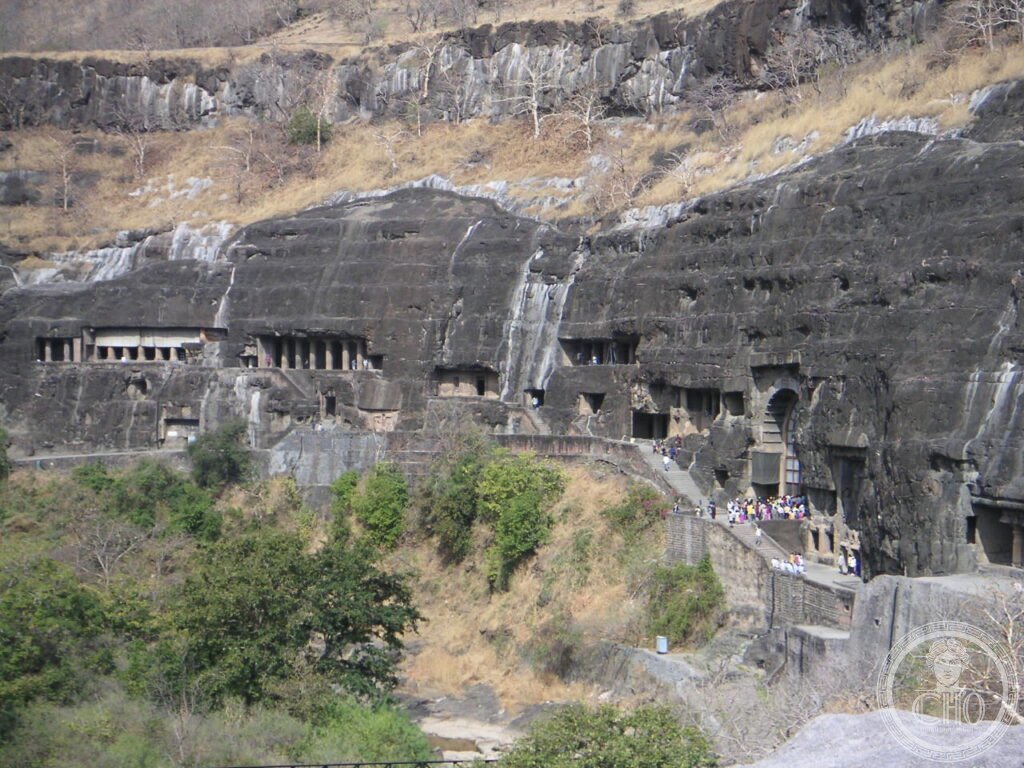
Cut into the basalt cliff of a horseshoe-shaped gorge on the Waghora River, the Ajanta Caves hold Buddhist monasteries and prayer halls carved across seven centuries. Their painted interiors, especially those finished under the Vakataka king Harisena in the 5th century, preserve some of the oldest surviving narrative murals from the Indian subcontinent.
At a glance
The Ajanta Caves are a group of rock-cut Buddhist monasteries (viharas) and prayer halls (chaityas) carved directly into a basalt cliff along the Waghora River gorge in Aurangabad District, Maharashtra. The gorge curves in a U-shape, so the cave entrances face each other across the ravine in a broad crescent.
Excavation happened in two distinct phases separated by several centuries. An early Hinayana, or Theravada, phase in the 2nd and 1st centuries BCE produced a handful of caves, including Caves 9, 10, 12, 13 and 15A. Work then paused for hundreds of years before resuming under the Vakataka dynasty in the 5th century CE, when the majority of caves, and virtually all of the surviving paintings, were made. The site was inscribed as a UNESCO World Heritage Site in 1983.
Key facts
- Location: Ajanta, Aurangabad District (now Chhatrapati Sambhajinagar), Maharashtra, India
- Coordinates: 20.5519° N, 75.7003° E
- Number of caves: a series of rock-cut caves numbered along the cliff, comprising viharas (monastery halls) and chaityas (prayer halls)
- Earliest phase: 2nd–1st century BCE, Hinayana/Theravada Buddhist tradition
- Main building phase: 460–480 CE, under the Vakataka king Harisena
- Recognition: UNESCO World Heritage Site, inscribed 1983
History
The earliest caves at Ajanta belong to the Hinayana, or Theravada, Buddhist tradition and were cut in the 2nd and 1st centuries BCE. After this initial phase, excavation stopped for several centuries, coinciding with the decline of the Satavahana dynasty in the region.
Work resumed in the 4th and 5th centuries CE under the Vakataka dynasty, which had replaced the Satavahanas in Maharashtra. The Vakataka king Harisena, who reigned roughly between 460 and 480 CE, became the site’s principal patron, and around twenty years of intense excavation and painting followed, producing most of the caves seen today, including twelve viharas and five chaityas. When Harisena died, Vakataka authority collapsed abruptly and his successors showed no further interest in sponsoring Buddhist works at Ajanta. The Chalukya dynasty took over the region from around 543 CE, but with its capital at Badami and its attention turned to the nearby Ellora caves, Ajanta received no further patronage and was abandoned.
The site then lay hidden under jungle growth for well over a thousand years until February 1819, when a British officer named John Smith, out with a tiger-hunting party in the Waghora gorge, spotted a cave entrance through the undergrowth. This proved to be Cave 10, the largest of the early prayer halls; Smith carved his name and the date on its wall, where it can still be seen. News of the discovery reached the Bombay Literary Society through William Erskine in 1824. Major Robert Gill was later sent by the Royal Asiatic Society to make painted copies of the murals, a task that occupied him for many years; most of his copies were destroyed in a fire at the Crystal Palace in London. A second set of copies was produced by John Griffiths and students of the Central School of Art in Bombay, though many of these were also lost to fire. In 1928 the British Museum scholar Laurence Binyon described the Ajanta murals as among the finest ancient paintings in the world.
What you see
The caves are numbered from west to east along the cliff face, and the numbering reflects position rather than age. Cave 9 and Cave 10, both from the 2nd century BCE, are pillared chaitya halls with barrel-vaulted ceilings; Cave 10, the larger of the two, contains some of the earliest surviving narrative paintings in India, showing scenes from the Jataka tales, the traditional stories of the Buddha’s previous lives.
The 5th-century caves carry the finest and best-preserved painting at the site. Cave 17 retains the most complete painted programme, with court scenes, elephants, horses and musicians recording daily life at a Vakataka court. Cave 1 is generally regarded as the finest vihara, and on the right-hand wall of its shrine entrance is the Bodhisattva Padmapani, a large painted figure holding a blue lotus. The modelling of the face and body, achieved through subtle shading, gives the figure a three-dimensional quality unusual in painting of this period, and the brushwork suggests it was completed in a single sustained sitting. The blue pigment used throughout the murals, including in this painting, was made from powdered lapis lazuli brought from mines in Badakhshan, in present-day Afghanistan, along the same trade routes that later supplied lapis to Renaissance painters in Florence.
Elsewhere, Cave 2 has an elaborately patterned ceiling with mandala designs, and Cave 26 contains a large reclining sculpture of the Buddha at the moment of his death, the largest single sculptural composition at Ajanta. The paintings themselves were made using a lime-plaster technique rather than true fresco: a rough base coat of cow dung, rice husk and lime was covered with a fine lime finish, onto which mineral pigments, including red and yellow ochre, lamp black, lapis lazuli blue, cinnabar red and terra verte green, were applied once the surface had dried.
Practical information
- Visiting: the caves are approached along the cliff and are best seen in the numbered sequence from west to east; current access arrangements, routes and any restrictions should be checked with the official managing authority before visiting.
- Tickets and hours: these are set and revised by the site’s official body, and visitors should confirm current details through the official channel rather than relying on older published figures.
- On site: several caves have low lighting to protect the paintings, so allow time for eyes to adjust and expect some caves to be more visible than others.
Getting there
Ajanta lies in Aurangabad District, Maharashtra, an area now administered as Chhatrapati Sambhajinagar. Visitors typically use Aurangabad as the nearest base for reaching the caves; current transport options and routes are best confirmed locally or through official tourism channels.
Nearby
- Ellora Caves — the rock-cut religious complex that took over as the region’s principal site once Ajanta lost patronage under the Chalukya dynasty.
- Aurangabad (Chhatrapati Sambhajinagar) — the district town most commonly used as a base for visiting Ajanta.
Sources
- UNESCO
- Bombay Literary Society
- Royal Asiatic Society
- Central School of Art, Bombay
- British Museum
Find it on the map
See this place and what’s around it →📷 Become a Cultural Heritage Online photographer
Share your photos of places: they stay published under your name as the author. The more they're seen, the more you get noticed — and soon a contest will reward the most appreciated photos.
Log in or sign up free to add a photo