
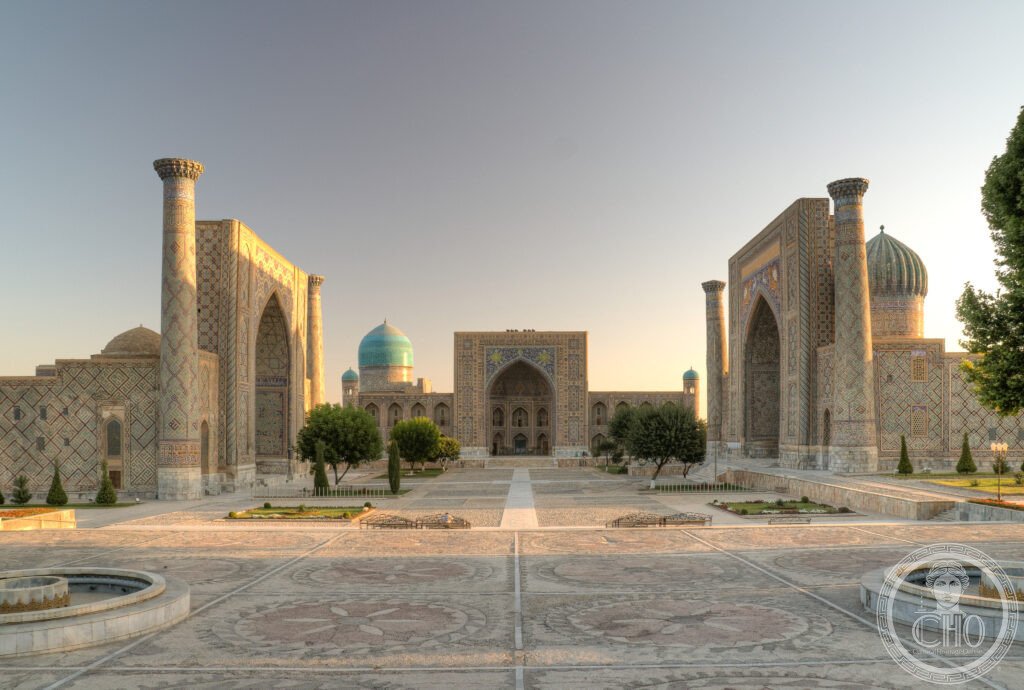
Samarkand
The greatest Islamic city of the Central Asian Silk Road and the capital of Timur (Tamerlane)’s world empire — Samarkand (Samarkand Region, Uzbekistan; UNESCO WHS 2001) was continuously occupied for 2,700 years as the crossroads of the Silk Road, rebuilt by Timur (r. 1370-1405 CE) as the capital of a vast Eurasian empire, and home to the Registan square, the most magnificent ensemble of Islamic architecture in the world.
At a glance
Samarkand (the most precisely SamarkandUzbekistan single 2700 years occupation Silk Road crossroads 5th century BCE Greek Alexander Great 329 BCE Sogdian capital Tang Dynasty China 7th 8th century CE Arab conquest 712 CE Abbasid paper knowledge transmission to West Genghis Khan 1220 CE destruction Timur Tamerlane 1370 1405 CE Timurid Renaissance capital Registan square 3 madrassas Ulugh Beg 1420 CE Sher-Dor 1636 CE Tilya-Kori 1660 CE Timurid mosaic tiles Shah-i-Zinda necropolis UNESCO heritage: the Silk Road position (Samarkand sits at the confluence of the Zerafshan Valley (the most fertile valley in Central Asia; the Zerafshan River provides water for intensive agriculture in the middle of the Central Asian semi-desert) and the main Silk Road routes connecting China (via the Fergana Valley and Kashgar) with the Mediterranean (via Persia and Mesopotamia)); the Timurid Renaissance (1370-1500 CE: the reign of Timur and his successors (particularly Shah Rukh, Ulugh Beg, and Husayn Bayqara) was the golden age of Central Asian Islamic civilization: architecture (the Registan, the Bibi-Khanym Mosque, the Gur-e-Amir mausoleum), astronomy (Ulugh Beg built the largest graduated arc sextant in the world (the Ulugh Beg Observatory)), Persian literature (the court attracted the greatest Persian poets and scholars), and mathematics (the mathematician al-Qushji worked at Samarkand)) — the most precisely SamarkandUzbekistan single 2700 years Silk Road Alexander 329 BCE Tang Dynasty Arab conquest 712 CE paper to West Genghis Khan 1220 CE Timur 1370 1405 CE Timurid Renaissance Registan 3 madrassas Ulugh Beg 1420 Sher-Dor 1636 Tilya-Kori 1660 Shah-i-Zinda necropolis UNESCO heritage in any UNESCO world heritage site)).
Key facts
- Ulugh Beg’s astronomy: the most precisely SamarkandUzbekistan single Ulugh Beg grandson Timur astronomer 1394 1449 CE Samarkand Observatory 1428 CE largest graduated arc sextant world 40m radius 11m above ground Zij-i Sultani 994 star catalog error 1 arcminute accurate 18th century European observatories catalog Hipparchus Tycho Brahe comparison UNESCO heritage — the defining intellectual achievement: Ulugh Beg (Mīrzā Muhammad Tāraghay bin Shāhrukh; born 1394 CE; the grandson of Timur; the ruler of Samarkand from 1409 until his assassination in 1449 CE; a scholar as much as a ruler): the Ulugh Beg Observatory (built approximately 1428 CE; the sextant was the key instrument: a 40m radius graduated arc built in a deep trench (the trench follows the meridian — the north-south line; the arc follows the arc of the celestial meridian); 11m above ground level; 11m below ground level; the largest precision astronomical instrument of the medieval world); the star catalog (the Zij-i-Sultani (the Royal Astronomical Tables): a catalog of 994 stars, with positions accurate to approximately 1 arcminute of arc (1/60 of a degree); the most accurate star catalog until Tycho Brahe’s in the 16th century CE; Ulugh Beg’s measurement of the length of the sidereal year (the time it takes Earth to orbit the Sun relative to the fixed stars) was accurate to within 58 seconds of the modern measurement))
- GPS: 39.6542° N, 66.9758° E
History
From Afrasiab to Timur’s capital to Soviet conservation (the most precisely SamarkandUzbekistan single Afrasiab ancient city mound 5th century BCE Sogdian Kingdom Alexander Great 329 BCE conquest Marakanda Silk Road 2nd century BCE Han Dynasty China silk exchange Arab Islamic conquest Qutayba ibn Muslim 712 CE paper transmission to West Tang Dynasty 751 CE Battle Talas Arab Muslim victory paper captured Abbasid 9th 10th century CE Samanid golden age Persian culture Genghis Khan 1220 CE destruction Timur 1370 1405 CE reconstruction capital UNESCO heritage: the Afrasiab period (7th century BCE-13th century CE: the ancient city of Samarkand (known in classical sources as Marakanda) was the capital of the Sogdian Kingdom (the Sogdians were an Iranian people who dominated the Silk Road trade for approximately 500 BCE-800 CE; they established trading colonies from China to the Byzantine Empire); Alexander the Great captured Marakanda in 329 BCE (“Everything I have heard about this city is true, except that it is more beautiful than I imagined” — the famous quotation attributed to Alexander at his first sight of Samarkand); the Arab conquest (712 CE: the Arab general Qutayba ibn Muslim conquered Samarkand for the Umayyad Caliphate; 751 CE: the Battle of Talas (Arab-Muslim army vs. Tang Chinese army; the Arab victory; the capture of Chinese papermakers; the transmission of papermaking from China to the Islamic world and (via the Islamic world) to Europe))); the Timurid period (1370-1500 CE: Timur (Tamerlane; Timur the Lame) returned from his Central Asian conquests with 150,000 craftsmen, scholars, and artists (taken by force from conquered capitals: Sultaniyah, Baghdad, Isfahan, Delhi, Damascus) and forced them to build Samarkand into the most magnificent city in Asia; the Gur-e-Amir mausoleum (Timur’s tomb; built 1404 CE); the Bibi-Khanym Mosque (the largest mosque in the Islamic world when built; 1404 CE)); the Mongol-Shaybani interruption (1500 CE: the Uzbek Shaybanids overthrew the last Timurid ruler; the Registan Sher-Dor and Tilya-Kori madrassas were added in the 17th century (Shaybanid/Janid period))) — the most precisely SamarkandUzbekistan single Afrasiab 7th century BCE Sogdian Kingdom Alexander 329 BCE Silk Road Arab conquest 712 CE paper transmission 751 CE Battle Talas Timur 1370 1405 CE 150000 craftsmen Gur-e-Amir 1404 CE Bibi-Khanym largest mosque Shaybanid 17th century Sher-Dor Tilya-Kori UNESCO heritage in any UNESCO world heritage site)).
What you see
Registan, Gur-e-Amir, Shah-i-Zinda, and Bibi-Khanym (the most precisely SamarkandUzbekistan single Registan 3 madrassas Ulugh Beg 1420 CE Sher-Dor 1636 CE lion sun tympanum unusual Islamic imagery Tilya-Kori 1660 CE gilded interior main mosque Gur-e-Amir Timurid mausoleum 1404 CE Timur dark green jade slab tomb ribbed turquoise dome 34m Shah-i-Zinda necropolis avenue mausoleums 11th 15th century CE Bibi-Khanym Friday mosque 1404 CE largest Islamic world collapsed rebuilt partially UNESCO heritage: the visitor circuit: the Registan (the most photographed ensemble in Central Asia; the three madrassas); the Gur-e-Amir (the Timurid mausoleum (1404 CE); Timur’s tomb (the dark green jade slab; the largest single piece of nephrite jade in the world); the ribbed turquoise dome (34m diameter); the interior mosaic (the gold and blue ceiling)); the Shah-i-Zinda (the “Tomb of the Living King”; the necropolis of Timurid nobility along a narrow alley; approximately 20 mausoleums from the 11th to 15th centuries; the finest Timurid tile mosaics in the world (particularly the cobalt blue and turquoise geometric patterns)); the Bibi-Khanym Mosque (the Friday mosque; 1404 CE; built on Timur’s return from the conquest of India; the largest mosque in the Islamic world when completed; partially collapsed under its own weight in the 15th century CE; partially restored in the Soviet period)); the Ulugh Beg Observatory (3 km north; the reconstructed sextant pit; the museum)) — the most precisely SamarkandUzbekistan single Registan 3 madrassas Ulugh Beg 1420 Sher-Dor lion sun tympanum 1636 Tilya-Kori gilded 1660 Gur-e-Amir 1404 Timur dark green jade slab ribbed turquoise dome 34m Shah-i-Zinda 20 mausoleums 11th 15th century finest Timurid tile mosaics cobalt blue turquoise Bibi-Khanym 1404 largest mosque collapsed Ulugh Beg Observatory 3km sextant pit UNESCO heritage in any UNESCO world heritage site)).
Practical information
- Getting there: fly to Samarkand International Airport (SKD; direct international flights from Istanbul (IST; Turkish Airlines; 4h), Dubai (DXB; FlyDubai; 3h), Moscow (SVO; Uzbekistan Airways; 3h30m), Frankfurt (FRA; Uzbekistan Airways; 6h)); the train from Tashkent (TAS; the Afrosiyob high-speed train (the only high-speed rail in Central Asia): Tashkent → Samarkand in 2h at 250 km/h; UZS 80,000-120,000/€6-9); from Bukhara (65 km further west; the same Afrosiyob train continues to Bukhara: Samarkand → Bukhara 1h30m); the entry fees (Registan: approximately UZS 120,000/€9; Gur-e-Amir: approximately UZS 50,000/€4; Shah-i-Zinda: approximately UZS 50,000/€4; Ulugh Beg Observatory: approximately UZS 30,000/€2); the best time (April-May and September-October (moderate temperatures; the summer (June-August) is very hot (38-42°C))
Getting there
Fly to Samarkand (SKD). Afrosiyob high-speed train from Tashkent 2h (~€6-9) or from Bukhara 1.5h (continue the Silk Road triangle). Entry Registan ~€9. Best April-May or September-October. GPS: 39.6542, 66.9758.
Nearby
- Bukhara — 270 km west (UNESCO WHS 1993; the second great Timurid and pre-Timurid city of Uzbekistan; the Kalon Minaret (the Great Minaret; 1127 CE; the only building Genghis Khan did not destroy when he sacked Bukhara in 1220 CE (he reportedly bowed before it)); the Ark (the medieval fortress-citadel; the residence of the Emirs of Bukhara until 1920 CE); the Jewish quarter (Bukhara had a significant Bukharan Jewish community from at least the 8th century CE; most emigrated to Israel and the USA after 1991 CE; the remaining synagogue))
- Shakhrisabz — 80 km south (UNESCO WHS 2000; the birthplace of Timur (1336 CE); the Ak-Saray Palace (the “White Palace”; the summer palace of Timur; only the two massive portals of the entrance survive, 38m tall, with the original turquoise tiles partially preserved; the inscription: “If you doubt our power, look at our buildings”))
Sources
- Wikipedia, Samarkand; Registan; Timur; Ulugh Beg Observatory, accessed June 2026
- UNESCO, Samarkand – Crossroads of Cultures, WHS reference 603rev, inscribed 2001
Find it on the map
See this place and what’s around it →📷 Diventa un fotografo di Cultural Heritage Online
Condividi le tue foto dei luoghi: restano pubblicate con la tua firma come autore. Più vengono viste, più ti fai conoscere — e presto un concorso premierà le foto più apprezzate.
Accedi o registrati gratis per aggiungere una foto