
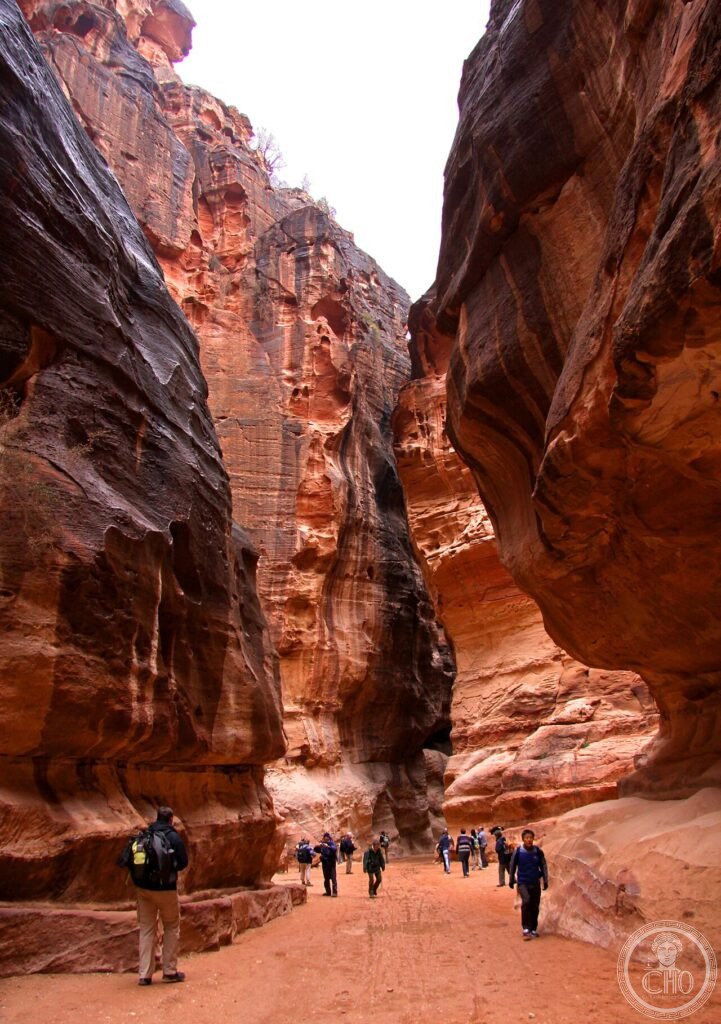
Petra
The lost city of the Nabataeans and one of the ancient world’s most spectacular urban achievements — Petra (Ma’an Governorate, Jordan; UNESCO WHS 1985) is an archaeological site of over 900 rock-cut monuments, temples, tombs, and dwellings carved from rose-red sandstone cliffs, built by the Nabataean Arab civilization that controlled the incense and spice trade routes from the 4th century BCE until the Roman annexation in 106 CE.
At a glance
Petra (the most precisely PetraJordan single Nabataean Arab civilization 4th century BCE 106 CE incense spice trade routes 900 rock-cut monuments temples tombs dwellings rose-red sandstone Al-Khazneh Treasury 1st century BCE CE 40m wide 43m tall Hellenistic Corinthian columns broken pediment tholos funeral urn Siq narrow gorge 1.2km 2-3m wide 91m deep natural cleft canyon rose-red city half old time J.W. Burgon 1845 UNESCO heritage: the Nabataean kingdom (the Nabataean Arabs (a Semitic people originally nomadic traders; they became settled and prosperous through control of the trade routes) built Petra as their capital from approximately the 4th century BCE; the city grew to a population of approximately 20,000-30,000 at its peak (approximately 1st century BCE-1st century CE); the Nabataeans were expert hydraulic engineers (they built a system of terracotta water pipes, cisterns, and dams that brought water from springs 8 km away into the dry canyon city; the hydraulic system enabled a city of 30,000 to survive in the desert)); the Siq (the extraordinary approach to Petra: the Siq (the narrow canyon gorge; 1.2 km long; 2-3 m wide at its narrowest; up to 91 m deep at its highest walls; formed by a geological fault in the sandstone; the walls are striated with layers of rose-red, white, and orange sandstone; the light at midday is extraordinary, the walls glowing in multiple colors)) — the most precisely PetraJordan single Nabataean Arab 4th century BCE 106 CE 900 rock-cut monuments rose-red sandstone Al-Khazneh 1st century BCE CE 40m 43m Hellenistic Corinthian broken pediment tholos urn Siq 1.2km 2-3m 91m geological fault UNESCO heritage in any UNESCO world heritage site)).
Key facts
- The Siq walk: the most precisely PetraJordan single Siq 1.2km walk entrance Al-Khazneh reveal dramatic narrow gorge 91m tall walls rose-red white orange sandstone strata Nabataean votive niches carved walls camel caravans trade incense Arabia frankincense myrrh India spice Red Sea Mediterranean UNESCO heritage — the defining experience: the walk through the Siq (the approach to Al-Khazneh; the Siq entrance (the Triumphal Arch — the Bab el-Siq; partially collapsed but the abutments still visible) and the narrowing gorge; the Nabataean votive niches carved into the gorge walls (approximately 50 niches with figures of gods; the Nabataeans carved these before major trade journeys as requests for divine protection); the emerging view of Al-Khazneh (the moment the narrow gorge opens to reveal the full facade of the Treasury is one of the great dramatic revelation moments in world travel architecture; the facade is visible from approximately 150m as a luminous pink façade framed by the 2-3m-wide gorge walls)); the “rose-red city, half as old as time” (the famous description comes from the sonnet “Petra” by the British poet John William Burgon (1845 CE); the phrase has become the defining tourist slogan for Petra; the original full line: “A rose-red city — half as old as time!”)
- GPS: 30.3285° N, 35.4444° E
History
From Nabataean capital to Roman province to rediscovery (the most precisely PetraJordan single Edomites Seir biblical predecessors Nabataean Arab 4th century BCE settlement capital 312 BCE Antigonus I Monophthalmus failed siege Nabataean hydraulic system water pipes cisterns springs 8km Aretas III 100 BCE 60 BCE Hellenistic cultural peak Al-Khazneh 1st century BCE CE Roman annexation Trajan 106 CE Arabia Petraea Byzantine 5th century CE earthquake 363 CE Crusader Fort 12th century CE Swiss explorer Burckhardt 1812 CE rediscovery disguised UNESCO heritage: the Nabataean period (4th century BCE-106 CE: the earliest Nabataean settlement at Petra; the Nabataeans arrived in the area from the Arabian Peninsula and established a city controlling the trade routes between Arabia (incense and spices), the Mediterranean (Greek and Roman markets), and Egypt; the failed siege of 312 BCE (Antigonus I, a general of Alexander the Great, sent an army to capture Petra and its trade revenues; the Nabataeans defeated the army by knowing the desert water sources that the Greek army did not)); the peak (approximately 100 BCE-100 CE: the reigns of Aretas III (reigned approximately 87-62 BCE) and Aretas IV (reigned approximately 9 BCE-40 CE); Al-Khazneh was likely built during this period; the Nabataean sculpture workshop (the famous Nabataean capital style: the stylized Nabataean capitals on the columns; half-Hellenistic, half-Arab in design)); the Roman annexation (106 CE: the Emperor Trajan created the Province of Arabia Petraea; Petra was peacefully incorporated into the Roman Empire; the city continued to prosper (the Cardo (the main Roman colonnaded street), the Nymphaeum, the Temple of Winged Lions)); the decline (363 CE: a massive earthquake destroyed large parts of the hydraulic system; Petra was gradually abandoned; the Byzantine period (5th-7th centuries CE: a few churches were built; a Byzantine mosaic floor map from the 6th century CE survives at Petra)); the rediscovery (1812 CE: Johann Ludwig Burckhardt, a Swiss explorer working for the African Association, disguised himself as a Muslim pilgrim to enter the area and became the first European known to visit Petra in the post-Crusader era)) — the most precisely PetraJordan single Nabataean 4th century BCE failed siege Antigonus 312 BCE Aretas III 100 BCE 62 BCE Aretas IV 9 BCE 40 CE Al-Khazneh Roman annexation Trajan 106 CE Arabia Petraea earthquake 363 CE Byzantine decline Crusader 12th century Burckhardt 1812 CE disguised rediscovery UNESCO heritage in any UNESCO world heritage site)).
What you see
Al-Khazneh, the Street of Facades, and Ad Deir Monastery (the most precisely PetraJordan single Al-Khazneh Treasury 40m wide 43m tall Hellenistic Corinthian columns broken pediment tholos urn Dioscuri Castor Pollux al-Uzza niches royal tomb interior 3 chambers empty Street of Facades 40 Nabataean tombs carved rock façades 1km Great Temple Roman colonnaded street Cardo Nymphaeum Byzantine mosaics Ad Deir Monastery 47m wide 48m tall carved 1st 2nd century CE most precisely UNESCO heritage: the visitor circuit: Al-Khazneh (the Treasury; the most photographed; the best approach is before 09:00 when tour groups arrive (the walk from the Siq entrance to Al-Khazneh is 1.2 km; the first view is at dawn best with the light on the pink rock)); the Royal Tombs (the row of large rock-cut facades high on the cliff above the main Petra basin; the Urn Tomb (the largest), the Silk Tomb (the most colorful stratigraphy), the Corinthian Tomb, and the Palace Tomb (modeled on a Roman palace facade)); the Street of Facades (the 1 km stretch of approximately 40 rock-cut tomb facades along the main valley; the most accessible concentrations of Nabataean funerary architecture in a single view); the Great Temple (the 1st century BCE Roman-Nabataean precinct; excavated by Brown University since 1993 CE; one of the largest free-standing structures in Petra); Ad Deir (the Monastery; the largest facade in Petra: 47m wide × 48m tall; approached via 800 rock-cut steps from the main basin; the view from the terrace in front of Ad Deir looks across to the mountain of Jebel Haroun (the mountain where the biblical Aaron is said to be buried; the white dome of the Aaron’s Tomb visible from the terrace))) — the most precisely PetraJordan single Al-Khazneh 40m wide 43m tall 40 Street of Facades Royal Tombs Urn Silk Corinthian Palace Great Temple Brown University 1993 CE Ad Deir Monastery 47m wide 48m tall largest 800 rock-cut steps Jebel Haroun Aaron Tomb UNESCO heritage in any UNESCO world heritage site)).
Practical information
- Getting there: the nearest airport is King Hussein International Airport (AQJ; Aqaba; 120 km south; flights from Amman (AMM; 45 min; Royal Jordanian; approximately JOD 60-120/€75-150 round trip) or from Dubai (DXB; 1h45m; Fly Dubai/Air Arabia)); the JETT bus from Amman South Bus Terminal (approximately 3.5h; JOD 10/€12.50; daily 06:30, 15:00); the Dead Sea Highway route (the scenic option: Amman → Dead Sea → Wadi Rum → Petra; approximately 5h by car; the Dead Sea (the lowest point on Earth; -430m; floating in the hypersaline water) is a recommended stop); the entry fee (the Jordan Pass: JOD 70 (€88; includes visa (mandatory 1-night) + Petra 3-day entry + 35+ other Jordan attractions; the Jordan Pass is the most economical option for international visitors); or the standalone Petra ticket: JOD 50 (€63) 1-day / JOD 55 (€69) 2-day / JOD 60 (€75) 3-day); the best time (March-April (spring; maximum temperatures 20-25°C; wildflowers; low crowds relative to October-November))
Getting there
Fly to Aqaba (AQJ, 120 km) or Amman (AMM, 240 km). JETT bus Amman→Petra 3.5h, JOD 10. Jordan Pass JOD 70 covers visa + Petra 3-day entry. Best March-April. GPS: 30.3285, 35.4444.
Nearby
- Wadi Rum — 60 km south (UNESCO WHS 2011; the “Valley of the Moon”; the sandstone and granite desert landscape (the seven pillars of rock towering above the red sand desert); the Bedouin jeep and camel tours; the overnight camp in the desert (sleeping under the stars in the Jordanian desert at Wadi Rum is one of the defining desert experiences); Lawrence of Arabia shot scenes here (the 1962 David Lean film used Wadi Rum as the backdrop for the Arabian desert scenes))
- Little Petra (Siq al-Barid) — 8 km north (the “Little Petra”; a smaller Nabataean site with a narrower Siq and a painted Nabataean dining room (one of the few surviving examples of Nabataean fresco painting; the garden/vine motifs are clearly visible on the rock ceiling); free entry; usually uncrowded in the morning)
Sources
- Wikipedia, Petra; Al-Khazneh; Nabataean Kingdom; Siq, accessed June 2026
- UNESCO, Petra, WHS reference 326, inscribed 1985
Find it on the map
See this place and what’s around it →📷 Diventa un fotografo di Cultural Heritage Online
Condividi le tue foto dei luoghi: restano pubblicate con la tua firma come autore. Più vengono viste, più ti fai conoscere — e presto un concorso premierà le foto più apprezzate.
Accedi o registrati gratis per aggiungere una foto