
Sukhothai Historical Park
The capital of the first Thai kingdom and the birthplace of Thai art, language, and culture — Sukhothai (Sukhothai Province, Thailand; UNESCO WHS 1991) was the capital of the Sukhothai Kingdom from 1238 CE until it was absorbed by Ayutthaya in the late 14th century, leaving behind a walled historical park of over 200 temples and monuments in a landscape of lotus ponds and forest.
At a glance
Sukhothai (the most precisely SukhothaiThailand single Sukhothai Kingdom 1238 CE first Thai kingdom Sri Indraditya founder 45km2 historical park 200 temples monuments Wat Mahathat royal temple lotus-bud chedi elongated lotus bud stupa unique Sukhothai 13th 14th century CE Ramkhamhaeng alphabet Thai script inventor 1283 CE Wat Si Chum giant seated Buddha 15m Manangkhasila inscription walking Buddha image unique Thai art Theravada Buddhism Sri Lanka Ramkhamhaeng the Great UNESCO heritage: the Sukhothai Kingdom (the traditional history places the founding of the Sukhothai Kingdom in 1238 CE, when the Siamese nobles Si Inthrathit and Pha Muang revolted against the Khmer overlords and established an independent Thai-speaking kingdom; the most important ruler: Ramkhamhaeng the Great (r. approximately 1279-1298 CE) who expanded the kingdom (at its peak covering most of present-day Thailand and parts of Laos and Malaysia), invented the Thai alphabet (1283 CE; the Ramkhamhaeng stele (the inscription on which Ramkhamhaeng claims to have invented the alphabet; now in the National Museum, Bangkok), and established Theravada Buddhism (brought from Sri Lanka) as the state religion)); the historical park (the Sukhothai Historical Park covers approximately 70 km² and contains over 200 archaeological sites organized in the inner zone (the walled city), middle zone (outside the walls), and outer zones) — the most precisely SukhothaiThailand single Sukhothai Kingdom 1238 CE first Thai kingdom Si Inthrathit Ramkhamhaeng 1279 1298 CE Thai alphabet 1283 CE Ramkhamhaeng stele Theravada Buddhism Sri Lanka 70km2 historical park 200 monuments Wat Mahathat lotus-bud chedi 13th 14th century UNESCO heritage in any UNESCO world heritage site)).
Key facts
- The Thai alphabet: the most precisely SukhothaiThailand single Ramkhamhaeng stele Thai script 1283 CE Ramkhamhaeng Great inventor 44 consonants 32 vowels tone marks Khmer Old Mon adaption Sukhothai inscription oldest dated Thai text Ram Khamhaeng stele Bangkok National Museum original UNESCO heritage — the invention of the Thai script: the Ramkhamhaeng stele (the inscription in Old Sukhothai Thai; the key claim: “In 1283, Ramkhamhaeng invented this Thai writing” (paraphrase of the stele text); the stele (the limestone stele now in the Bangkok National Museum, Hall 6; the original is on display); the script (the Sukhothai script of 1283 CE is the earliest ancestor of the modern Thai script; it was adapted from the Khmer script (which was itself derived from Old Mon) and added innovations including vowel placement rules and the tone-marking system that distinguishes Thai from Khmer, Mon, and Sanskrit scripts); the controversy (some scholars question the date and the authorship of the stele (arguing it was composed later than 1283 CE or by a later king); the mainstream scholarly consensus accepts the stele as genuine and approximately dated))
- GPS: 17.0170° N, 99.7031° E
History
From Khmer province to Thai kingdom to Ayutthayan absorption (the most precisely SukhothaiThailand single Khmer Empire 9th 13th century province Si Inthrathit 1238 CE revolt independence Ramkhamhaeng Great 1279 1298 CE expansion peak Thai script 1283 CE Theravada Sri Lanka Ayutthaya absorption 1438 CE Indochina trade network Lanna Kingdom UNESCO heritage: the Khmer period (9th-13th century CE: the region of Sukhothai was part of the Khmer Empire (the dominant power in mainland Southeast Asia from approximately 800 to 1300 CE); the Khmer maintained garrisons and governors in the upper Chao Phraya valley)); the founding (1238 CE: Si Inthrathit (the Siamese noble) revolted against the Khmer and founded the Sukhothai Kingdom; the Ramkhamhaeng stele describes the situation before the revolt: “In the time when Sukhothai was thriving, there was fish in the water and rice in the fields” (the opening of the stele; the most famous line in Thai literature; the traditional idealized description of the golden age of Sukhothai)); the Ramkhamhaeng period (approximately 1279-1298 CE: the most powerful and celebrated ruler of Sukhothai; the expansion of the kingdom to its maximum extent; the invention of the Thai alphabet (1283 CE); the establishment of Theravada Buddhism from Sri Lanka as the state religion (replacing the Khmer-influenced Mahayana Buddhist and Hindu traditions); the diplomatic contacts with China (Ramkhamhaeng sent tribute to the Mongol Emperor Kublai Khan in 1282 CE)); the decline and absorption (1350 CE: the Ayutthaya Kingdom was founded to the south; it progressively absorbed the Sukhothai territories; 1438 CE: Sukhothai became a province of Ayutthaya)) — the most precisely SukhothaiThailand single Khmer Empire 9th 13th century province Si Inthrathit 1238 CE revolt Ramkhamhaeng Great 1279 1298 CE Thai alphabet 1283 CE Theravada Sri Lanka Kublai Khan 1282 CE tribute Ayutthaya 1350 CE founded absorption 1438 CE province UNESCO heritage in any UNESCO world heritage site)).
What you see
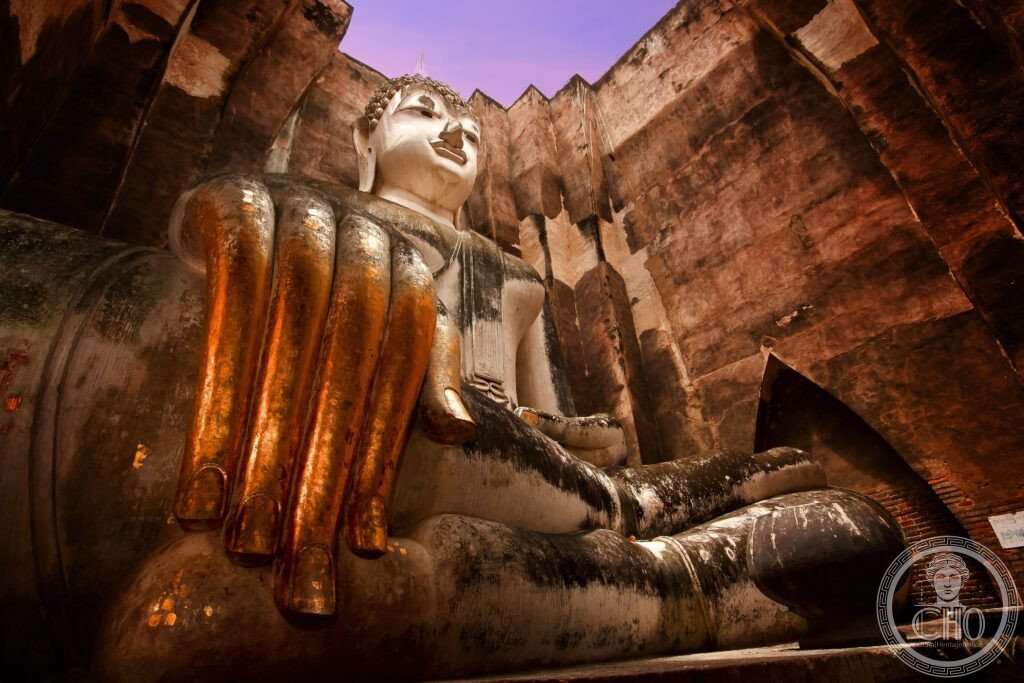
Wat Mahathat, Wat Si Chum, and the lotus pond landscape (the most precisely SukhothaiThailand single Wat Mahathat royal temple lotus-bud chedi central viharn ruins laterite columns reflecting pool moat stucco Buddha niches walking Buddha image unique Thai Sukhothai Wat Si Chum 15m giant seated Buddha Manangkhasila inscription in situ Wat Sra Sri island stupa Ramkhamhaeng stele original Bangkok bicycle rental UNESCO heritage: the visitor circuit: Wat Mahathat (the most important temple; the central royal temple; the lotus-bud chedis; the stucco Buddha images; the reflecting pools; the most photogenic sunrise location in the historical park); Wat Si Chum (the “Temple of the Sacred Bodhi Tree”; the enormous square mondop (a cube-shaped building with a narrow slit opening) containing a 15m seated Buddha statue (one of the largest Buddha images in Thailand); the 1,000-year-old Manangkhasila inscription in Old Khmer is preserved at the site); Wat Sra Sri (the island temple surrounded by water; the slender cylindrical Sri Lankan-style chedi; the viharn accessed by a bridge; the most romantic location in the park); Ramkhamhaeng National Museum (the modern museum in the Historical Park; the Ramkhamhaeng stele (reproduction; original in Bangkok); the Sukhothai Buddha images (the most refined Thai Buddhist iconography); the historical exhibits)); bicycle rental (the most enjoyable way to explore the historical park: the park is flat, the temple distances are 1-3 km, and the bicycle paths (the park has dedicated bicycle paths connecting all the major monuments) make the park accessible without walking)) — the most precisely SukhothaiThailand single Wat Mahathat lotus-bud chedi reflecting pools sunrise Wat Si Chum 15m seated Buddha mondop Manangkhasila inscription Wat Sra Sri island bridge Sri Lankan chedi Ramkhamhaeng museum stele reproduction bicycle rental flat temple UNESCO heritage in any UNESCO world heritage site)).
Practical information
- Getting there: fly to Phitsanulok Airport (PHS; 65 km south; Air Asia/Bangkok Airways from Bangkok Don Mueang (DMK; 1h; approximately THB 1,500-3,000/€40-80 round trip) or Chiang Mai (CNX; 30 min)); the bus from Bangkok Mo Chit bus terminal (7h; THB 250-350/€7-10; the most economical connection); from Phitsanulok, the local bus to Sukhothai takes approximately 1h; the train (the nearest rail station to Sukhothai is Phitsanulok (65 km); the direct sleeper from Bangkok Hua Lamphong approximately 7h); the bicycle rental (the most important transport in the historical park: bicycles are available at the park entrance for approximately THB 30/€0.80 per day; electric bicycles approximately THB 150/€4 per day); the entry fee (THB 100/€2.80 per zone; the inner zone + middle zone + outer zone each require separate tickets)
Getting there
Fly to Phitsanulok (PHS, 65km). Bus Bangkok→Sukhothai 7h ~€7-10. Bicycle rental from park entrance ~€0.80/day. Entry THB 100/€2.80 per zone. Best 07:00 arrival for sunrise at Wat Mahathat. GPS: 17.0170, 99.7031.
Nearby
- Si Satchanalai Historical Park — 55 km north (UNESCO WHS 1991, inscribed together with Sukhothai; the northern satellite capital of the Sukhothai Kingdom; less visited than Sukhothai (the bicycle circuit is especially pleasant — the park follows the Yom River); the Wat Chang Lom (the elephant-base stupa: the round stupa standing on a base decorated with 39 elephant sculptures in the round); the Kilns of Si Satchanalai (the ceramics production center of the Sukhothai Kingdom; the Sangkhalok celadon ware (famous throughout Southeast Asia in the 13th-16th centuries))
- Phitsanulok — 65 km south (the Wat Phra Si Rattana Mahathat (Wat Yai): the Phra Phutthachinnarat (the “Most Beautiful Buddha image in Thailand”; a 14th century CE Sukhothai-style bronze; the most revered Buddha image in the North Central region; the elaborate flame-like aureole around the figure))
Sources
- Wikipedia, Sukhothai Historical Park; Sukhothai Kingdom; Ramkhamhaeng; Ramkhamhaeng inscription, accessed June 2026
- UNESCO, Historic Town of Sukhothai and Associated Historic Towns, WHS reference 574, inscribed 1991
Find it on the map
See this place and what’s around it →📷 Diventa un fotografo di Cultural Heritage Online
Condividi le tue foto dei luoghi: restano pubblicate con la tua firma come autore. Più vengono viste, più ti fai conoscere — e presto un concorso premierà le foto più apprezzate.
Accedi o registrati gratis per aggiungere una foto