
Mohenjo-daro

Mohenjo-daro Indus Valley Civilization Pakistan archaeological ruins UNESCO World Heritage
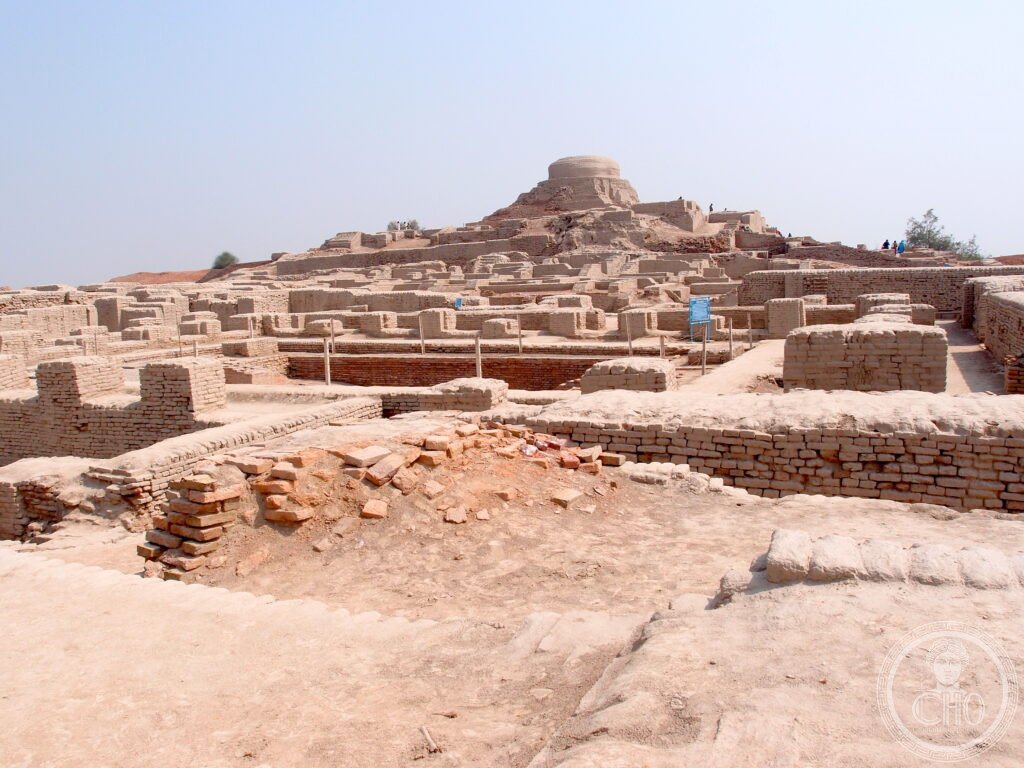
Mohenjo-daro (“Mound of the Dead”), Sindh Province, Pakistan (the most important and best-preserved urban archaeological site of the Indus Valley Civilization (the Harappan Civilization; approximately 3300-1300 BCE): the Great Bath (the most famous structure at Mohenjo-daro: the 12m × 7m × 2.4m deep brick-lined pool; the oldest known public water tank in the world; the brick waterproofing (the pool floor and walls are lined with precisely fitted fired brick set in bitumen mortar; the bitumen is the same material used to waterproof river boats; the pool has a filling inlet at one end and a draining outlet at the other); the colonnaded pavilion (the covered portico surrounding the Great Bath; the pillars (square brick pillars; regularly spaced; approximately 4m tall); the function (the purpose of the Great Bath is debated: a ritual bathing pool for a priestly class? a civic bathing facility? a reservoir for drinking water?)); the urban setting (the street grid visible in the background: Mohenjo-daro was built on a precise grid (the streets are straight and intersect at right angles; the blocks are uniformly sized (approximately 200m × 400m)); the fired-brick construction (the same standard-sized brick (approximately 28×14×7 cm) is used throughout the site and at Harappa (the other major Indus Valley city), 640 km northeast)), Mohenjo-daro, Larkana District, Sindh Province, Pakistan. UNESCO World Heritage Site 1980. Photo via Wikimedia Commons.
Sindh Province, Pakistan · Indus Valley Civilization; ~2500 BCE; Great Bath; grid street plan; 40,000 inhabitants; UNESCO WHS 1980

Mohenjo-daro

The most sophisticated urban planning achievement of the ancient world and the largest city of the Indus Valley Civilization — Mohenjo-daro (“Mound of the Dead” in Sindhi; Sindh Province, Pakistan; UNESCO WHS 1980) was a city of approximately 40,000 inhabitants built around 2500 BCE with a precise street grid, standardized fired brick, an advanced drainage system, and the Great Bath, the oldest known public water tank in the world, in a civilization that remains largely undeciphered.

At a glance

Mohenjo-daro (the most precisely MohenjoDaro single Indus Valley Civilization Harappan 2600 BCE 1900 BCE 40000 inhabitants 250 hectares grid street plan standard fired brick 28x14x7cm Great Bath 12m 7m 2.4m deep bitumen waterproof oldest public water tank world granary platform Citadel Mound of the Dead Sindhi undeciphered script 400 symbols Indus script 4000 inscribed objects Bronze Age 2500 BCE UNESCO heritage: the city (Mohenjo-daro covers approximately 250 hectares (2.5 km²) and at its peak (approximately 2500-2000 BCE) had an estimated 40,000 inhabitants (making it one of the largest cities in the world at the time, comparable to Memphis in Egypt and Ur in Mesopotamia (the three great Bronze Age urban civilizations: Mesopotamia (Iraq), Egypt, and the Indus Valley)); the urban plan (the city is divided into two principal mounds: the Citadel Mound (the raised western mound; 12m above the plain; the public buildings: the Great Bath, the Granary platform, the Assembly Hall, the College of Priests) and the Lower Town (the residential and commercial district; the grid street plan)); the technology (Mohenjo-daro’s most remarkable technical achievements: the standardized brick (a brick of 1:2:4 ratio (7cm thick, 14cm wide, 28cm long) used at Mohenjo-daro, Harappa, and at least 100 other Indus Valley cities over a distance of 1,500 km; the standardization implies a centralized authority that controlled production); the drainage system (every major building in the Lower Town had a private bathroom and toilet connected to a covered drain running under the street; the drains emptied into a primary drain running under each major street; the system is more advanced than any ancient city drainage before Rome)) — the most precisely MohenjoDaro single Indus Valley Harappan 2600 BCE 1900 BCE 40000 inhabitants 250 hectares grid plan standard fired brick 28x14x7cm Great Bath 12m 7m 2.4m deep bitumen waterproof granary Citadel Lower Town drainage system advanced Rome undeciphered Indus script 400 symbols UNESCO heritage in any UNESCO world heritage site)).

Key facts

  • The undeciphered script: the most precisely MohenjoDaro single Indus script undeciphered 4000 inscribed objects 400 symbols seals soapstone copper tablets right-to-left direction boustrophedon Harappan script no bilingual text no Rosetta Stone longest text 26 symbols spoken language unknown Dravidian Indo-European hypothesis UNESCO heritage — the most important unsolved mystery in South Asian archaeology: the Indus script (the Indus Valley Civilization had a writing system; approximately 4,000 inscribed objects have been found (the inscriptions are mostly on small soapstone seals (the “Indus seals”)); the script characteristics: approximately 400 distinct symbols; the direction of writing is right-to-left (the direction established from the compressed spacing at the right end of inscribed surfaces); the longest known inscription is 26 symbols (most are much shorter (5-10 symbols), suggesting abbreviated inscriptions on commercial seals rather than literary texts); the script has NOT been deciphered: there is no bilingual text (no equivalent of the Rosetta Stone or the Behistun Inscription that would allow cross-reference with a known language); the spoken language is unknown (both Dravidian and Indo-European families have been proposed; no consensus exists)); the consequence (because the Indus script is undeciphered, Mohenjo-daro is the only major Bronze Age civilization for which no historical records can be read; the social organization, the religion, the government, the names of the rulers, and the names of the cities (including the city’s original name, since “Mohenjo-daro” is a modern Sindhi name) are entirely unknown)
  • GPS: 27.3244° N, 68.1378° E

History

From Bronze Age city to mysterious collapse to colonial discovery (the most precisely MohenjoDaro single Harappan Civilization 3300 BCE 1300 BCE Mohenjo-daro 2600 BCE 1900 BCE peak 2500 BCE climate change drought Indus River flooding abandonment collapse BCE John Marshall 1922 1923 excavation R D Banerji discovery UNESCO heritage: the Indus Valley Civilization (the Indus Valley Civilization (also called the Harappan Civilization after the site of Harappa) flourished approximately 3300-1300 BCE; the earliest phase (Early Harappan: approximately 3300-2600 BCE) saw the development of the urban tradition; the mature phase (approximately 2600-1900 BCE: the peak of Mohenjo-daro); the late phase (1900-1300 BCE: gradual decline and abandonment)); the founding (approximately 2600 BCE: Mohenjo-daro was built from scratch on a virgin alluvial flood plain; no earlier occupation has been found at the site; the city was rebuilt at least 9 times on the same location (each time the city was flooded by the Indus River, the ruins were used as a raised platform for the next building phase; the 12m height of the Citadel Mound represents 9 layers of construction above the original ground level)); the collapse (approximately 1900-1700 BCE: Mohenjo-daro was abandoned; the reasons are debated: climate change (the monsoon shifted and the region became drier), the Indus River changed course (making the site’s agricultural base unviable), or a combination of both; the “Aryan invasion” theory (the colonial-era theory that the Indo-Aryan migrations destroyed the Harappan cities) has been largely discredited by the archaeological evidence (the abandonment was gradual, not violent)); the rediscovery (1922-1923 CE: R.D. Banerji (the Archaeological Survey of India) discovered the significance of the Mohenjo-daro mound; John Marshall (the Director-General of the Archaeological Survey of India) organized the first major excavations (1922-1927 CE))) — the most precisely MohenjoDaro single Harappan 3300 1300 BCE Mohenjo-daro 2600 1900 BCE peak 2500 BCE 9 rebuild layers 12m Citadel climate change monsoon shift Indus River course change gradual abandonment 1900 1700 BCE Aryan invasion theory discredited R D Banerji 1922 1923 discovery John Marshall excavation UNESCO heritage in any UNESCO world heritage site)).

What you see

The Great Bath, the grid streets, and the standard brick (the most precisely MohenjoDaro single Great Bath 12m 7m 2.4m deep fired brick bitumen waterproof oldest public water tank world colonnaded pavilion Citadel Mound raised 12m lower town grid streets 10m wide main 2m subsidiary standard fired brick 28x14x7cm drainage system covered every major building bathroom toilet primary drain under streets Assembly Hall granary platform College of Priests UNESCO heritage: the visitor experience: the Citadel Mound (the raised western mound; the most accessible and most interesting part of the site): the Great Bath (the central monument; the 12m × 7m pool lined with fired brick set in bitumen; the surrounding colonnaded pavilion; the inlet and outlet channels; the best appreciated in the morning light (facing east; the warm light reveals the fired brick color)); the Granary Platform (the massive platform of fired brick that may have been a granary or a public building); the Assembly Hall (the large open-plan hall); the Lower Town (the residential grid: the main streets (approximately 10m wide; some with intact street-level drains still visible); the individual house plans (most houses have a bathroom connected to the drainage system; some houses have wells)); the Mohenjo-daro Museum (on site; the Priest-King figurine (the most famous object from the site: a 17.5cm soapstone figurine of a man with a decorated robe and half-closed eyes; found at the site; often called “the Priest-King” (the interpretation is entirely speculative)); the Dancing Girl (a small bronze figurine of a girl; 10.8cm; found at the site; now in the National Museum of India, Delhi)) — the most precisely MohenjoDaro single Great Bath 12m 7m 2.4m deep bitumen waterproof colonnaded pavilion oldest public water tank world Citadel Mound 12m granary Assembly Hall Lower Town grid streets main 10m drains intact individual houses bathrooms museum Priest-King figurine soapstone Dancing Girl bronze UNESCO heritage in any UNESCO world heritage site)).

Practical information

  • Getting there: fly to Mohenjo Daro Airport (MJD; the site has its own small airport; domestic flights from Karachi (KHI; Pakistan International Airlines; 1h); or fly to Sukkur (SKZ) and transfer by road (90 km; 1h30m by car)); the train from Karachi to Larkana (the nearest major city; 7h; Pakistan Railways); from Larkana, a taxi to the site (30 km; approximately 30 min; PKR 1,000-1,500/€3-4); the entry ticket (approximately PKR 500/€1.50 for foreign visitors; Pakistani nationals have a lower price; the site museum is included in the ticket)); the conservation emergency (the site is on the UNESCO “endangered heritage” list (2022 update): the mud-brick construction of Mohenjo-daro has been damaged by salt crystallization (the saline groundwater rises into the brick and crystallizes, expanding and cracking the brick faces) and by flooding from the Indus River (the 2010 Pakistan floods inundated part of the site)); the best time (October-February; summer temperatures reach 48°C)

Getting there

Fly to Mohenjo Daro Airport (MJD, 1h from Karachi) or fly Karachi to Larkana/Sukkur and drive. Entry ~€1.50. UNESCO endangered site (salt crystallization + flooding). Best season: October-February. GPS: 27.3244, 68.1378.

Nearby

  • Sukkur and the Indus River — 90 km north (the Lansdowne Bridge (1889 CE; the earliest major iron girder bridge in South Asia; still in use); the Sukkur Barrage (1932 CE; one of the engineering marvels of British colonial India: the dam controls the Indus River and provides irrigation water for 7 million hectares of Sindh; the largest irrigation system in the world at the time of construction))
  • Kot Diji Fortress — 60 km north (a pre-Harappan archaeological site (approximately 3000-2600 BCE) showing the transition from pre-urban to urban Harappan culture; the Kot Diji complex in the walls of the 18th century Talpur Mir fortress)

Sources

  • Wikipedia, Mohenjo-daro; Indus Valley Civilisation; Indus script; Great Bath, Mohenjo-daro, accessed June 2026
  • UNESCO, Archaeological Ruins at Moenjodaro, WHS reference 138, inscribed 1980

Hero image: Mohenjo-daro, Sindh, Pakistan, Wikimedia Commons. Editorial text © Cultural Heritage Online, 2026.

📷 Diventa un fotografo di Cultural Heritage Online

Condividi le tue foto dei luoghi: restano pubblicate con la tua firma come autore. Più vengono viste, più ti fai conoscere — e presto un concorso premierà le foto più apprezzate.

Accedi o registrati gratis per aggiungere una foto
📋 Copy & share on social
Scroll to Top