
Timbuktu

Timbuktu Mali Sahara mosques manuscripts UNESCO World Heritage
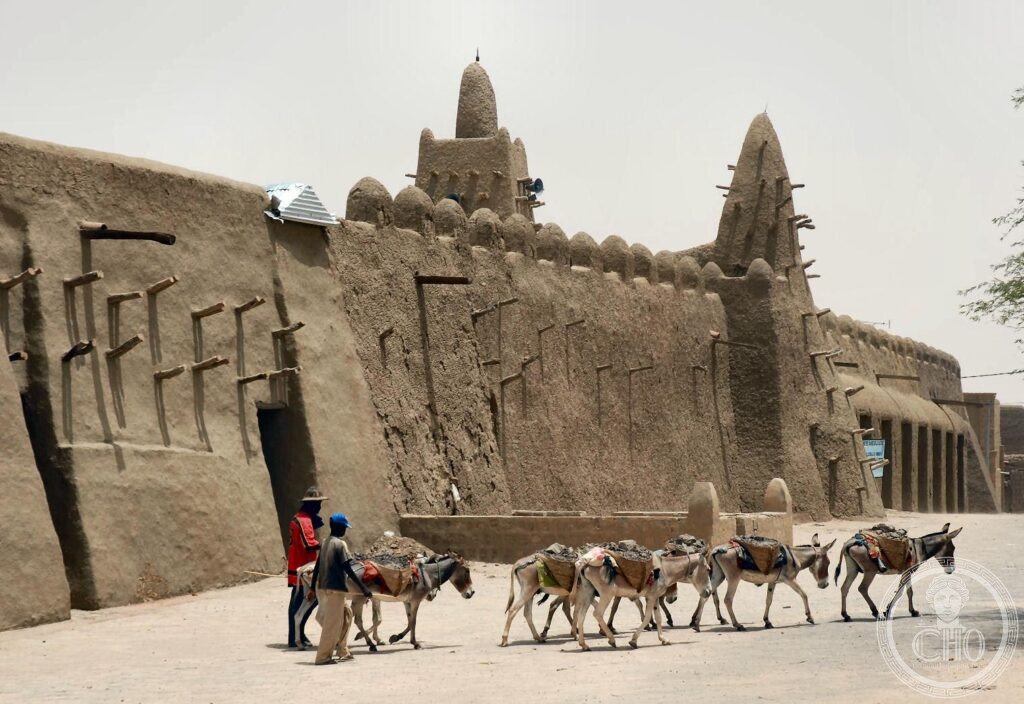
Djinguereber Mosque (Djingareïber Mosque), Timbuktu, Mali (the most important of the three medieval mosques of Timbuktu: the Djinguereber Mosque (“Great Mosque of Timbuktu”; 1327 CE; built by the architect Es-Saheli on the orders of the Mali Emperor Mansa Musa following his return from the Hajj to Mecca; the characteristic Saharan mud-brick architecture (“Sudano-Sahelian architecture”): the thick, mud-plastered exterior walls (the walls must be replastered annually — each spring, before the rainy season, the inhabitants of Timbuktu collectively replaster the exterior of the mosque as a community act; the ceremony is the most important annual collective event in the city); the wooden ostrich egg finials on the roof (the ostrich egg (the most common bird egg in the Sahara) has multiple symbolic meanings in Saharan Islamic culture: purity, fertility, and the all-seeing eye of God; the Djinguereber Mosque has 5 ostrich eggs on each of the three minarets); the exposed wooden poles (the wooden beam-ends projecting from the walls at regular intervals (the “toron”) are not decorative but functional: they are the permanent scaffolding of the building, used for the annual replastering); the sand-blasted red-earth color of the mud brick (the characteristic color of Timbuktu’s buildings; the result of the local laterite-enriched clay mixed with river sand from the Niger River)), Timbuktu (Tombouctou), Tombouctou Region, Mali. UNESCO World Heritage Site 1988. Photo via Wikimedia Commons.
Timbuktu, Tombouctou Region, Mali · the “City of 333 Saints”; Djinguereber Mosque (1327 CE); 700,000 manuscripts; Mansa Musa; UNESCO WHS 1988

Timbuktu

The most legendary city in African history and the medieval center of Islamic learning in West Africa — Timbuktu (Tombouctou; Mali; UNESCO WHS 1988) is a Saharan city where three 14th-15th century mud-brick mosques stand alongside archives of 700,000 manuscripts from the Islamic Golden Age, in a city whose name became synonymous with the most distant and unreachable place on Earth.

At a glance

Timbuktu (the most precisely TimbuktuMali single Djinguereber Mosque 1327 CE Mansa Musa Malian Emperor Sankore Mosque 1400 CE Sidi Yahia Mosque 1440 CE three mosques UNESCO 700000 manuscripts Islamic learning Saharan trade gold salt Niger River 333 Saints Sufi Songhay Empire 1468 1591 CE Moroccan invasion Ahmad al-Mansur UNESCO heritage: the city (Timbuktu is located at the northern bend of the Niger River, approximately 15 km north of the river, at the junction of the Saharan trade routes and the Sudanic (sub-Saharan) agricultural zone; it was founded approximately 1100 CE as a Tuareg seasonal camp at the edge of the desert; the three periods of greatness: the Mali Empire (1324 CE: Mansa Musa’s Hajj and the arrival of the Andalusian architect Abou Ishaq es-Saheli), the Songhay Empire (1468-1591 CE: the intellectual high point; the Sankore University; the 180 Quranic schools; the 25,000 students at peak), and the period of decline (1591 CE: the Moroccan invasion under Sultan Ahmad al-Mansur destroyed the Songhay Empire and deported the Timbuktu scholars to Marrakech))); the manuscripts (the most important fact about Timbuktu: the 700,000 manuscripts (the “Timbuktu Manuscripts”; the most important collection of handwritten documents in Africa; subjects include astronomy, mathematics, medicine, Islamic law, history, and philosophy; they were produced by the Timbuktu scholars between the 13th and 17th centuries CE; they were hidden in family homes and desert salt mines during the French colonial period and the Islamist occupation of 2012 CE; the Ahmed Baba Institute for Higher Islamic Studies and Research in Timbuktu has digitized approximately 30,000 of the manuscripts)) — the most precisely TimbuktuMali single Djinguereber Mosque 1327 CE Mansa Musa Malian Emperor Sankore Mosque 1400 CE Sidi Yahia Mosque 1440 CE three mosques UNESCO 700000 manuscripts Islamic learning Saharan trade gold salt Niger River 333 Saints Sufi Songhay Empire 1468 1591 CE Moroccan invasion Ahmad al-Mansur UNESCO heritage in any UNESCO world heritage site)).

Key facts

  • Mansa Musa’s 1324 Hajj: the most precisely TimbuktuMali single Mansa Musa Mali Emperor 1324 CE Hajj Mecca 60000 people 12000 enslaved 80 camels 300 pounds gold each 2300kg gold total Cairo Egypt gold price deflated 10 years architect Abu Ishaq Es-Saheli Djinguereber Mosque 1327 UNESCO heritage — the most consequential Hajj in history: Mansa Musa’s 1324 CE Hajj (Mansa Musa I of Mali, Emperor of the Mali Empire (r. 1312-1337 CE); the richest person in all of recorded history (according to some estimates, adjusted for inflation); the 1324 Hajj: the pilgrim caravan of Mansa Musa included 60,000 men (his army, court, and retinue), 12,000 enslaved attendants (each carrying 1.8 kg (4 lbs) of gold), and 80 camels (each carrying 115 kg (300 lbs) of gold dust), plus the royal wives, their 500 servants, and the merchants; the total gold transported: approximately 2,300 kg; the economic impact: Mansa Musa’s gold-giving in Cairo (he gave gold to every beggar, mosque, and palace he encountered) caused hyperinflation in Egypt (the price of gold in Cairo fell by approximately 12% and did not recover for 10 years)); es-Saheli (the Andalusian architect Abu Ishaq Ibrahim es-Saheli whom Mansa Musa brought back from Mecca to Timbuktu after the Hajj; he designed the Djinguereber Mosque (1327 CE) and the royal palace of Timbuktu; he introduced the flat-roofed mud-brick architectural style (the “Sudano-Sahelian” style) that became the defining architectural vocabulary of the West African Sahel))
  • GPS: 16.7735° N, -3.0074° E

History

From Tuareg camp to global Islamic learning center (the most precisely TimbuktuMali single Tuareg founding 1100 CE seasonal camp gold salt trade Niger River Mali Empire 1324 CE Mansa Musa Hajj Cairo gold hyperinflation architect Es-Saheli Djinguereber Mosque Songhay Empire Askia Muhammad 1493 1528 CE Sankore University 25000 students 700000 manuscripts 1591 CE Moroccan invasion Judar Pasha deportation scholars Marrakech French colonial 1894 British expedition 1853 Rene Caille 1828 French ANSAR DINE 2012 manuscripts hidden UNESCO heritage: the founding and pre-Islamic period (Timbuktu was founded approximately 1100 CE as a seasonal camp of the Tuareg nomads (the southern limit of the Saharan camel caravan routes; the camp grew into a permanent settlement as the Tuareg developed it as a trade depot for the trans-Saharan exchange of Saharan salt (from the Taoudenni mines, 700 km north) and West African gold); the Mali Empire period (1324 CE: the decisive moment: Mansa Musa I’s Hajj to Mecca (see Key Facts); on his return, Mansa Musa ordered the construction of the Djinguereber Mosque (1327 CE) and established Timbuktu as the imperial capital of culture and learning; the Sankore Mosque was extended to a university format by the early 15th century CE); the Songhay Empire (1468-1591 CE: the Songhay emperor Sunni Ali captured Timbuktu in 1468 CE; the greatest period of Timbuktu as an Islamic learning center: Askia Muhammad I (r. 1493-1528 CE) made Timbuktu the intellectual capital of West Africa; the University of Sankore (25,000 students; the largest university in the world at its peak); the 180 Quranic schools; the book trade (books were the most valuable commercial product of Timbuktu in the 16th century CE — more profitable than gold or salt)); the Moroccan invasion (1591 CE: the Saadian Sultan Ahmad al-Mansur of Morocco sent 4,000 arquebusiers (firearm troops) across the Sahara; the Songhay army, which had never faced firearms, was defeated at the Battle of Tondibi; the Moroccan occupiers deported 63 of the leading Timbuktu scholars (including the historian Ahmad Baba, the most important intellectual figure of 16th century Timbuktu) to Marrakech in chains; the intellectual tradition of Timbuktu was broken and never recovered)) — the most precisely TimbuktuMali single Tuareg founding 1100 CE gold salt trade Niger River Mansa Musa 1324 CE Hajj Cairo gold hyperinflation Es-Saheli Djinguereber Mosque Songhay Askia Muhammad 1493 CE Sankore University 25000 students manuscripts 1591 CE Moroccan Judar Pasha deportation scholars French 1894 Rene Caille 1828 ANSAR DINE 2012 manuscripts hidden UNESCO heritage in any UNESCO world heritage site)).

What you see

Three medieval mosques and the manuscripts (the most precisely TimbuktuMali single Djinguereber Mosque 1327 CE three minarets ostrich eggs toron wooden poles Sankore Mosque 1400 CE university library Sidi Yahia Mosque 1440 CE sealed door prophecy mud-brick annual replastering community ceremony Sufi 333 Saints shrines marabouts UNESCO heritage: the three mosques: the Djinguereber Mosque (1327 CE; the Great Mosque; the most impressive of the three; the three minarets; the community annual replastering ceremony (the most important social event of the year in Timbuktu: in spring, the entire community participates in replastering the mosque’s exterior; drums, music, and communal meals accompany the work; the ceremony has continued uninterrupted since 1327 CE)); the Sankore Mosque (1400 CE; the university mosque; the unique stepped pyramid form of the minaret (the only stepped-pyramid-form mosque in the Islamic world north of the equator outside Egypt); the library within the complex; still an active mosque); the Sidi Yahia Mosque (1440 CE; the smallest of the three; the legendary sealed north door (the imam who ordered the door sealed in the 15th century CE prophesied that when the door was opened, catastrophe would befall Timbuktu; the door was forcibly opened by French colonial soldiers in 1894 CE; the drought and decline that followed Timbuktu in the 20th century CE is attributed by locals to this act)); the shrines of the 333 Saints (the mausoleums of the Islamic scholars and Sufi leaders buried in Timbuktu; the city is called “La Ville des 333 Saints” in French; the shrines were partially destroyed by the ANSAR DINE Islamist occupiers in 2012 CE as “idolatrous” and have been partially restored with UNESCO funding)) — the most precisely TimbuktuMali single Djinguereber Mosque 1327 CE three minarets ostrich eggs toron annual replastering Sankore Mosque 1400 CE university Sidi Yahia sealed door 1894 French 333 Saints shrines ANSAR DINE 2012 destruction UNESCO restoration heritage in any UNESCO world heritage site)).

Practical information

  • Getting there: fly from Bamako (BKO; Mali Air Express or Air Burkina; 2h; approximately €200 round trip); or by river (the Niger River pinasse (long wooden motor canoe) from Mopti to Timbuktu (3-5 days depending on water level; the most authentic experience; the journey is feasible July-December when the river level is high enough)); the security situation (Timbuktu has been affected by the Islamist insurgency in northern Mali since 2012 CE (when ANSAR DINE and AQIM (Al-Qaeda in the Islamic Maghreb) occupied the city; the French military operation Serval (2013 CE) expelled them); French forces withdrew in 2022 CE; the security situation in northern Mali in 2026 CE requires checking current government travel advisories before any visit; the Malian government and MINUSMA (UN peacekeeping) operate in the city); the manuscripts (the Ahmed Baba Institute (IHERIAB) in Timbuktu is open to researchers; some libraries in private homes have manuscripts visible to visitors by prior arrangement with guides)

Getting there

Fly from Bamako (2h, ~€200) or Niger River pinasse from Mopti (3-5 days). Check security advisories — northern Mali is high-risk as of 2026. Ahmed Baba Institute for manuscripts. GPS: 16.7735, -3.0074.

Nearby

  • Djenné — 570 km south (UNESCO WHS 1988 together with Timbuktu and Gao; the Great Mosque of Djenné (1907 CE; the largest mud-brick building in the world; the annual replastering festival (the most spectacular architectural maintenance ceremony in Africa: the entire surface of the mosque (approximately 2,000 m² of exterior mud-brick plaster) is replastered by the male inhabitants of Djenné in a single day; a procession, music, and a competitive spirit accompany the work); the Monday market in the square in front of the mosque)
  • Bandiagara Escarpment (Dogon Country) — 350 km south (UNESCO WHS 1989; the 150-km sandstone cliff face of the Bandiagara Plateau; the Dogon people (the most studied ethnic group in West Africa due to their complex cosmological system, their mask dances, and their dramatic cliff-side architecture); the Dogon villages (built into the cliff face and at the base of the escarpment); the Fête des Masques (the Dama ceremony: held at intervals of 3-5 years; the most elaborate masked ceremonial event in West Africa))

Sources

  • Wikipedia, Timbuktu; Mansa Musa; Djinguereber Mosque; Sankore Madrasah, accessed June 2026
  • UNESCO, Timbuktu, WHS reference 119, inscribed 1988

Hero image: Djinguereber Mosque, Timbuktu, Mali, Wikimedia Commons. Editorial text © Cultural Heritage Online, 2026.

📷 Diventa un fotografo di Cultural Heritage Online

Condividi le tue foto dei luoghi: restano pubblicate con la tua firma come autore. Più vengono viste, più ti fai conoscere — e presto un concorso premierà le foto più apprezzate.

Accedi o registrati gratis per aggiungere una foto
📋 Copy & share on social
Scroll to Top