
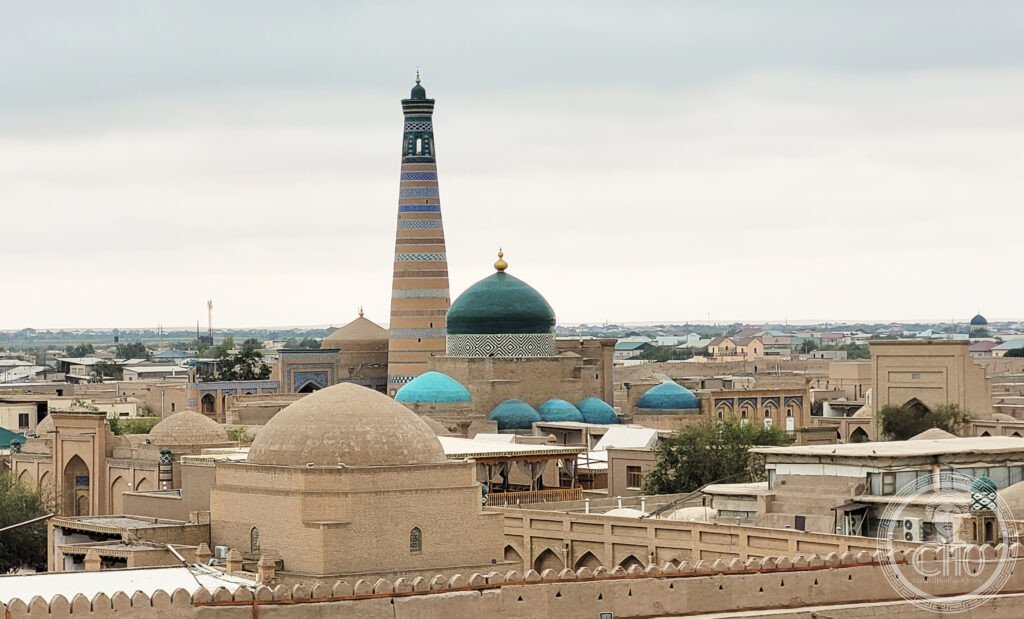
Itchan Kala is the walled inner city of Khiva, a mud-brick oval enclosing hundreds of mosques, madrasas and mausoleums built by the Khans of Khiva between the seventeenth and early twentieth centuries. Its uniform earth-toned walls and the unfinished blue cylinder of the Kalta Minor make it one of the most visually coherent surviving Silk Road cities.
At a glance
Khiva sits at the western end of Uzbekistan’s Silk Road route, in the Khorezm oasis formed by the delta of the Amu Darya. It is the smallest and most compact of the country’s three great Silk Road cities. The historic core, Itchan Kala, is enclosed by its own wall and kept separate from the largely modern Dishan Kala outside it.
Inside the walls the city reads as a single architectural composition: mud-brick fortifications, the towers of the Khan’s palace and dozens of minarets and domes restored under a long programme of architectural preservation. The Kalta Minor Minaret, left unfinished, is the monument most associated with Khiva, while the taller Islam Khoja Minaret and the blue dome of the Pahlavon Mahmud Mausoleum define the skyline behind it.
Key facts
- Location: Khiva, Xorazm Region, Uzbekistan
- Status: Inscribed as a UNESCO World Heritage Site in 1990
- Walls: an oval circuit of baked and sun-dried brick, roughly 1.5 km by 650 m, pierced by four gates facing north, south, east and west
- Monuments: around fifty historic mosques, twenty madrasas, two notable minarets, two royal tombs, six caravanserais and the Khan’s palace within the walls
- Coordinates: 41.3782° N, 60.3627° E
History
The Khorezm oasis, fed by the Amu Darya delta, was one of the earliest centres of settled civilisation in Central Asia, forming a satrapy of the Achaemenid Persian Empire and later a key crossroads where the desert route from China met the steppe route to Russia and the road to the Mediterranean. In 1221 the Mongol generals Jebe Noyan and Subutai destroyed the Khorezm Empire, sacking its cities, including the old capital Urgench, while Khiva remained a smaller settlement. The region’s population is thought to have collapsed by around ninety per cent within a decade of the invasion.
From 1512 the Khanate of Khiva, an Uzbek successor state, became the dominant power in the region, and its Khans built most of the surviving monuments of Itchan Kala between the seventeenth and early twentieth centuries. By the 1840s and 1850s Khiva had become the principal slave market in Central Asia, where captured Persians, Russians and Slavic peoples were sold. In 1873 General Kaufman’s Russian imperial campaign conquered Khiva, ostensibly to free enslaved Russian subjects, though geopolitical and economic motives were equally at play; the Khanate became a Russian protectorate and Tsar Alexander II subsequently decreed the abolition of slavery there, ending the last formal slave market in Central Asia. The Islam Khoja Minaret and its adjoining madrasa, built in the last years of the Khanate before Russian control tightened, are the final major monuments of the pre-Soviet Islamic tradition in Uzbekistan. Every principal building in Itchan Kala has since been restored under Soviet-era and later architectural preservation work.
What you see
The Kunya Ark, the Khan’s palace, is the oldest complex within the walls, built up in stages and containing the throne room of Muhammad Amin Khan, the most ornately decorated interior in the city. The Juma Mosque, whose site has held a place of worship since the tenth century, is entered through a hypostyle hall of two hundred and fifteen individually carved wooden columns, some dating to the tenth and eleventh centuries and others added as late as the eighteenth; the dim, cool hall throws a forest of carved shadows across the floor.
The Kalta Minor Minaret dominates views across the city: a squat, unfinished cylinder wrapped in blue and floral tilework, left incomplete after Muhammad Amin Khan’s death. A spiral staircase climbs to its truncated top, giving a view over the blue domes and earth-coloured walls of the whole walled city. The fortification walls themselves can be walked along parts of their southern and eastern stretches, offering a further vantage point over Itchan Kala’s rooftops.
Practical information
- Entry: a general ticket covers Itchan Kala, with some individual monuments, such as the Kunya Ark museum, requiring separate admission; an all-monuments pass is worth considering for a full day. Check current arrangements with the site’s official ticketing channel.
- Best time to visit: the walled city is quietest early in the morning before tour groups arrive from Urgench, and at sunset, when the mud-brick walls take on a warm orange colour.
- Access within the site: the Kalta Minor Minaret can be climbed via an internal staircase; the city walls are walkable along parts of the southern and eastern sides.
Getting there
Khiva is reached via Urgench International Airport, which has connections from Tashkent and Bukhara, followed by a short taxi transfer into the city. Travellers combining Khiva with Bukhara typically move between the two by taxi to Urgench airport, a flight to Bukhara, and a further short taxi ride; current schedules and fares should be checked directly with carriers or local operators.
Nearby
- Elliq Qala (Khorezm Ancient Fortresses) — 30 to 100 km north, a desert plateau holding around fifty archaeological sites of ancient Khorezm, including Toprak Qala, a third-century rectangular fortress whose excavated painted stucco and terracotta figures are now held in the Hermitage, St Petersburg
- Nukus, Karakalpakstan — around 200 km north, home to the Savitsky Collection at the Karakalpakstan State Museum of Art, holding one of the largest collections of Russian avant-garde art outside Russia
Sources
- UNESCO
Find it on the map
See this place and what’s around it →📷 Become a Cultural Heritage Online photographer
Share your photos of places: they stay published under your name as the author. The more they're seen, the more you get noticed — and soon a contest will reward the most appreciated photos.
Log in or sign up free to add a photo