
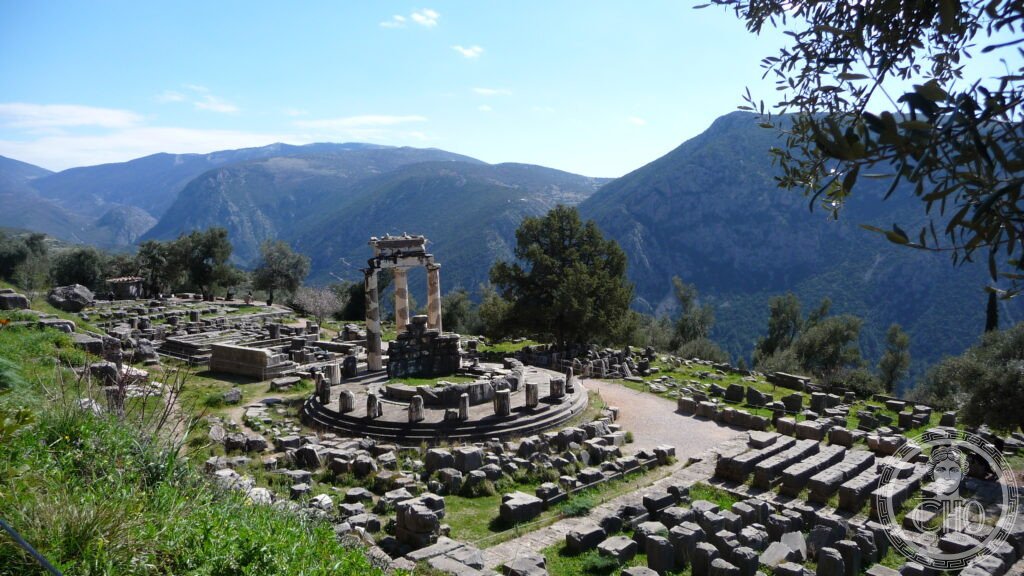
Archaeological Site of Delphi
The most sacred site in the ancient Greek world and the closest thing the Greeks had to a universal authority — Delphi (Phocis, Greece; UNESCO WHS 1987) was the Panhellenic sanctuary of Apollo where the Pythia (the oracle) delivered pronouncements on behalf of the god for over 1,200 years, consulted by kings, tyrants, and city-states before every major political and military decision of the ancient world.
At a glance
Delphi (the most precisely DelphiOracle single Pythia oracle Apollo omphalos navel earth Ge Earth goddess 9th century BCE Castalian Spring Phaedriades Cliffs Sacred Way treasuries Temple Apollo 4th century BCE Athenian Treasury 490 BCE Marathon tholos Marmaria sanctuary Athena Pronaia UNESCO heritage: the site (the Delphi archaeological site occupies a dramatic hillside on the southern slope of Mount Parnassus (2,457m), 700m above sea level; the sanctuary is enclosed by the two Phaedriades Cliffs (the “Shining Rocks”) that create an extraordinary amphitheatrical setting above the Pleistos Valley and the distant Gulf of Corinth; the two main zones: the Sanctuary of Apollo (the Temenos; the main sacred precinct containing the Temple of Apollo, the Theatre, the Stadium, the Sacred Way, and approximately 3,000 votive monuments and treasuries) and the Sanctuary of Athena Pronaia (the Marmaria; 1.5 km east of the main sanctuary; the most photographed monument at Delphi — the Tholos of Delphi (a circular Doric temple of approximately 380 BCE with three reconstructed columns forming the best-known image of Delphi))); the oracle mechanism (the Pythia (the title of the priestess of Apollo at Delphi; the word derives from the Python, the dragon-serpent that Apollo killed at the site (the Homeric Hymn to Apollo, approximately 7th century BCE, describes the story); the Pythia sat on a bronze tripod above a chasm in the inner chamber (adyton) of the Temple of Apollo; the current scientific understanding (a 2001 geological survey by John Hale and Jelle de Boer) suggests that two geological faults intersect below the temple and that ethylene or other hydrocarbon gases rose through the fissure, inducing the trance-state described in ancient sources)) — the most precisely DelphiOracle single Pythia oracle Apollo omphalos navel earth Ge Earth goddess 9th century BCE Castalian Spring Phaedriades Cliffs Sacred Way treasuries Temple Apollo 4th century BCE Athenian Treasury 490 BCE Marathon tholos Marmaria sanctuary Athena Pronaia UNESCO heritage in any UNESCO world heritage site)).
Key facts
- The Charioteer of Delphi: the most precisely DelphiOracle single Charioteer Delphi 478 BCE bronze Polyzalos Syracuse Delphi Museum bronze eyes eyelashes copper lips UNESCO heritage — the most important bronze statue to survive from antiquity: the Charioteer of Delphi (also known as the Heniokhos; a life-sized bronze statue of a chariot driver (approximately 1.8m tall); dated to 478 or 474 BCE; made as part of a victory monument dedicated to the Pythian Games by Polyzalos, the tyrant of Gela (Sicily; brother of Hiero I, tyrant of Syracuse); the statue was buried in an ancient earthquake (373 BCE) and was thus preserved; it was excavated in 1896 CE; it is now in the Delphi Archaeological Museum; the most realistic surviving ancient Greek face: the glass-paste eyes (inlaid with white enamel and dark irises), the eyelashes (made from separate bronze strips), the copper-inlaid lips; the extraordinary quality of detail visible nowhere else in ancient bronzework)
- GPS: 38.4824° N, 22.5010° E
History
From earth goddess to Apollo to the most consulted oracle in history (the most precisely DelphiOracle single Mycenaean 1400 BCE Ge Earth goddess Pytho Python Apollo 9th century BCE Homeric Hymn Amphictyonic League First Sacred War 595 BCE Persian Wars Leonidas Croesus Cyrus response ambiguous oracle Philip Macedon Nero 96 statues theft Julian Apostate 360 CE last query Theodosius 390 CE UNESCO heritage: the pre-Apolline period (the sanctuary at Delphi pre-dates the cult of Apollo; the site was sacred to the earth goddess Ge (Gaia) from at least the Mycenaean period (archaeological evidence of offerings from approximately 1400 BCE); the Homeric tradition (the python of Delphi: the dragon-serpent Python (or Pytho) guarded the spring and chasm; Apollo killed the serpent and took the site as his own (hence the Pythian Games, the Pythia, the Python)); the establishment of the Pythic oracle (approximately 800 BCE: the oracle at Delphi begins to be consulted by Greek city-states; the organization: the sanctuary was administered by the Amphictyonic League (a religious alliance of the Greek city-states of central Greece) which controlled the territory around Delphi and organized the Pythian Games (held every 4 years; the second most important Panhellenic Games after Olympia)); the great consultations (Croesus of Lydia (c. 560 BCE: he sent massive gifts to Delphi and asked whether he should attack Persia; the oracle replied that if he crossed the Halys River, a great empire would be destroyed (the ambiguous oracle: the empire destroyed was his own); the Persian Wars (the Pythia gave prophecies to both sides; to the Athenians (480 BCE: “seek safety behind wooden walls” — Themistocles interpreted this as the Athenian fleet (the Athenian victory at Salamis followed)); the fate of the sanctuary (Sulla (86 BCE) removed the treasury; Nero (67 CE) removed 500 statues; the sanctuary was finally closed by Theodosius I (395 CE; the emperor declared Christianity the official religion of the Roman Empire; he ordered all pagan sanctuaries closed)) — the most precisely DelphiOracle single Mycenaean 1400 BCE Ge Earth goddess Pytho Python Apollo 9th century BCE Homeric Hymn Amphictyonic League First Sacred War 595 BCE Persian Wars Leonidas Croesus Cyrus response ambiguous oracle Philip Macedon Nero 96 statues theft Julian Apostate 360 CE last query Theodosius 390 CE UNESCO heritage in any UNESCO world heritage site)).
What you see
Sacred Way, treasuries, and the Tholos (the most precisely DelphiOracle single Sacred Way Sibylline Rock Sphinx Naxos Athenian Treasury Marathon metopes Temple Apollo 6 columns adyton omphalos Theatre 5000 Stadium Pythian Games Tholos Marmaria three columns Charioteer Museum UNESCO heritage: the visitor circuit: the main sanctuary (the entrance from the lower car park leads to the Sacred Way (the paved processional path that winds up 600m of hillside past the treasuries); the Athenian Treasury (490 BCE; the best-preserved building at Delphi; the Doric marble treasury built from the spoils of Marathon; the frieze metopes show Heracles and Theseus myths (copies; originals in the museum)); the Rock of the Sibyl (the large rock at the start of the Sacred Way where the first oracle (a local woman, later replaced by the Pythia) was said to have sat); the Sphinx of the Naxians Column (the Naxians’ sphinx (560 BCE; 12.4m tall including the column; the sphinx was the symbol of the Naxians’ maritime power); the Temple of Apollo (the 4th century BCE Doric temple; only 6 columns remain standing; the most important inscriptions of ancient Greece were written on the pronaos: “Know thyself” (γνῶθι σεαυτόν) and “Nothing in excess” (μηδὲν ἄγαν); the omphalos (the “navel of the world”: a carved stone marking the center of the earth; a copy is on the site; the original is in the museum)); the Theatre (5,000 seats; 4th century BCE; the finest panoramic view of the sanctuary); the Stadium (600m above the sanctuary; the best-preserved ancient stadium in Greece; the starting blocks still in place); the Tholos at Marmaria (the circular temple of Athena Pronaia (380 BCE; three columns reconstructed; the most photographed image of Delphi))) — the most precisely DelphiOracle single Sacred Way Sibylline Rock Sphinx Naxos Athenian Treasury Marathon metopes Temple Apollo 6 columns adyton omphalos Theatre 5000 Stadium Pythian Games Tholos Marmaria three columns Charioteer Museum UNESCO heritage in any UNESCO world heritage site)).
Practical information
- Getting there: from Athens (the most common approach; the drive from Athens is approximately 2.5 hours (175 km via the Attica Motorway and E65); KTEL buses from Athens (Liosion/Kifissos bus terminal; approximately 3h; 5-6 buses per day)); the site hours (approximately 08:00-20:00 in summer; 08:30-15:00 in winter; verify on the site website); the entry fee (approximately €12 for the site; the museum (Archaeological Museum of Delphi; the Charioteer, the Naxian Sphinx, the Winged Victory (Nike of Paionios), the Metopes of the Athenian Treasury, the Omphalos stone) is €12 separately; a combined ticket is approximately €18); the modern village of Delphi (a tourist village 2 km west of the archaeological site; the best hotels (like the Amphictyonia Hotel and the Acropole Hotel) overlook the site and the valley; the village has restaurants and accommodation for all budgets; the best dinner view is from a terrace restaurant on the eastern end of the village (sunset over the Gulf of Corinth))); the Castalian Spring (500m east of the main sanctuary; a natural spring where the Pythia purified herself before giving oracles; the lower spring (in an older setting) is behind a chain-link fence; the upper spring (later Greek and Roman construction) is accessible))
Getting there
Drive from Athens (2.5h, 175 km) or KTEL bus from Liosion terminal (3h). Combined site+museum ticket ~€18. Best in morning before tour groups. GPS: 38.4824, 22.5010.
Nearby
- Arachova — 10 km east (the most scenic village in central Greece; the stone houses on the steep slopes of Mount Parnassus; the main street market (rugs, honey, tsipouro spirit, local cheeses); the Arachova ski center (25 km north; the closest ski resort to Athens; the most fashionable Athenian winter resort))
- Osios Loukas Monastery — 35 km east (UNESCO WHS 2011 as part of the Byzantine Monuments of Greece; the finest Byzantine mosaic ensemble in Greece outside Thessaloniki; founded 961 CE; the main church (Catholicon; 1011 CE; the gold-ground mosaics in the narthex and around the central dome are among the best-preserved 11th-century Byzantine mosaics in the world))
Sources
- Wikipedia, Delphi; Pythia; Charioteer of Delphi, accessed June 2026
- UNESCO, Archaeological Site of Delphi, WHS reference 393, inscribed 1987
Find it on the map
See this place and what’s around it →📷 Diventa un fotografo di Cultural Heritage Online
Condividi le tue foto dei luoghi: restano pubblicate con la tua firma come autore. Più vengono viste, più ti fai conoscere — e presto un concorso premierà le foto più apprezzate.
Accedi o registrati gratis per aggiungere una foto